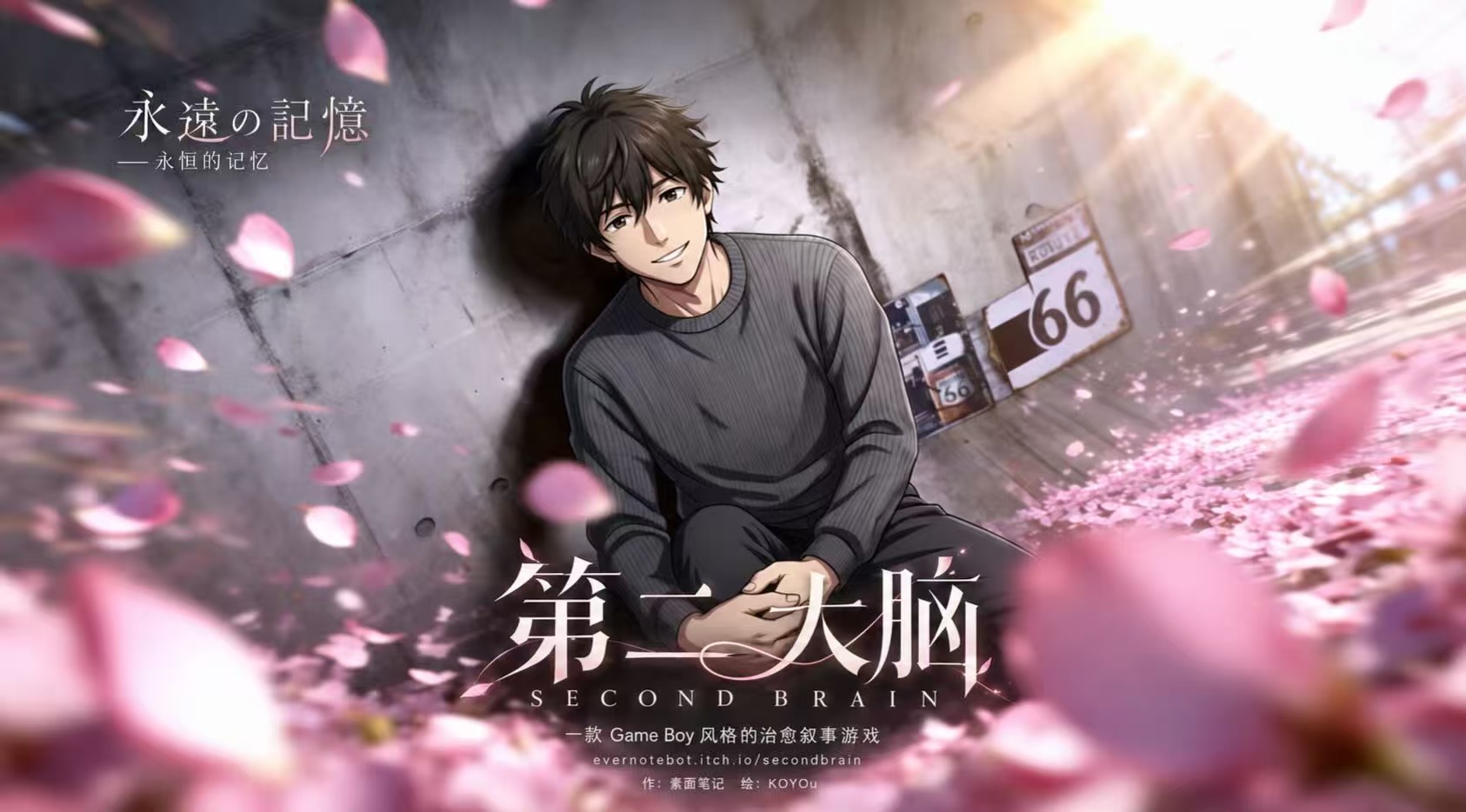
The greatest charm of this game doesn't lie in the storyline of Chapters 1 through 4, but in giving every player the power to design their own memories into Chapter 5 using Skills — this is how I define the "Second Brain." I truly believe that your life is a fascinating story to me.
Let me explain why Chapter 5 exists at all.
Chapters 1 through 4 are the same for everyone. Yuki, born in 1989, leaves the city, climbs the mountains, sits in the zen room, learns to breathe in the meadow. I wrote every word of it. You walk it exactly as the last player did, and exactly as the next one will. That is the point — it is the shared prologue, the four questions with the blank waveforms, the part where the game is still mine.
Then, after the fourth chapter, the screen asks: "Do you believe in parallel worlds?" And this is the seam of the whole design. Because the honest answer the game is really asking is: are you willing to stop being a reader, and become an author?
Chapter 5 is deliberately left unfinished. Not incomplete by accident — unfinished by design, the way a diary is unfinished until someone writes in it. There is no branching tree I authored for you to pick from, because a set of endings I wrote would still be my endings. Instead, Chapter 5 hands you a Skill: rank your own values, answer for a life lived in reverse, decade by decade, against real pension figures and real costs. The system doesn't retrieve a story — it computes one, from you. What comes out is a life no one has lived before, folded into a single line: SB1-…
That code is the moment the game stops being mine and becomes yours. And here is why the game cannot be complete without it: a game about memory that only ever shows you my memories is a contradiction. "Memory is everyone's most precious asset" — but if the only memories in the game were Yuki's, the sentence would be a lie. The asset it's talking about is yours. So the game leaves a space exactly the shape of your life, and until you step into it, that space stays empty. The four chapters are the frame. Your memory is the painting. A frame around nothing is not a finished work.
This is also why the Memory Packet matters more than any ending I could have written. When you hand your SB1-… code to another person and they enter it, your life plays out on their screen — same code, same life. You didn't complete the game for yourself; you completed a version of it that only exists because you lived it. The next player completes a different one. The game has as many true endings as it has players willing to write themselves into Chapter 5, and not one of them was written by me.
So when I say I believe your life is a fascinating story — I mean it structurally, not as a compliment. The game is literally built to be finished by it. Yuki's journey through four chapters was only ever the invitation. The real work — the fifth chapter, the part that turns "a game about a man named Yuki" into "a game about you" — doesn't exist until you bring your memory to it.
That is the Second Brain: not the one I wrote, but the one that only completes itself when you remember, in it, who you are.