

Thank you — this is the most thorough feedback I've received, and you clearly played with real attention. Let me answer each point honestly, because several of them touch the core of what the game is trying to be.
On the UI and unclear scenery — You're right, and I won't defend it. The interaction model asks you to walk up to an object and press A, which isn't obvious on first contact, and the four-shade-green palette makes some objects hard to read. This is the fairest criticism and the first thing I'll fix. A short "how to interact" prompt at the start and clearer object outlines would remove most of the friction you hit.
On the story and themes — Thank you. That's the part I care about most, so it means a lot that it landed.
On not being able to view collected memories/emotions individually — This is a real gap. Right now the SELECT menu only shows a count. You're right that being able to open each of the 75 emotions and 30 zen phrases you've collected — to actually re-read the one that matched a moment you lived — would make the collection feel like yours instead of a number. I'm adding an individual gallery view. Good catch.
On "no discernible branches" — This is the most important point, and here I have to both agree and reframe, because it reveals something the game hasn't communicated well.
You're correct that Chapters 1–4 are a single fixed storyline — dialogue choices there don't fork the narrative. That's intentional: those four chapters are the shared prologue everyone walks through.
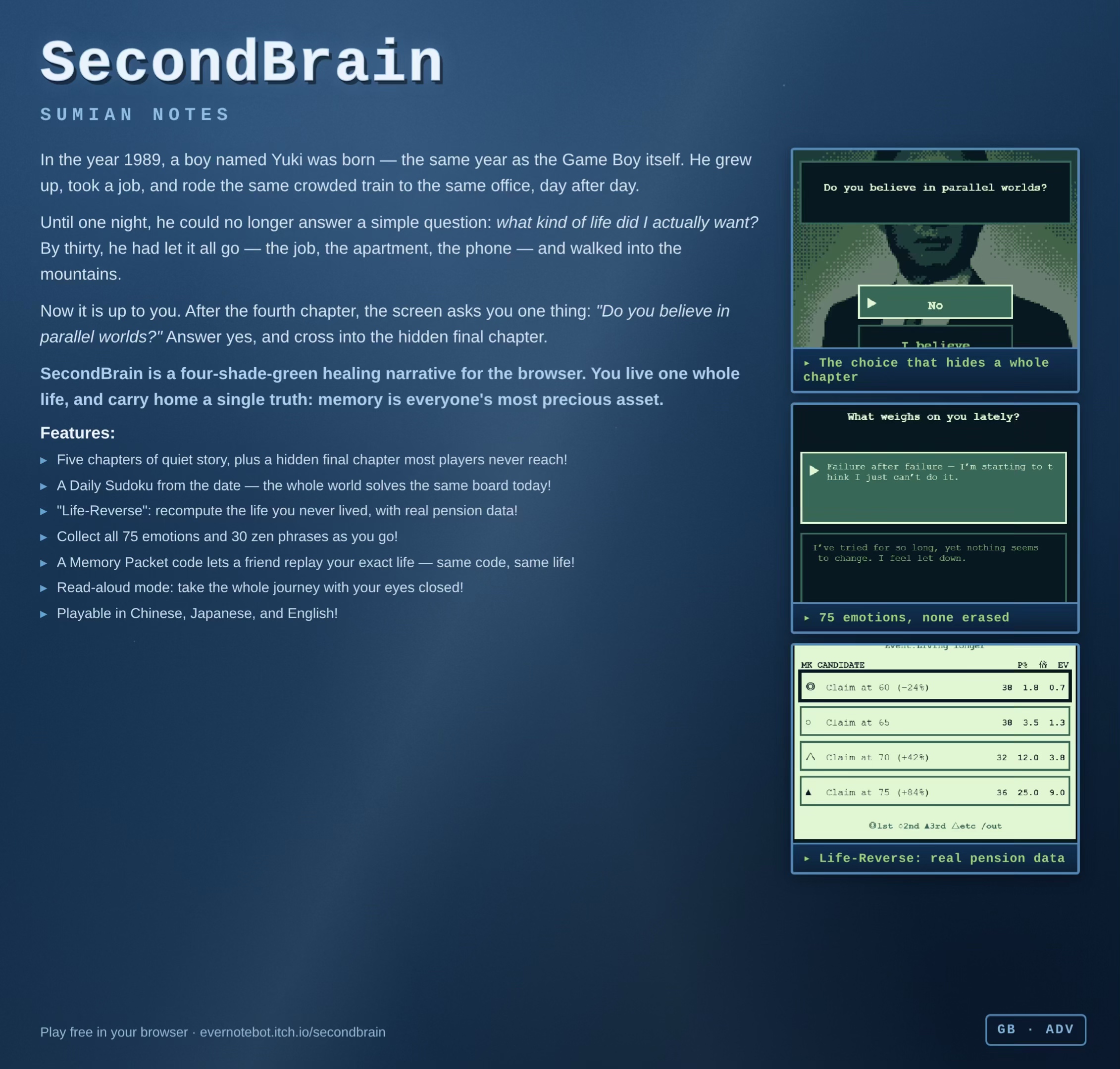
But the actual branching lives in Chapter 5, and it works differently from what "multiple-choice dialogue" usually means. Chapter 5 isn't a pre-written tree of endings I authored. It's a generative system — think of it as a Skill that composes your own memory-story from your inputs:
- In Life-Reverse, you rank your own values and answer questions about a life lived in reverse, decade by decade. The system computes a specific life from those inputs — pension timing, education paths, the roads not taken — using real-world data. Different inputs produce a genuinely different reckoning.
- That result compresses into a Memory Packet — a code like
SB1-…. This is the branch. It isn't one of N endings I wrote; it's yours, generated from your choices. - Hand that code to another player, they enter it, and your life replays on their screen. Same code, same life. Different code, different life.
So the branching you were looking for is real — it's just not in the Chapters 1–4 dialogue. It's the whole engine of Chapter 5: you don't pick from my branches, you author your own memory-story, and it becomes a shareable artifact. The reason it didn't read as "branching" is almost certainly the UI and framing problem you already identified — the game never makes clear that Chapter 5 is the branching system. That's on me to communicate, and your feedback just told me exactly where it breaks.
On the external link in Chapter 1 — This is the single most valuable thing you flagged, and you're right without qualification. Sending a player out of the browser mid-story is a retention killer, and I'd bet you're speaking for many who simply closed the tab there. The entire experience should live on one tab. I'm removing that external dependency and bringing whatever it pointed to inside the game. Thank you for stopping there and telling me why — that "why" is worth more than a bug report.
On your summary — You've diagnosed it precisely: the major elements exist, but they need one unified, legible system that ties them together and stays inside the browser. That's the right priority, and it's now my roadmap:
- A clearer interaction model + object readability (your point 1)
- An individual gallery for memories/emotions (your point 3)
- Surfacing Chapter 5's generative branching so it reads as branching (your point 4)
- Everything on one tab — no external links (your point 5)
For what it's worth: what's past Chapter 5 is exactly the thing you're asking for — the Memory Packet system that turns your single playthrough into something you can regenerate and hand to others. Your instinct that "keeping everything on one tab will improve retention" is correct, and it's the fix I'm prioritizing first.
Thank you again. You didn't just report problems — you handed me the order to fix them in. That's rare, and it genuinely helps.