

Cards sharing names with Slay the Spire (Letter A part 2)
Today I would like a compare two pairs of cards which are named by slightly differing forms of the same word, still close enough in my opinion.
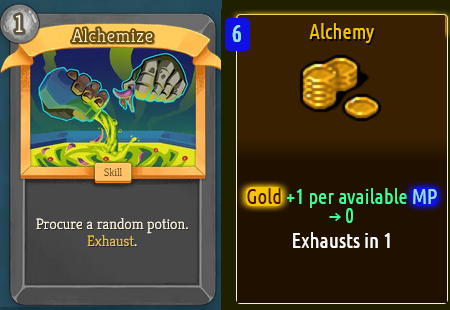
Both cards are rather simple and straightforward, and, in contrast to previous post, I did not think about StS version when creating Alchemy card in WtC. So these may be considered ‘co-evolution’ case, where generic card name naturally results in broadly thematic effects.
Although WtC does have potions, they actually are a subtype of cards and not a separate entity. Similar to StS, WtC potions are “Single use” and are more powerful compared to normal cards. However, they have to be drawn, and take space both in hand and in deck, which is a significant drawback. On the plus size, there is no specific limit on number of potions and all card-based synergies apply to them. StS potions serve as a risk management tool, while in WtC this role is severely diminished.
WtC Alchemy gives gold amount which is potentially scaling through the run, which is unlike any StS gold-giving card. This is connected to the fact that in WtC, costs grow as well, so income needs to keep up to stay relevant.
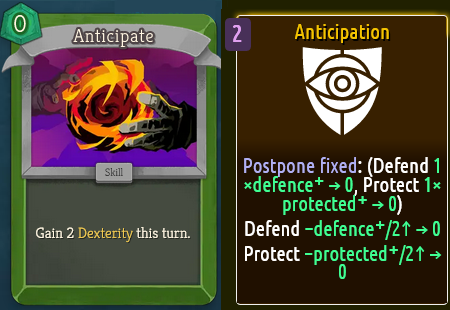
Anticipation card is another interesting case since it was in WtC before StS2 release, so I can say with confidence that it was not influenced by StS in any way. The card also illustrates why WtC is more complex and harder to learn, since id toes not shun from longer formulas and multiple effects on card.
In case it is not clear, Anticipation “invests” half of current defence to gain full amount next turn. There is no direct analogue in StS, the closest one is probably Blur. This card can be very useful in “slow tanking” builds. The “colors” of WtC resources have minor thematic significance, and Wp (Willpower) in Anticipation cost does tend a bit towards the defence.
For reference, ‘protected’ status which is also affected by Anticipation works like “multiplicative defence”, i.e. it reduces incoming damage by division instead of subtraction.
Finally, “Postpone fixed” keyword means “Postpone effects with fixed current values” as opposed to bare postpone, which means “Execute effect as written, re-evaluate formulas at the moment of execution”. In this case “Pospone (Defence 1xdefence)” would do nothing, since at the start of next turn current defence would already be zero.
Also keep in mind that WtC does not (by default) clear player’s hand at the end of turn, so cards like Anticipation can be easily kept in hand until the right occasion arrives.
Speaking briefly of StS Anticipate, I think it’s design is good in principle, but in my limited understanding the card is far too weak, requiring at least 3 blocking cards in hand to just break even compared to standard Defend.