

Cards sharing names with Slay the Spire (Letter A part 1)
After the introduction above, it is time to move to the more entertaining part. Since Way to Crown’s strongest influence is Slay the Spire, it would be interesting to compare and discuss cards which share a name. (I shall abbreviate game names as WtC and StS henceforth).
I obviously in no way imply that my versions of cards are somehow “better” or “worse”, especially since the games are different enough that even copying card text verbatim would result in significantly altered actual effect. However, I have had lots of fun matching card name / flavor with its actions, and in some cases my matching feels (for me at least) interesting enough to worth sharing.
I also briefly discuss in-game power / balance of some cards, but again it should be taken lightly, since there is no way to truly compare such disparate things.
Finally, I’d like to re-check myself to make sure I did not just lazily copy some card, but made sufficient effort to re-interpret it to merit inclusion.
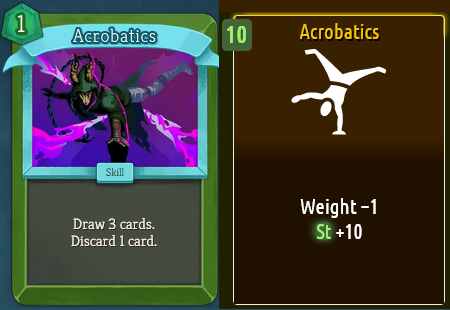
Acrobatics is a staple Silent card in StS. My version is completely different, but also related to Rogue hero, with vaguely corresponds to Silent. On its face, this is a weird 10-cost “do nothing” card, since “Weight -1” basically means “when drawing this card, draw 1 more card” and “St +10” just pays back the cost of card in Stamina (St), making it neutral overall.
Despite all that, there are multiple ways to utilize Acrobatics in WtC, which IMO neatly illustrates several key differentiating concepts of the game:
- The “dexterity’ status makes all St card cost less, so if hero gets dexterity=2, Acrobatics becomes a net gain of 2 St
- Some items multiply resource gain, so for example picking Sack of Grain item makes Acrobatics give 15 St instead of 10
- Cards in WtC can be upgraded at any moment, and multiple times. To balance that, most individual upgrades are much weaker than StS. Acrobatics gets +1 more St per upgrade, so in principle can become even better St source.
- Some cards use other card costs as a basis for their effects, making expensive cards valuable. For example “Flaunt Riches” doubles the cost of leftmost card in hand, and then reimburses cost of target card back to hero (with some additional limitation). In other words, combo of Acrobatics + Flaunt Riches may give hero 20 St, which is quite large amount (starting max St for Rogue hero is 15).
- Even better, “Fair Trade” card discards 1 card and draws card with total cost up to the cost of discarded card, making Acrobatics + Fair Trade into “refill the hand” combo.
- In a similar manner ‘devotion’ mechanics calculates total amount of each resource in hand to use as a basis for effect power. For example “Trained Lungs” card reduces hero fatigue proportional to devotion to St. Without delving into too much detail, it is sufficient to say that “fatigue -10” is extremely powerful in late game, since it greatly helps “infinite” builds.
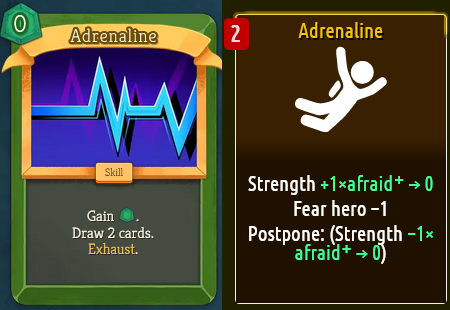
Adrenaline is another very powerful StS Silent card. In this case, I would say that WtC version is “flavor win”, even though it is much more specialized and does not fit just any build. While hard to quantify exactly, StS seemingly takes significant effort to smooth out card choices, making sure that no card would be totally useless regardless of the rest of the deck. As stated in the first post, WtC, either boldly or foolishly, takes opposite stance, so that many cards can either be completely useless or extremely overpowered depending on deck composition.
Returning to example of Adrenaline, WtC version approximately says “Gain X strength this turn, where X = amount of ‘afraid’ status on hero” (getting burst of strength from fear is a good flavor IMO). For a quick reference, ‘afraid’ in WtC is similar to ‘doom’ status in StS: when it exceeds HP, hero loses.
Besides enemies which attack hero with fear, there are cards and items which self-fear as a (normally negative) side effect. There is even a dedicated hero (Dreamwalker), who specializes in applying bad statuses to himself and converting those into attacks and resources.
Also note that seemingly cumbersome use of “postpone: strength -X” actually gives card an extra layer of flexibility (“postpone” means “execute affect at the start of next hero turn”). For example, “Momentary Lapse” card removes postponed effects, while ‘redirect’ status can even point strength loss to enemy instead.
Overall, WtC Adrenaline is very niche card which can become win condition when fit into right build.
In the upcoming days, I will continue this series, moving through cards alphabetically. Until next time :)