Indie game storeFree gamesFun gamesHorror games
Game developmentAssetsComics
SalesBundles
Jobs
TagsGame Engines

Way to Crown: Hardcore card-based roguelike

A topic by AlSoKnown created 2 days ago Views: 77 Replies: 3
Viewing posts 1 to 4
(1 edit)

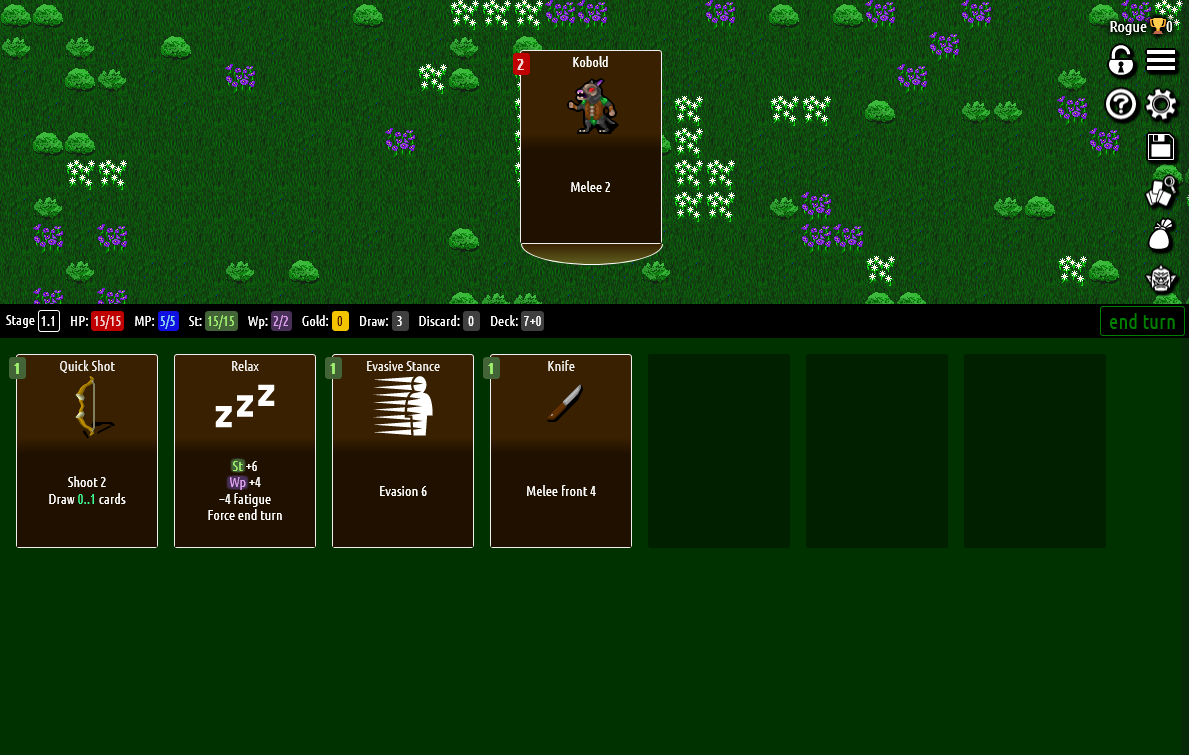
Way to Crown is a free deckbuilding roguelike, directly inspired by Slay the Spire.

While keeping very similar core gameplay structure, Way to Crown intentionally ignores or reverses many game design decisions of Slay the Spire, with the goal of making much more diverse, unpredictable and high-variance experience.

This inevitably creates much steeper learning curve as well as much higher amount of unexpected losses, especially for beginner players. Potential upside is increased game depth and “positive discovery” moments, where new crazy synergies regularly emerge, surprising even me as the developer. Thus, the cliche “no two runs are the same” motto becomes a bit more realistic, since the number of substantially different deck archetypes is actually higher.

Way to Crown embraces many elements which are considered undesirable by modern roguelike game design, such as stalling / grinding, various infinite loops, arbitrary card modification, complex and precise documentation of every game entity and concept. So, this game is aimed at experienced players, who want deeper and more challenging experience, but also ready to suffer more setbacks and spend more mental effort during the run, especially in learning phase.

Game is fully playable and has lots of content. This post is marked as “50%” since I do not plan to stop development, but instead continue slow and steady stream of updates.

Regular per-release devlogs are published in game-specific forum. The reason for posting here is to share some insights and perspectives which may be of interest to wider audience, who might not like my game but still be amused by some of my ideas and decisions.

Soon, I plan to post some more detailed articles in this topic. Meanwhile, if there are already questions or feedback, I am eager to discuss.
(+1)

Hey, I just had a play of the demo. I really like the music in the tutorial. Is it original or stock music? I'm a composer and would love to have a go at creating something similar completely for free. If you're interested I have a website with previous works: https://www.hughholbech.com/

This previous soundtrack of mine is for a similar game and shows what I could do: 

Best of luck with the project!
(1 edit)

On unlocks, meta-progression and ascensions

In my opinion, there are two main reasons for meta-progression in game:

  • Slowly increasing player’s power to give additional incentives to play
  • Smoothing learning curve by unlocking new mechanics and options gradually

In Way to Crown, meta-progression is heavily pushed towards second goal. The only way meta-progression increases player’s power is by giving more build variants, but that obviously cuts both ways since the consistency falls dramatically.

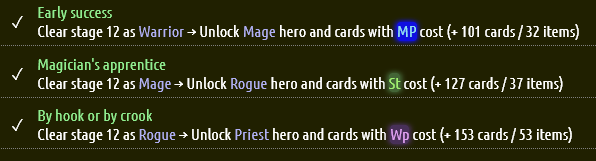
Main body of game content is unlocked extremely quickly and in large batches, giving players just enough time to skim over new things before plunging into full game. For even more impatient and self-confident players, game has a simple “Unlock everything” option in settings.

Several core mechanics of the game (card stash, card upgrades, quests) are also locked away, but the requirements to unlock are deliberately very low, so they serve as an extended tutorial.

The only part of unlocking which is somewhat slow is ‘advanced heroes’. The game has 4 basic playable heroes, similar to Slay the Spire, but the total of heroes is currently at 18. Additional heroes vary wildly in power, difficulty and depth, but any build possible with them is also available for main heroes, perhaps with lesser efficiency.

Thus, having few advanced heroes still locked does not affect the gameplay at all, since every other part of the game is already fully available.

Ascensions aka difficulty levels are not ordered in ‘ladder’ style like Slay the Spire, but instead are unlocked all at once and can be arbitrarily chosen before every run. I think this is much better design, and honestly wish that Slay the Spire (and many other similar games) would do the same.

Ascensions are softly grouped according to my own intentions of balance, with starting ‘zero ascension’ considered an easy mode, while the few ascensions tightening resource management are considered ‘normal difficulty’. Highest ascension is quite punishing, to the point that I myself prefer to play with the few of the harshest ascensions turned off.

In future posts, I will discuss specific examples of cards, items and heroes in game. It might be a spoiler for those who prefer to experience first-hand discovery of game content.

(1 edit)

Resource management

One significant and relatively rare in genre feature of Way to Crown is an approach to card costs resources.

Instead of usual ‘3 energy per turn’, Way to Crown uses four different resources: HP, MP, Stamina and Willpower. Card cost may contain any combination of resources, very similar to Magic the Gathering. As a result, instead of usual grouping of cards per hero, they are grouped by ‘color’ of resource used, with four ‘basic’ heroes (Warrior, Mage, Rogue and Priest) representing simple ‘mono-colored’ decks, while other heroes use various combinations of colors/resources.

Note that Way to Crown does not place any restrictions whatsoever on hero/card combinations, but heroes have built-in perks and starting decks which make their ‘preferred’ resources easier to obtain and more efficient to spend. It is a common strategy to ‘splash’ (borrowing Magic the Gathering term) a card or two from non-primary resource in the deck to achieve some specific narrow effect (such as healing or protection from poison), or to complete a strong combo.

Another fundamental difference of Way to Crown resource management is that all resources are persistent, and do not change between turns and even between battles. For example, Mage starts with 15 MP, and it is player’s responsibility to find ways to replenish that pool. Game has many cards and items with ‘add resource’ effects, but most of them have some additional twist or requirement, forcing player to balance between sometimes contradictory goals of killing enemies and restocking.

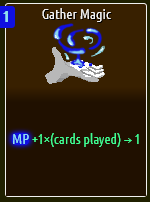
Aforementioned Mage hero has “Gather Magic” card (and yes, the name is intended as a weak reference to Magic the Gathering):

image.png

Since Gather Magic restores 1MP per card played (this turn), it is best played as late during the turn as possible, but even then it is not net-positive unless you play 2 or more on the same turn. So player immediately is faced with several interesting choices: kill last enemy or delay for a turn to restore MP? Play cheap but situationally useless cards just to increase card counter? Dilute deck with weak zero-cost cards, making draws less consistent for the purpose of getting free counter increases?

Persistence of resources between battles (called ‘stages’) makes resource management even more crucial, since frequently used strategy of “spend everything just to barely get over the threshold of winning encounter” almost never works. On the other hand, much higher resource caps mean that, given sufficient justification, player can spend, for example, 15 MP in a single turn, so the overall variance of possible outcomes is increased both in positive and negative direction.

These are some of design decisions which in my view justify ‘hardcore’ epithet I used in game description.