

As a big fan of legacy RTS games (e.g. Starcraft, Command & Conquer, etc.) and wanting to use my expertise of physics, math, and computer science for gaming, I wanted to try my hand at bringing my original concept to life with the help of Claude Code (more on this later). As I alluded to in another thread, came up with a concept for a novel game mechanic that ties into the real-time strategy in a new way - the delayed-time strategy!
While there are some games out there that use finite communication speed as a game mechanic (e.g. NEBULOUS: Fleet Command uses delayed radar effects), the game I'm building has a very unique spin on it. Enter the world of Echolumination (my first video game), a "simple"-looking 2D RTS game with two speeds of information: sound speed and light speed, but in the fictional atmosphere (with an absurdly high index of refraction), light speed is only one tenth of the speed of sound! Note, this does not imply any relativistic effects (time dialation, length contraction, etc.) since causality is not slowed down.
What this means the entire map has a true state that the players cannot see but rather each player gets a perception field of the state of the game determined by the speed of light (which is sloooow in this game) instead of fog of war. So you see distant units, buildings, spells, etc. effects in the past (with further objects, further in the past). However, your units can relay information they see back to you at the speed of sound which is much faster. Thus as you move your units around, you will see the world around fast-forward in time as you explore - it won't rewind if you leave the field of view (instead it stays frozen as an image until a fresher image is available).
Because of this sound communication channel instead of light, units also respond with latency the further they are from a command center - and they will appear to not start to move until later as well due to the round-trip sound delay. But don't worry, there are abilities in the game that can speed things up (e.g. abilities and such that can communicate faster in some situations). I also am building a vast array of special abilities that are unique to this type of game which can mess with your opponent's ability to control their units, hide objects from light (or sound), and more. But because it's grounded in classic RTS gameplay, I will also include a number of more conventional unit types and mechanics.
Here is a schematic image of the concept in space-time diagrams: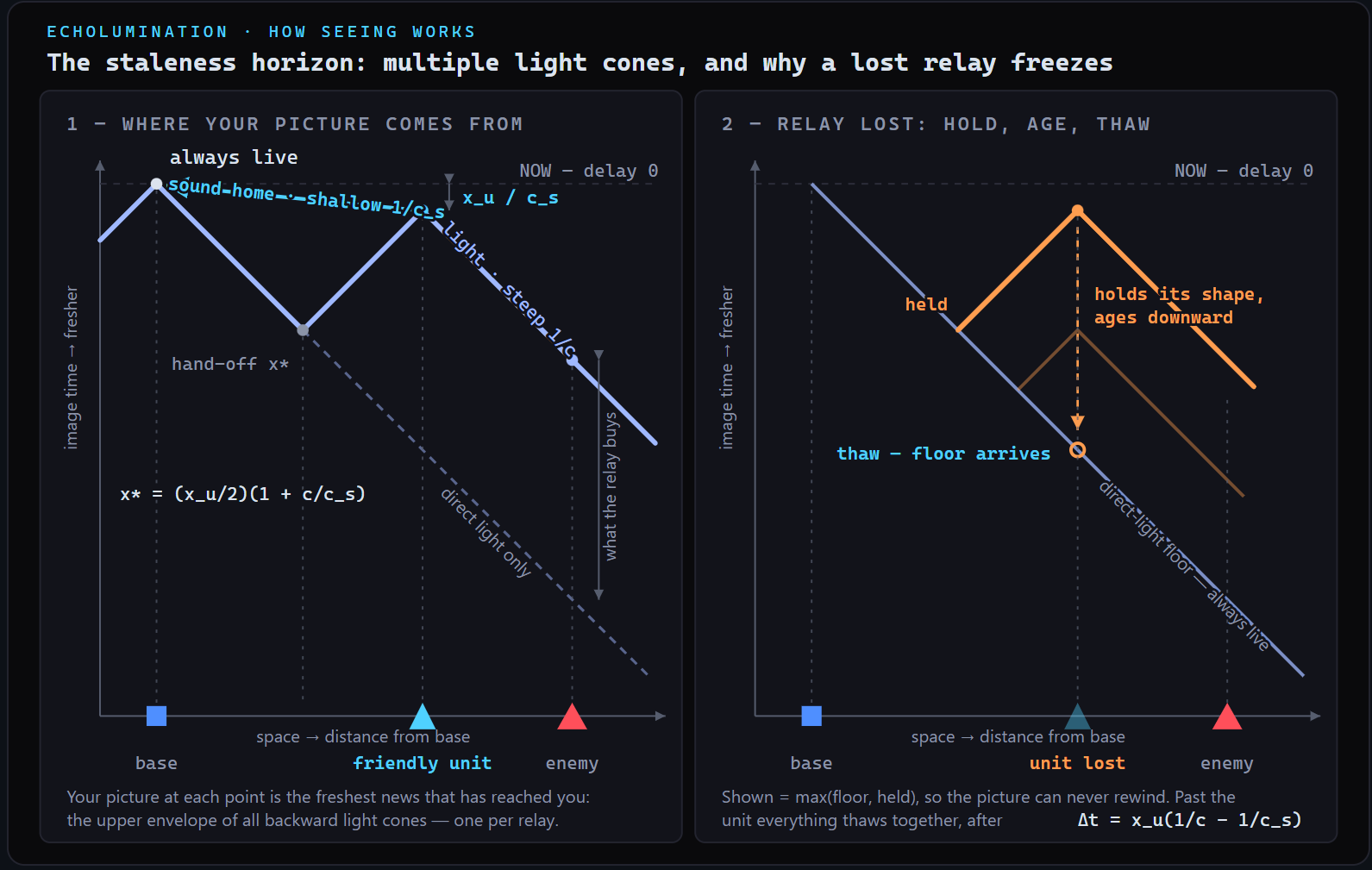
Your perceived view of the battlefield is the minimum delay over all information channels (i.e. all units/structures with speed of sound delays). Each player will have a vastly different view and dead units stay visible until you see them die (you might see events unfold in a different order than another player).
However, due to the unique nature of how this game has to operate, I was unable to come up with a good way to build this dynamic sound/light delay rendering effect into an existing game engine and had to develop one on my own with Claude (which it works great). The key ingredient is a history ring buffer that each unit/structure/entity has with multiple points for each which then use bilinear interpolation to calculate the perception delay for the entire unit (yes, due to slow light speed effects, you get crazy lensing effects possible like stretching and distorting). Furthermore, to add another wrench to the works, objects which exceed the speed of light in a medium can have multiple images - some of which appear to move backwards! This is also built-into the renderer with a complicated backward light-cone solver which tries to find all solutions where world lines of the entities intersect backward light-cones (fancy-speak for the proper rendering calculations).
Because of the large memory footprint in storing temporal data in a large history ring buffer per entity per vertex, I am strictly keeping this game 2D for now (while the principle is possible in 3D as well, it might be too memory-intsive to store 4D data for every unit)!
So where am I in the project? I started 3 weeks ago but I already built the engine, pathfinding systems, a simplistic UI (incl. minimap, unit editors, options), most units/buildings/effects and the key concepts. I am now working on other abilities as well as testing interactions. This was all done with Claude Code (Fable for planning and Opus/Sonnet for coding) - while this game is AI-coded (at my careful direction), the assets will be 100% human-made (art/music/sound/etc.). The game currently is using very simple graphics (polygon shapes for all the units/structures/effects) and there is no sound added yet (but it will be tied into the same delayed-perception engine). Multiplayer will be a long-term goal since that will require a lot more effort.
I am planning on finishing an alpha build of the game in the near future (few weeks) but then must decide how to move onwards with assets (e.g. using a pre-made set of assets or hiring artists). If this is something that is interesting to you and would like to discuss mechnics, or art ideas, let me know! I'm a new user to itch.io and felt that this big post should probably be best suited for the general discussion (since I haven't added the game to a project here yet - so no dev log yet). There is no release for the game yet, so it's still a concept discussion.
Thanks for reading my first gaming project introduction! If you have questions, comments, or other ideas, feel free to let me know :)