

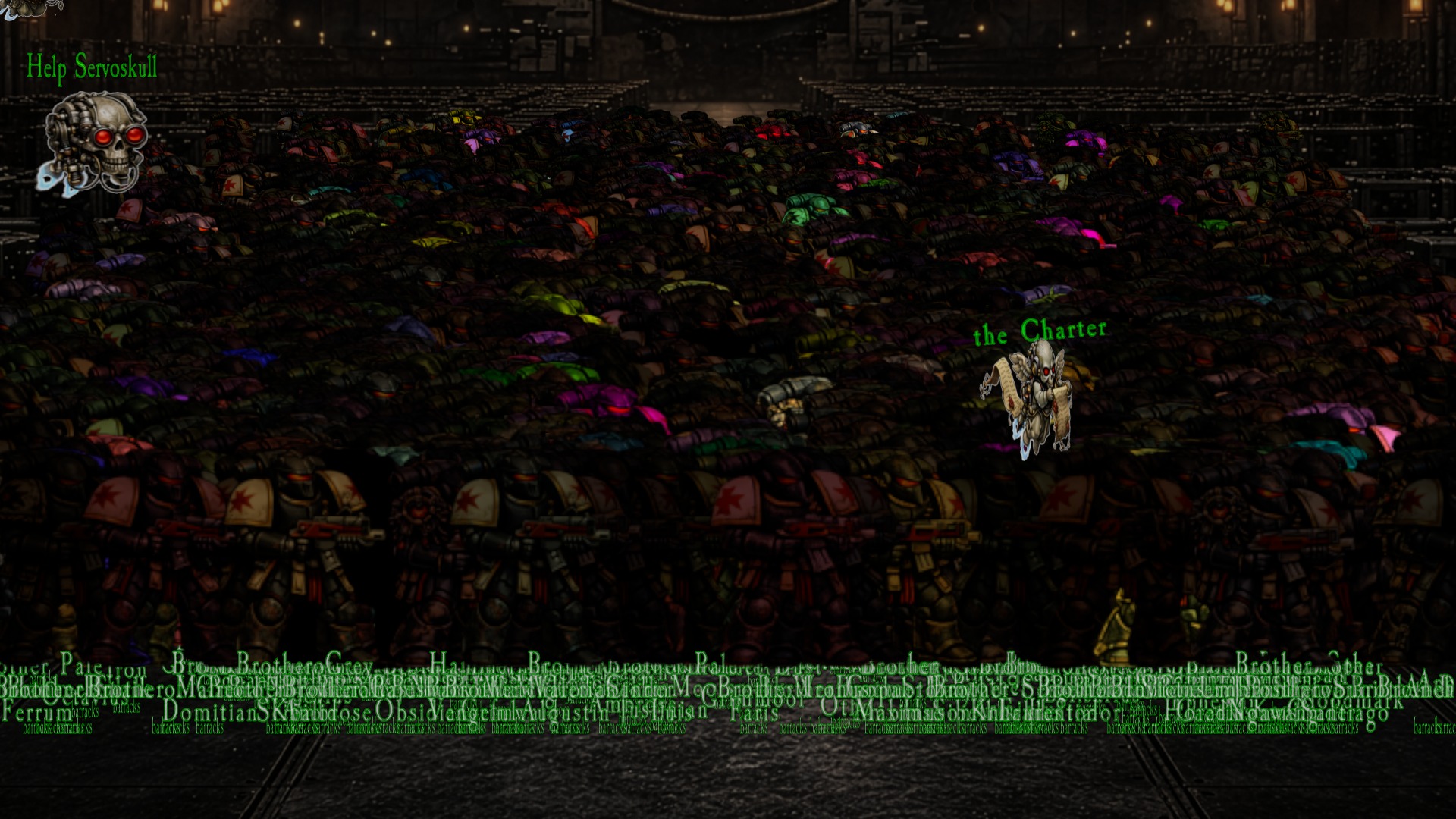
1000 marines on screen, the goofy color tints represent "personality"
Each Space Marine carries a hidden Culture DNA profile made up of numerical trait values that define personality, discipline, aggression, loyalty, and psychological stability. High aggression deepens reds and increases emissive intensity; high honor cools the blacks and tempers the gold; high intelligence warms white panels toward ivory; warp exposure introduces faint violet shadow sheens. Personality traits adjust saturation, gloss, and contrast rather than base color, meaning every Marine visually reflects their internal state without obvious UI indicators. Over time, players can recognize temperament, origin, and corruption simply by how a Marine’s armor feels on screen — turning color into quiet storytelling.
This week was about foundations. A lot of invisible-but-critical systems got cleaned up, stabilized, and restructured so the game can grow without collapsing under its own weight later.
On the Voidship side, docking and helm control received major refinement. Docking now properly hooks into the DockingFlow system, and — more importantly — helm authority feels correct. Any turn or throttle input immediately cancels docking, and the explicit abort key works as intended. The old warp misfire behavior has been removed. Undocking still needs work, so we’re not treating docking as production-ready yet, but structurally the system is much cleaner and more predictable. This was a big step toward stable fleet movement and eventually real strategic navigation.
Warpstorms were also refactored. Canvas behavior was cleaned up so storm panels remain visible for testing while still being interactive. Toggle logic is more consistent, and storms now behave more like proper galactic obstacles instead of UI experiments. Across the board, world-style panels are becoming standardized, which will make future systems easier to implement and debug.
The biggest conceptual leap this week was the Imperial History engine. Rather than treating worlds as static data points, we’re moving toward a living timeline system anchored in real Warhammer 40K canon — from the Dark Age of Technology and Old Night through the Great Crusade, the Horus Heresy, and beyond. The History system will live directly on the ImperialWorld GameObject and generate dated lore entries while modifying world attributes over time. This shifts the galaxy from a decorative star map into an evolving simulation of ten thousand years of Imperial rise, decay, and catastrophe.
We also began restructuring the Tarot system toward a centralized MasterTarot controller. Instead of placeholder cards with isolated effects, the direction now is systemic influence — editor-driven, sprite-assigned, and capable of modifying the galaxy at scale. The Tower card was conceptualized as a destabilizing force within that framework. This is early groundwork, but it’s moving the Tarot from flavor to architecture.
Finally, several UI and Canvas issues were diagnosed and fixed — including button interaction problems and a camera-related drag offset bug that was throwing elements thousands of units off-screen. With those resolved, iteration speed has improved significantly. On the visual side, Rogue Trader–style corridors and darker Dark Crusaders interior concepts continue to refine the aesthetic: black, white, red, gold — solemn, cathedral-industrial, void-heavy.
This week wasn’t flashy. It was structural. The game is steadily transforming from a collection of experiments into a coherent Imperium simulation engine.