On Sale: GamesAssetsToolsTabletopComics
Indie game storeFree gamesFun gamesHorror games
Game developmentAssetsComics
SalesBundles
Jobs
TagsGame Engines
(1 edit) (+1)

Very hard, really very hard. I don't know how many attempts I did.

But then suddenly I felt it and was able to get to the treasure. Funnily enough, in my best try I started flying in a wrong direction for some reason and went far outside the map to finally realize I need to make the whole way back and more haha.

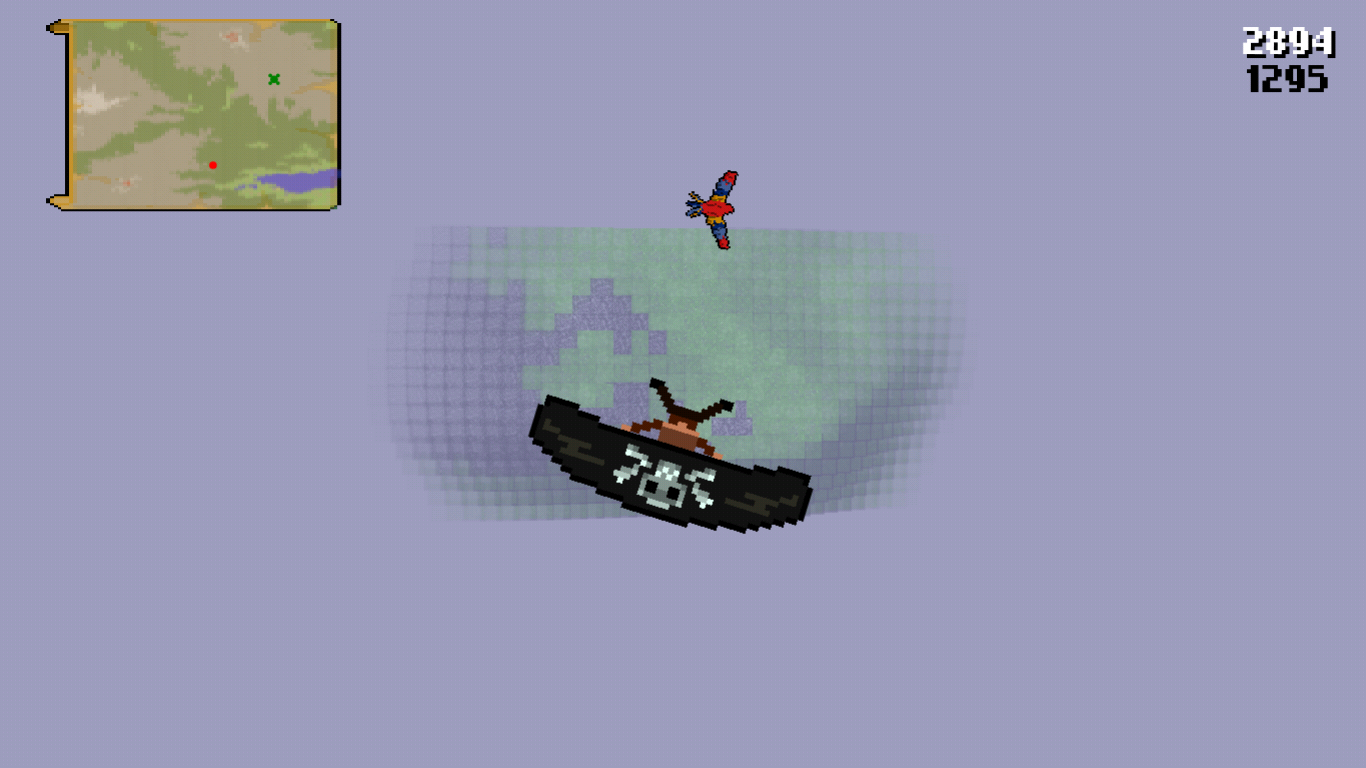
I really had fun after I mastered controls, cool little game. The highest I got is 2894 (is it highest possible? was not able to get even higher) after trying to reach a vulcano (successfully). I think the most important problem that takes the fun away is loading time after each fail.

Also it gets pretty beautiful when you get really high, all those little villages down there. I liked the drawings too.

Good job guys

(+1)

Thank you for the comments! Looking forward to show them to the family tomorrow morning. :) 

Yes, I realized somewhere half way that the controls were not immediately intuitive, that's when I decided we maybe need the how-to-fly screen. The kids picked them up quickly, but that's what they do. They are modeled after an actual glider, but I wanted to do without the theory handbook. The wing has two separate brakes, which allow you to brake either the left side or right side of the wing (or both). It only has one (foot-operated) accelerator which essentially tips the wing forward. 

And yes, there is a maximum altitude. It is somewhat random above 2500 - we also modeled the weather to be realistic, but still calculable. So there is a randomly set "cloud base" which is how high air is rising until it condensates. That's how high you can follow it. There is mechanical wind (somewhat obvious), which turns into lift or sink, depending on which way the terrain is sloping. And each tile gets a thermal energy - currently still mostly random. So we check if the ground is "hot" or "cold" at an offset from your position. If you are high enough, it will average across several tiles, which sometimes can give you bigger boosts - i.e. thermals.

You can reduce the loading time by changing the terrain size in the settings, but I agree it is most fun with the largest maps. We did hit a lot of resource limits, but it was also part of the fun being able to discuss these. I tried to stay within the limits of what the microstudio IDE encourages to use. While it supports the necessary external libraries, they are currently still a bit patched on, and you suddenly need to read handbooks elsewhere and map javascript data structures.

(+1)

Jakob: I know it starts hard but then suddenly you do it!