You're welcome! Feel free to give my game a try whenever you get a chance, I'd really appreciate your feedback!
sermodi
Creator of
Recent community posts
Thnks for taking the time to leave your feedback!!!
Sorry to hear the visual style didn't quite land for you. Art and design arn't really my strong suit, so I went for maximum simplicity. I'm definittely planning to polish and improve the visuals in future versions!
I'd love to know what you think in the future!
Balatro meets pharmaceutical Blackjack is such a cool and unique twist! The risk of overdosing vs reaching the target keeps the tension super high. Since you like deck-builders/card games, mine takes inspiration from Balatro but with particle physics interactions, I'd love it if you could give it a look! Great job on this! [Rated]
The 3D steampunk aesthetic on this is absolutely gorgeous! Love the cabinet-as-HUD concept and high-stakes risk/reward balance. My jam game is pretty much the complete opposite—extreme simplicity—so if you fancy trying something totally different, I'd love to know what you think! Excellent work! [Rated]
If you have time, could you check out and rate my game?
https://itch.io/jam/do-you-wanna-jam-2026/rate/4902473
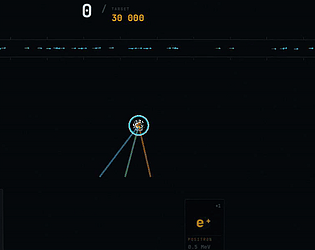
QUENCH is a deckbuilding roguelike about collisions. You hold a hand of quarks, you smash them together, and a real particle comes out. Stable ones score almost nothing. Unstable ones score enormously, and when they decay they spawn more particles, which score too, cascading until a single hand pays six figures. But every unstable particle heats the beam, and at zero stability the magnets quench and the run is over.
Instability is your score and your death. Same number, both directions. That's the jam theme, and it's also the whole game.
Eight rounds, escalating targets, a shop between them, ~15 minutes a run. Browser, mouse only.
Eight rounds. My best is 45 428 966 and I wrote the game.
Beat it, or tell me where the beam quenched (round, score, and the particle that did it). Post it here and I'll tell you what that particle really does in a detector. If you got to the ending, tell me which of the two you got.
And maybe, could you rate my game?

-------------------------------------------------
The physics is not decoration
Nothing about the particles is invented. the game holds +-50 real composite particles with their actual quark content, their measured mass in MeV and their real lifetime. The decay modes come from the Particle Data Group with their published branching ratios, so when a particle breaks apart on screen it breaks apart the way it does in a detector, with aprox. the same probabilities.
The two rules you play by are the real ones: quark + antiquark = meson, three quarks = baryon.
Charge has to come out an integer. Colour has to cancel. A combination the Standard Model forbids is a combination the game rejects — I never had to write a "because I said so" rule, because a real one already existed for every case.
That turned out to be the best design decision in the project. The scoring pair — mass and lifetime — is real physics doing the job of a game system, and it's deeper than anything I'd have invented: mass is your raw number, lifetime is your multiplier, and the shorter a particle lives the more it pays. You end up learning which hadrons are fragile by playing, not by reading.
------------------------------------------------
What it's built on
Structurally this is Balatro, and I'm not going to pretend otherwise: rounds with escalating targets, a shop that sells stacking passive upgrades, and a score that is two numbers multiplied together. Balatro's real lesson isn't the maths, it's the order in which it teaches you the maths, and I stole that on purpose.
Where it departs: Balatro gives you two resources, hands and discards. QUENCH gives you one. Every collision is a commitment (there's no safe way to dump a bad hand) and every round you also pick your beam energy, which buys reach at the cost of margin. Detectors are the jokers, one-shot theories are the consumables, and there's a 50-particle catalogue plus an endless mode with its own leaderboard for anyone who wants to keep going after the eighth round.
Also, from the score-attack corner of the genre: the screen shakes as a data channel, not as decoration. You know whether a hand was good before you finish reading the number.
A couple of small things devs tend to ask about: it's Godot 4.7, all the balance lives in JSON so the whole game can be rebalanced without recompiling, and all 24 sounds are synthesised at runtime ( there isn't a single audio file in the project).
------------------------------------------------
The curiosity: try to put two top quarks in the same collision
Do it at 13 TeV. That's the only hint you get.
The reason it's interesting: the top quark is the one quark that never hadronises. It's so heavy it decays in about 10⁻ ²⁵ seconds, which is faster than the strong force can bind it to anything, so there is no hadron anywhere in nature that contains a top. Toponium (the bound state two tops "should" make) cannot exist. Every physics-literate player eventually reaches for it anyway.
The game has an answer prepared for that. It is not a rejection message.
----------------------------------------------
Beat it, or tell me where the beam quenched (round, score, and the particle that did it). Post it here and I'll tell you what that particle really does in a detector. If you got to the ending, tell me which of the two you got.
And maybe, could you rate my game?