Indie game storeFree gamesFun gamesHorror games
Game developmentAssetsComics
SalesBundles
Jobs
TagsGame Engines

scriptorum

20
Posts
82
Followers
20
Following
A member registered Dec 15, 2017 · View creator page →

Creator of

Recent community posts

(1 edit)

This worked out really well! I found your method easier to remember this way:

1. Pick two non-adjacent letters from the word.

2. Make a new word that has those two letters adjacent.

I definitely think the adjacent-letter approach was faster and easier to use. Really very simple. On that basis alone it's better. I do think the word quality was higher with the fixed/floating approach -- probably because it forces you to different word forms which are more frequently original and unrelated -- but takes more time and mental pressure,.

For example, with BRICK, and we pick R (fixed) and C.

* Adjacent Letter Method looks for words that have CR and RC in it. Arc, Crunch, Marco Polo, Create.

* Fixed/Floating Method looks for R in the second position and a C anywhere put in the fourth. Scar, Acorn, Scurry, Ocarina.

Adjacent Letter floods you with a ton of words, so if the goal is a random word, you have to be careful to take the first ones that come to mind. Consider CRxxx. Cry, Crafty, Cricket, Crouton, Crucible, Crucify, Cruella, Crimp ... I mean really there's no end of words there, so if you don't pick the first ones that come to mind you will subconsciously direct yourself to certain words. Again, that's only a problem if your goal is a random-seeming word.

Thanks for sharing this technique!

(1 edit)

I played this for a while (without the additional 1d10 mnemonic tables posted in the comments) and here are my thoughts:

  • I thought it did a great job of pressing modulating the action.  Twists sneak in there at the right pace. Release usually comes in time. Sometimes the states repeat themselves and you're not expecting it, creating a insane drama or a deeper moment of reflection and regrouping.
  • Occasionally you get a triple state. Three pushes in a row for example. I think it would be better to instead treat that as a random event trigger. Then characterize the event into one of the three pacing states and continue from there.
  • The PACE system does nothing at all to manage the number of threads you are dealing with. That's really still all on the player. It's possible thread management could be worked into the mnemonic tables, but I'd want to make sure they balanced having too few or too many threads.
  • I wonder if I can get by with a simpler random system, rather than memorizing 1d10 inflection points into a 4 entry table and a P-T-R-T sequence. Probably. :)
  • This worked great for scene setup. It doesn't have to but can drive the beats of the mid-scene moments. I really felt the tension ebb and flow. This can also be used to put together an adventure like a miniature version of Adventure Crafter.
(1 edit)

I've also considered formalizing the pacing state interpretations into mnemonics so you could randomly generate one for inspiration. Just roll a 1d10 and look at the correct state table. More to memorize, but this is a the easiest way I can think to add Adventure Crafter style elements to Hands-Free.

This uses the same mnemonics as in Hands-Free RPG: count along the word until you get your number, map the letter there to the word in the table, and interpret the setup of the scene based on the matching description.

Push (FORMIDABLE)

LetterWordDescription
F Force Immediate action required: act now or lose ground.
O Obstacle Something prevents progress or blocks your path.
R Risk The stakes get higher. Fewer safe options to choose from.
M Mandate A decision is demanded; you must choose.
I Immediacy You can't wait. Time pressure forces your hand.
D Danger Introduce a new, present threat.
A Assault An enemy or force acts against you.
B Breakdown Your plan fails or unravels. Loss of control.
L Loss You lose some advantage, such as position or resource.
E Escalation The situation gets worse or intensifies.

Twist (NIGHTMARES)

LetterWordDescription
N New Info Priorities shift due to new information.
I Inversion A reversal of roles or expectations.
G Gap False assumptions become exposed.
H Hidden A concealed element comes to light.
T Turn Things take a sudden shift in direction.
M Misdirection A false lead or deception is revealed.
A Alteration The objective doesn't change, but the circumstance do.
R Revelation A surprising truth comes to light.
E Exception Something behaves in an unusual manner.
S Shock A sudden, unforeseen disruption occurs.

Release (AFTERSHOCK)

LetterWordDescription
A Aftermath Consequences settle or reduce.
F Finish An main objective or conflict is resolved.
T Truce A contentious conflict pauses or ends.
E Ease Room to breathe; current pressures lessen.
R Reward Gain something of value.
S Stability A new status quo holds.
H Healing Time to recover, regroup, or restore.
O Outcome A clear and definite consequence is determined.
C Closure Loose ends or side threads are tied off.
K Knowledge The fog is lifted over a mystery.

Ooh, that's interesting. I'll give your way a try.

I've been playing with it and it's not hard but it takes a smidge brain ooze more than the standard 1/T/T+1/10 wrinkles.

Still on an AI art rant? I already agreed to remove it. It will be gone in the next version, replaced with my own art, Lord have mercy on our souls. (Well not my soul, I apparently sold mine.) The next version will be released when its ready. Further AI posts will be deleted as off-topic.

(2 edits)

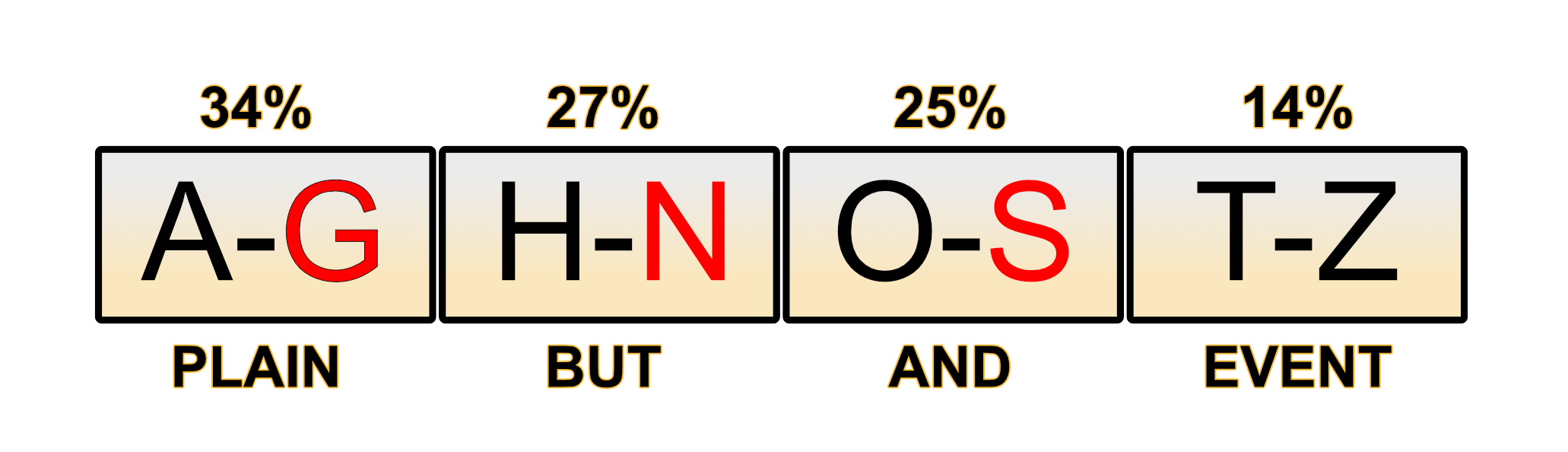
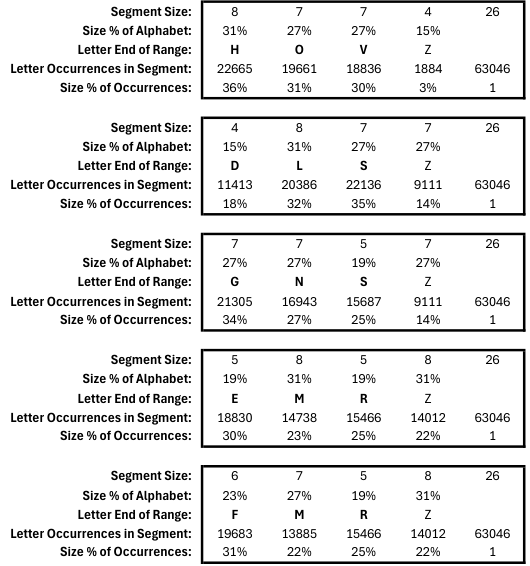
For those who are with me this far, I did the analysis of letter distribution and the results are a bit tricky to work with. The image below shows a variety of letter choices for the three anchor points, and the true probability for each plain/but/and/event outcome based on a 10k English (most popular) word list. To read the charts, look at first top one. This represents our initial starting point, HOV, which purports to have a decent separation of segments, giving a wrinkle 52% of the time and an event 15% of the time. However upon analysis of which letters are actually common, the true percentages shift to 3% chance of events and everything else more or less even. This didn't come as a shock to me, as it was clear that the event segment included X and Z which would naturally be less utilized.

However thanks to a sharp difference between D and E (the latter of course being the most common letter) I'm really kind of stuck either setting plain outcomes at 18% or 30% but nothing in between. That's probably fine. EMR is not a bad choice, but that makes events a bit too spicy. My favorite is probably GNS as anchors, creating a 34% chance of a plain result, a 14% chance of an event, and 52% chance of an and/but complication, skewing ever slightly to the and.

Now as for a mnemonic, GNS has some possibilities:

  • GAINS
  • GENES
  • GENUS
  • Granular Narrative Spectrum
  • Guided Narrative Scale

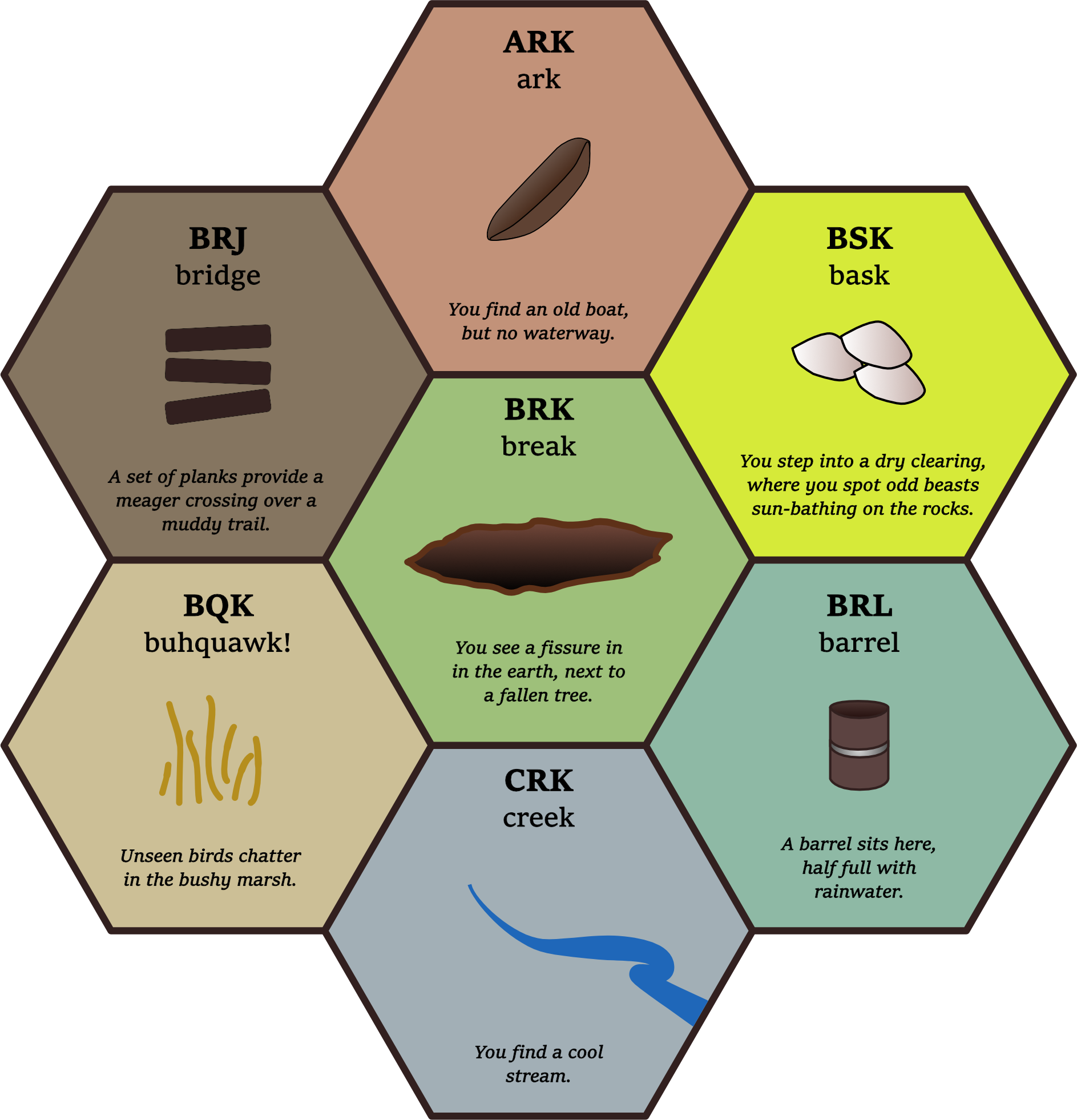
Also note these are flat topped hexes. If you prefer pointy tops, that works too, I'd recommend using 1st letter =+NE/-SW, 2nd = +E/-W, 3rd = +SE/-NW.

An example map.

I am currently testing a clock system! This will likely be the subject of my next devlog.

Wow, some very nice words, thank you.

I'm intending to put together an actual play that shows the tools in use. I know what you mean about mental fatigue; I'd say more about it but I haven't solved that myself, yet. Basically if I end a session on a good note, I'm ready to play again very soon. And if it's mediocre, I find it hard to get back into it. But I think that's true about any solo RPG.

Regarding memorization and mental grids, this is a big subject. I've studied techniques like the Method of Loci, and the Major System. While worthwhile to learn, and a fun party trick to recite 100 digits of pi,it's overkill to learn them JUST FOR HANDS-FREE. If I could come up with a simplified version...

As for PWYW, I intend to put up a donation box after Hands-Free settles a bit more. I keep making lots of changes. I'm glad you learned the acronyms, but you know know I'm actively considering changing some of them. I think "BEGINS" needs some more work. I've also been toying with a better genre randomizer.

The TIMERS thing means I'm terrible at editing. It will be fixed in the next version. As for AI, I thought if I was completely above board on what parts of AI art I did use that people would accept it, but I completely underestimated how much the RPG community hates AI art. I want focus to be on the game  and not AI, so when I have the time I'll excise the offending elements. Thanks for your feedback.

Death portals and the artificial core were both courtesy of the "secret" category. I love that you roll it last, adds a nice twist.

(1 edit)

I did it rockless, but I love the idea. The creation of the planets bit by bit and analysis of colony viability was a blast to play. The summary from my crew of colony engineers:

Fonda-3 is the worst. It is breathable, but landmass is scant, no native food to be found, and temperature spikes are deadly. A artificial metallic core with no known purpose also leaves us concerned.

Fonda-1 is breathable in a pinch, but we’ll have to subsist on ice bugs and invest in tunnel infrastructure between bases which must be positioned between ridges to protect from intense weather.

Fonda-4 is next best. Breathable atmosphere, but the surface is dangerous (flying beasts, meteors, stray death portals) and an underground base built to be structurally sound will be quite costly.

Fonda-2 is clearly the best choice. Full stop. Requires work with lightning and pest mitigation, but otherwise is a beautiful planet for us. Welcome home, folks.

I made Lick-29, a frog ship, a sloshy but sleek colony vessel hopping its way to Swamp Candidate 462. Many amphibians gave their life so that the future generations could visit Licky, which is now a history museum, and eat Impossible Flies that nobody eats anymore and you only try it here out of nostalgia.

The musical interludes were fantastic. I wound up playing Frogs by Nick Cave and the Bad Seeds during the final rest. It was majestic.

After five turns of guilt, I am a master of procrastination. I defeated guilt once and had to clean my kitchen. :(

(1 edit)

I saw your request over at /r/Solo_RolePlaying. Making the document screen-readable sounds like a great idea for a system like this. A Doc version is a bit hard to do because it's all in Homebrewery Markup, but the markup is a text file and in itself might be interpretable by a screen reader. I'll upload it here.

That's awesome! 

Zoltar is a great way to ask for more information without yes/no.  Instead of asking "Is there a magic portal?" you could ask, "What do I discover?" In one shot, the resulting word could lead you to a magic portal or a dwarf in a tree or just an eerie silence.

I would LOVE to hear what you've done with it!