Very nice. This fella looks like they will pack lots of hurting
Nerosus
Creator of
Recent community posts
Since its been so long without any word, I have created my own playmaterials to fix some of the errors, add things that are missing and make them more print friendly.
Custom Playmaterials
Seems interesting. A thing I can say for sure that would be nice, is consistent "button states". Either a red button means unpowered or turned off. Otherwise it will confuse the player if something can be interacted with or not. Like the buttons on the ship that turns on the lights have two different ways to show this (the one at the front and the two at the top).
Finally got a chance to try this out. Overall it seems nice, but there are a couple things I either missed or did not work:
- The list of things needed should include tokens or something. After a 6 or so "rounds", I simply couldn't continue playing due too being overwhelmed by having to keep track of were units were. The map already contains land features, discovery notes and "explored" markings. Leaving very little room to add "basic unit #4" to a hex.
- Missing culture: It seems like the war gaming-aspect might work well in the game, but I had hoped for more of a "storytelling game". So having things that make the civilization feel like it has culture and such, would be nice.
- Grey lines to write on, I really dislike writing in open space. So having grey guidelines would help a lot.
- A clean hex map for custom play. I know there are free ones out there, but having one in the style of the game would be neat. And if so, make it a faded grey so a pencil is easier to see.
I am glad that to hear it has helped and you have decided to try playing ttrpgs. I hope you and your group have fun with it.
If you have questions about the game, please just ask. There is also a reddit board dedicated to pbta games (what Glitter Heart is based on), which is full of people experiencee in playing these sorts of games. So you could certainly also find help there.
I feel like I should mention that I am working on an alternate way of handling imagical powers. I am hoping to make it less “overwhelmning” with all the move cards and more flexible so people can be more creative. It is not meant to be a replacement though, just a different way if people don’t like the cards. Which I have experienced/noticed a couple times.
Aaah, that explains it. That prompt didn't come up on my phone. Just a REF error. But when I used the link with a different login on my computer, I also got that prompt to accept urls and the images showed without any problems.
And you are not being nagging at all. Being informed about any errors I have missed is healthy for the project. And the wizard using a d8 was certainly an error. So thank you very much for catching that :D . I'll be making a small dev log to inform that the link have been fixed and the die error, and I would like to add your user name as credit. Will that be OK with you?
As for your sidequestion: I don't see why they can't mix it. The GM can after all add requirements if it becomes to wild. But for your specific example, I would say that they don't need to mix them, since most characters with spells/abilities that can manipulate a specific element, can usually also launch it in some form. Like rock, fire, ice, etc. So unless the player would find the other way more interesting, just let them launch some metal spikes.
Hello there
Hopefully I can answer your questions, and please feel free to ask:
=== HP Lines ===
The lines in the HP section is meant to help count the boxes (each line is between the 5th and 6th box). But in hinsight, I should have mentioned that the lines were for that. So I might make a small update to clarify that. But gaining more boxes as they level up could be a possibility if one wants a more "from zero to hero"-feel. But with how dungeon world works, having less than 10 HP is very dangerous, so I would advice against it.
=== Philosophy ===
I would like to explain the design philosophy before giving examples. I wanted magic to follow the same flow as other PbtA games: conversation to mechanic, supported by the fiction. The player describes the character’s actions and intent, and the GM evaluates how that would look like in the current fiction. This helps to break magic away from the D&D mentality of a spell list, making magic feel more like part of the conversation.
And being so freeform also allows the player and GM to shape the limits and flavour of magic, so that it fits the character and story/world the group is playing in. Again, all through the conversation and the fiction.
=== Examples ===
As mentioned, it starts with the conversation and fiction. So can someone with the Elemental Power: water control blood? Well, what role does blood have in the world? Normally the GM makes this call, but should still have a conversation with the player about it. Because if yes, water magic can control living blood, then that means going forward, that is part of the fiction.
I am not sure if you specifically want examples for Elemental Power: Water, but here goes.
- The player describes forming a rushing torrent of water, intending to knock the pirate overboard. The GM decides the pirate is distracted, giving the wizard a chance to do so and asks the player to roll.
- The player describes the character pushing all the water away from themselves, creating a large bubble of air in the lake so that their watery foes won't be able to reach them. The GM decides this seems a little over what normally could be done with Cast a Spell, but doesn't feel it fits as a ritual. So decides that the spell will take a moment to cast, giving the enemy a chance to attack or intervene.
- The player describes how they want to flood the whole city, raising the water level of the river. This the GM decides is beyond simply casting a spell, and would require a ritual. They decide that the character needs a Place of Power connected to the river and a roll to pull this of.
- The player describes their character forming condensed balls of water, firing a pressurized beam of water at their foe. The GM had described the orc as wanting to attack the wizard, so the GM reminds the player about this incoming attack. This is to make it clear that there is a danger to be dealt with here and now. The player doesn't feel to keen about getting cut down, so describes how their character tries to keep a safer distance from the orc by turning around and moving around the furniture. The GM asks the player to roll Defy Danger, and if it succeeds, it will open up for the character to do some magic without the risk of being attacked.
- The player describes the character dipping their staff in the water, creating a strange rippling portal with a vague image of a different shore so that they can escape the island. The GM feels like teleportation of this sort would need a ritual with the requirement that it will take some time (minutes) and will be unreliable due to the portal leading to an unknown place.
A lot of it is all about gut feeling rather than hard mechanics/limits. Which is why it is important to communicate with the rest of the group so peoples expectations are at the same level.
Great to hear it was a success, despite the lack of toughness in the game. How did it go? Like, what location and such did the group get to play in and what playbooks did they choose?
I am assuming you are the one that also posted on Reddit about using the wizard core move, since your names are almost the same :P
Thank you very much. I hope it will help to make the experience pleasent you and the players.
I wouldn’t mind hearing how it goes with the group. It is usually interesting when new people to the hobby try it out.
And if there is any questions, please feel free to ask. Because I have only really tried the hack with more experienced groups. Never completly new players.
So based on your experience, there could be things I need to clarify, or maybe even things that need to be changed to have the game flow better for beginners.
It is more that I did not include it. To me, the immolator is missing a lot of "story" in its kit. Basically, a playbook should give an indication of what kind of story you want to play out (a little hard with the DnD baggage for DW). And all the Immolator really was about, was fire and burning things. Nothing about what it meant to "be an immolator" or what kind of story they tried to tell.
But it is something I want to try and look into.
Seems like there is a lot of good stuff in this, but I seem to be missing a lot of guides on how combat/confrontation works. It talks a lot about that the characters must defeat horrible harbingers, but doesn't really give examples on this. Just that when they fill out the NPC's conditions, they are taken out or don't pursue their drive any longer. Which doesn't sound very helpful.
I have never been more excited to press "Start battle" in a strategy game! I just love seeing how that one unit explodes into a whole bunch of em and start dancing and jumping.
Regrettably, it's code doesn't work well at all when using larger maps or multiple opponents, taking incredibly long time loading and lags.
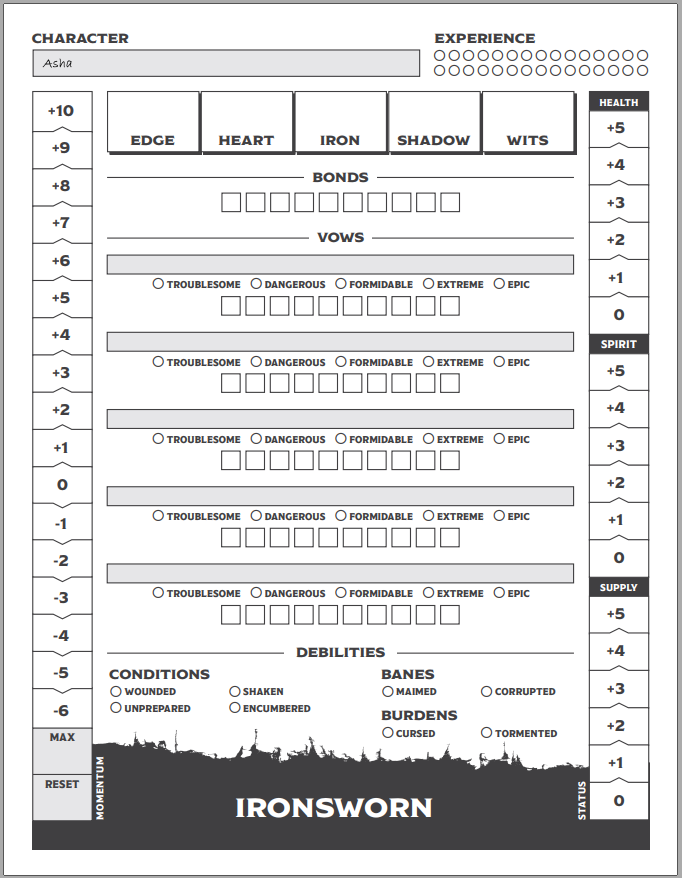
I am not sure, but I think it is only the "menace" boxes that has been added (small boxes inside the vow boxes).
But they seem to be missing from the horizontal sheet but are included in the landscape one for some reason.