


amirkosh662@gmail.com
A member registered Dec 22, 2023 · View creator page →
Creator of
Tend a vineyard by day. Defend it from foxes by night — armed with nothing but a flashlight.
Simulation
Play in browser
Unturned mod
Terraria mod
Sasuke Uchiha is a character from the manga and anime series Naruto, where you can talk to him. GameJam project
Recent community posts
Essence Creation Devlog — Why I Treated Creation as Body, Mind, and Purpose
Hey everyone — I wanted to share some of the design thinking and development process behind Essence Creation, my solo Blueprint-only Unreal Engine 5 entry for CGDC Speedgame: Hardmode 2026.
When the theme CREATION was revealed, I didn’t want to use it as just a story wrapper or a visual theme. I wanted creation to be the actual mechanic. That led to the core idea behind the whole project:
You don’t solve the puzzle directly — you create something that can.
Essence Creation has a Portal-style sci-fi test chamber vibe, but the answer isn’t a portal gun or a cube. The answer is a lifeform you design.
Using the Creation Matrix, the player spends limited essences to create creatures for specific problems. A bigger creature can hold a heavy pressure plate. A faster and more agile creature can cross a dangerous kinetic ramp. A smarter creature can hack a terminal. A kinder creature can earn the trust of a frightened scientist.
Because essences are limited, every creature is a decision, not a free button press.
The biggest design shift for me was realizing that creation shouldn’t stop at physical stats. If the system only let the player tune Size, Strength, HP, Speed, and Jump, it would be functional — but it wouldn’t fully express the theme. So I pushed the idea further and added inner traits like Kindness, Intelligence, and Anger.
I wanted the player to shape not just a body, but a temperament. Not just a tool, but a being with intent.
That’s what made the theme click for me:
A creature’s body defines what it can do, but its spirit defines what it is willing to do.
To me, CREATION isn’t just about making the strongest thing possible. It’s about deciding what kind of life you’re bringing into the world, what purpose it serves, and what that says about the player as its creator.
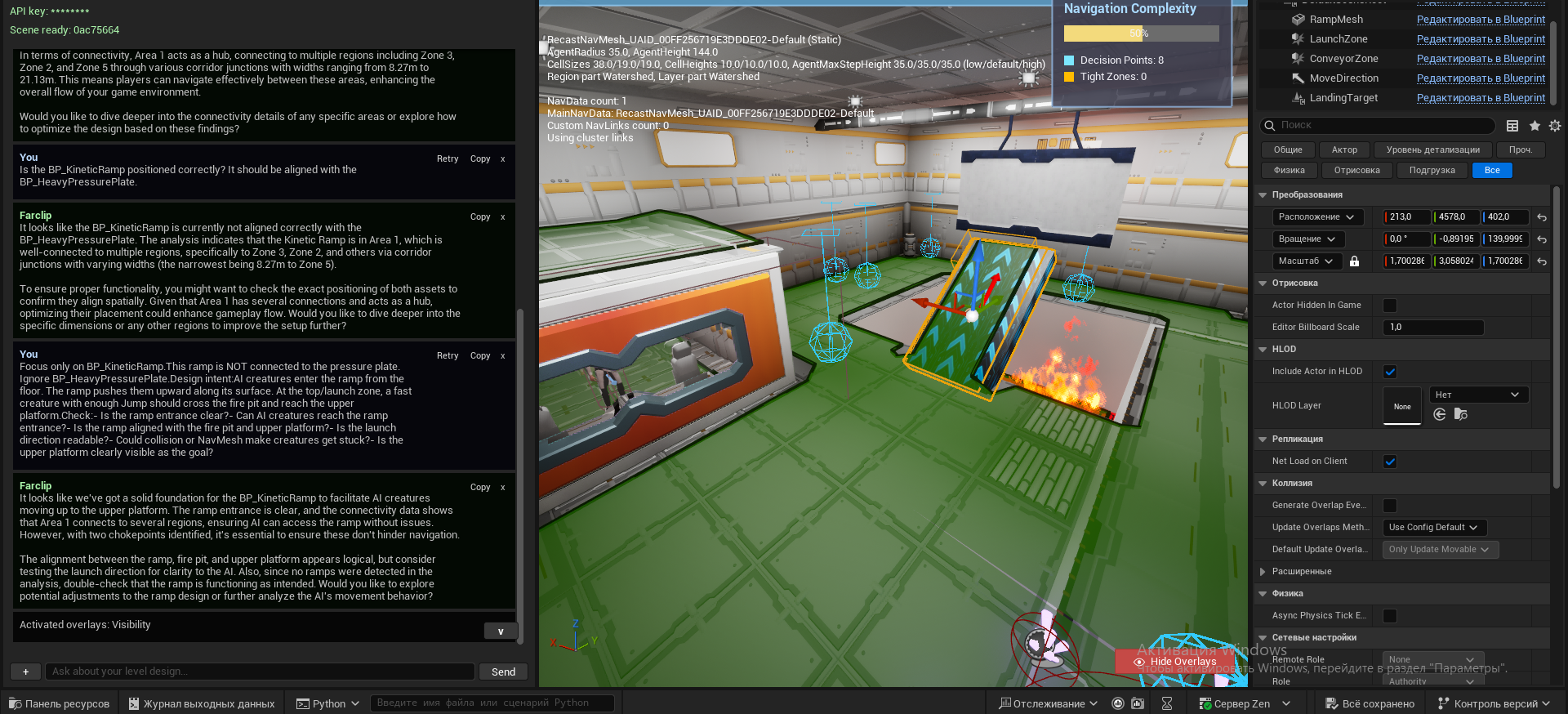
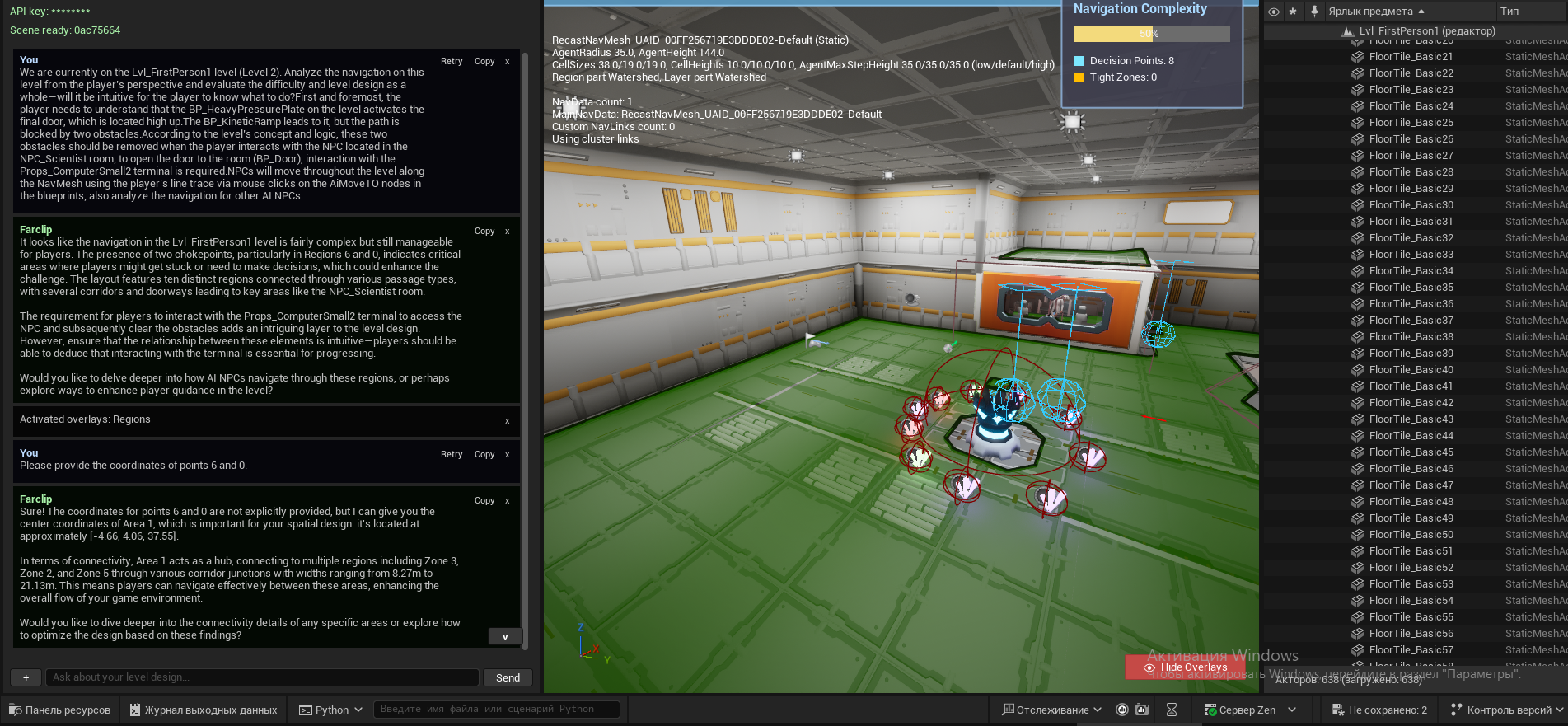
I also used Farclip during development, and honestly, it felt like one of the freshest tools I’ve tried in a long time. What impressed me most was that it lived inside the actual UE5 workflow and helped with the kinds of questions this project constantly creates:
Does this room read clearly? Can this creature actually navigate this space? Is the path to the terminal obvious? Are there dead zones, awkward sightlines, or layout issues that hurt the puzzle?
Instead of feeling like a content gimmick, Farclip felt more like spatial design intelligence inside the editor, and that made it genuinely useful for this game.
Day 1 — Building the Core Systems
The first day was almost entirely about building the foundation of the game.
Before I could make any real levels, I needed the creation system itself to work. So most of the day went into the basic mechanics: the Creation Matrix, creature spawning, essence costs, creature attributes, movement commands, and testing whether created creatures could actually behave like puzzle-solving tools.
This took way longer than I expected.
A big part of the day was spent making sure the player could create a creature, select it, command it, and see it move correctly through the level. I also had to make the Creation Matrix feel like a real object in the world, not just a menu. The creature had to be created from a physical point, receive its attributes, register as the active creature, and respond to player commands.
I tested creature movement a lot, because the whole game depends on it. If the creatures cannot move reliably, the entire concept breaks. Since the game is based heavily on AI movement and NavMesh, even simple things like clicking a point and sending a creature there became extremely important.
By the end of Day 1, the project finally had its skeleton:
- the player could use the Creation Matrix
- creatures could be created from essences
- attributes could be assigned
- creatures could move with AI commands
- basic puzzle objects like doors, pressure plates, and essence pickups started to work
This day was not glamorous, but it was probably the most important one. I spent almost the entire day, basically until late night, just making the game’s core systems stable enough so the actual puzzle design could exist on top of them.
Day 2 — Designing the Puzzle Chambers
On Day 2, I finally started focusing on the actual levels.
Once the core creation system worked, I realized that this mechanic could support a lot of different puzzle ideas. The player is not limited to one kind of interaction. A creature can be designed for size, movement, strength, intelligence, kindness, aggression, or a combination of those traits. That made it surprisingly natural to come up with different puzzle logic.
The harder part was not inventing the puzzle ideas. The harder part was designing the rooms so the puzzles were readable.
I wanted the levels to feel like sci-fi test chambers, with a clean Portal-like structure: the player enters a room, sees the obstacle, sees the goal, and understands that the solution is not direct. They need to create the right creature.
During this day I worked on the logical flow of the levels:
- small creatures for narrow spaces
- large creatures for heavy pressure plates
- intelligent creatures for terminals
- kind creatures for the frightened scientist
- fast and jumping creatures for movement-based challenges
- dangerous areas where the wrong creature would fail
This was also the day where I used Farclip the most for level design.
While building rough level prototypes inside UE5, I kept asking Farclip about the design directly in the editor: whether the puzzle space was readable, whether the navigation made sense, whether important objects were visible enough, and whether the player would understand the intended path.
That helped me a lot, because Essence Creation depends heavily on spatial logic. Almost everything is connected to NavMesh, creature movement, NPC positioning, visual intuition, and whether the player can read the chamber correctly.
If the creature cannot navigate, if the scientist is placed badly, if the terminal does not visually connect to the door, or if the puzzle flow is unclear, the whole room becomes confusing.
Farclip felt like the perfect tool for this part of the project, because I was not just asking for random ideas. I was using it to think about the actual playable space: sightlines, navigation, dead zones, level flow, and puzzle readability.
By the end of Day 2, the game had moved from “working systems” to actual puzzle chamber design.
Day 3 — Integration, Fixing, Packaging Chaos, and Making It Playable
Day 3 was the hardest one.
At this point, the main problem was no longer “what should the game be?” The problem was making all the systems work together without breaking.
The first level needed to teach the basic loop: collect essences, use the Creation Matrix, create a small creature, access a hidden area, recycle or deconstruct the form, create a larger creature, activate the heavy plate, and open the door.
The second level was much more ambitious. It combined the real identity of the project:
- Intelligence for terminal hacking
- Kindness for the NPC Scientist
- Speed and Jump for the kinetic ramp
- Size limits for the launch
- fire as a danger zone
- pressure plates and doors as the final puzzle chain
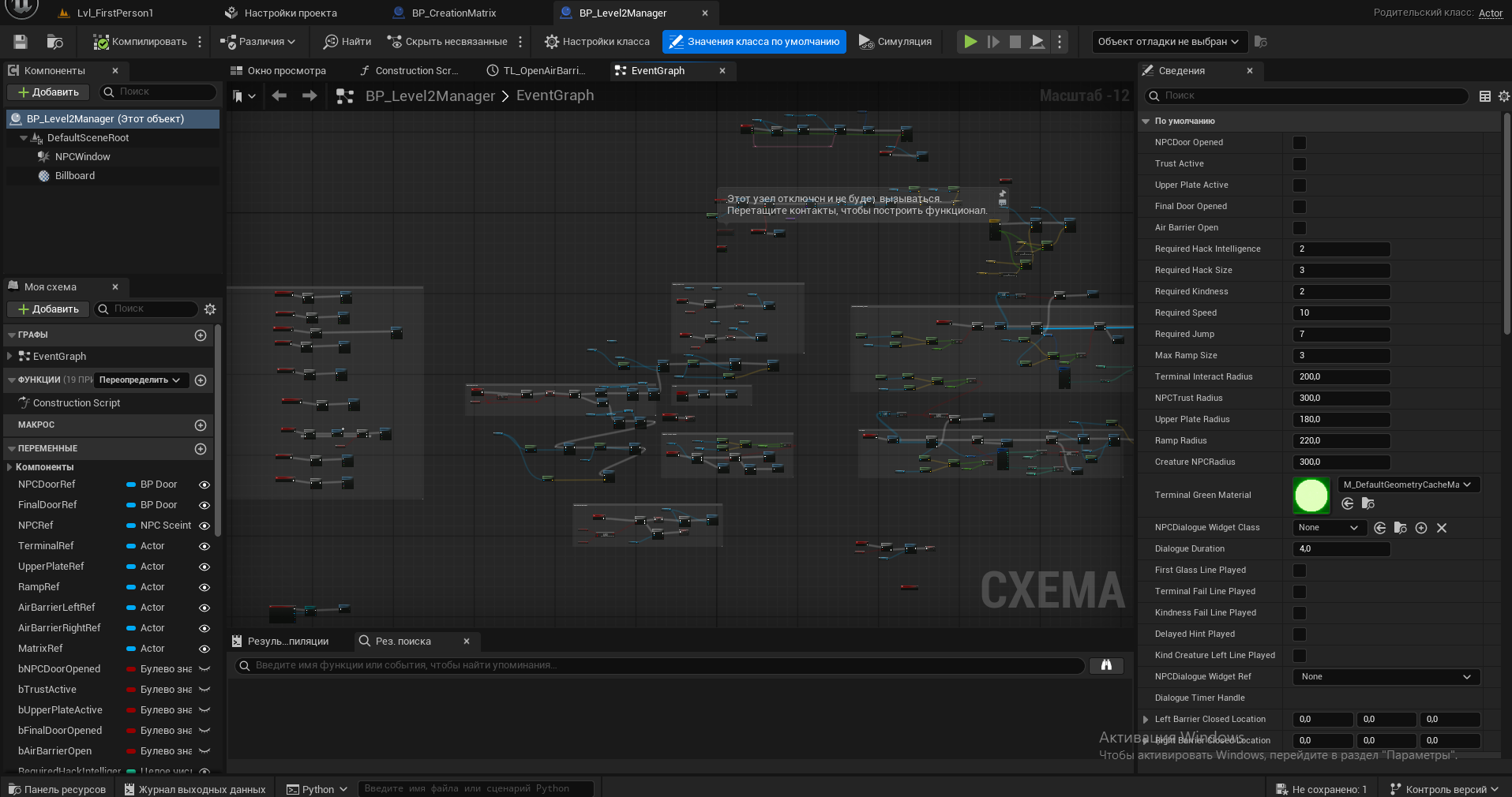
A lot of the final day was spent fixing Blueprint logic and making the level actually playable from start to finish.
The kinetic ramp became one of the biggest technical challenges. I did not want it to be a normal moving platform. I wanted it to be a sci-fi conveyor ramp: the ramp itself stays in place, but anything standing on it gets pushed upward. Then, at the top, the player has a small timing window to launch the active creature across a gap.
That meant I had to solve several issues:
- moving both the player and the creature on the ramp
- stopping the creature’s AI MoveTo from fighting the conveyor movement
- detecting when the creature is inside the launch zone
- launching only the active creature
- checking Speed, Jump, and Size before the launch
- making the creature movement look cleaner and less broken
The NPC room also needed a lot of work. The terminal had to recognize a creature with enough Intelligence, the terminal screen had to change after the hack, and the Scientist had to react to Kindness instead of force. This was important because I wanted the player to understand that the game is not only about physical attributes. Some problems need a mind, and some problems need trust.
I also worked on UI and feedback: the Creation Matrix needed to show physical and spirit attributes, the player needed to understand what they were creating, and the game needed enough visual feedback to make the puzzle readable.
Then, right near the end of the jam deadline, the project hit one of the most stressful parts of the whole process: UE5 packaging and compilation problems.
The game itself was already taking shape, but the build process started failing because of issues in my Unreal Engine setup, most likely caused by plugin conflicts. Nothing wanted to compile or package properly. At first, I thought it was a problem with my computer or Windows installation, so I spent a huge amount of time troubleshooting things that were not even part of the game design anymore. I even went as far as reinstalling Windows because I thought the issue might be on my system.
That packaging and build nightmare ended up taking me a couple of extra days of troubleshooting, which was extremely frustrating because the hardest creative and Blueprint work was already done. The project was not blocked by the concept anymore — it was blocked by getting Unreal to actually build the game correctly.
Day 3 became the “make it real” day in every possible sense: bug fixing, testing, connecting systems, removing unnecessary complexity, fighting the build process, and trying to make sure the final version communicated the idea clearly.
By the end, Essence Creation became a rough but playable jam build: a sci-fi puzzle game where the player creates life, shapes its body and spirit, and uses that creation to solve problems the player cannot solve alone.
Final Thoughts
Essence Creation is still a jam build. It is rough in places, and there are many things I would improve with more time: better onboarding, cleaner UI, stronger creature feedback, more animations, more levels, and more polish overall.
But I’m proud of what it became.
At its core, Essence Creation is a puzzle game about creation as responsibility — shaping body, mind, and purpose into the solution.
For me, that was the strongest interpretation of the theme:
Creation is not just making life. Creation is giving life a reason to exist.