Having recently finished an article on the Toxic Yuri VN Jam collecting several interviews from different authors a few weeks ago, I thought this was a sobering confirmation of the ambivalence I had.
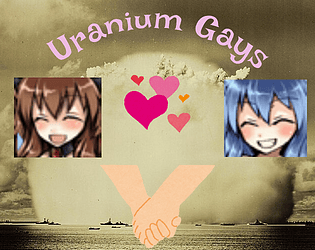
My cheery optimism about the whole ordeal ended up being tempered by the many different goals and (self-)criticisms people have on the jam, its successors, and their own entries. Everyone, even the people who saw a bright future, had ideas that contradicted each other. Even my own entry, Uranium Gays, is weaved from a different cloth altogether.
I ended up letting the article be a cacophony of different voices, a kind of historical document of this strange, exciting, but ultimately ephemeral moment. I don’t get many “bad vibes” from participating in the jam, but then again there are moments of friction where my own experiences as a Chinese Indonesian clash with the culturally white hegemony. I can only but reflect on instances that can be parsed as microaggression but ignore it for the sake of the success of these communities.
I also now work adjacent to the translated manga industry, which means I have to think about the commercial reception of yuri manga among other genres. It has been interesting to read how fans of yuri manga (both in English and Japanese) interact vs many English yuri visual novels. There’s this tension that may never be resolved because the two creative communities have very different priorities, stemming from race and gender.
As you’ve noted, I think whiteness or at least more broadly the feeling that you belong to the Global North defines the stakes of English-language yuri. The self-flagellation might be stemming from the real failures of the leftist movements in the United States and United Kingdom to solidify trans rights – it’s a fashionable, though understandable for me anyway, form of defeatism. The enlightened liberal values have fallen to the rise of the MAGA right and TERFs of the United Kingdom. I am sympathetic to my Global North comrades in that regard, though my sympathy can only go so far when I live in a fascist country (Indonesia) that has elected a war criminal. Welcome to the club, my American and British friends.
And it’s this mindset that affects even the brightest of thinkers. I once read through A Brief History of Transmisogyny by Jules Gill-Peterson, which has a few elucidating chapters. But as Talia Bhatt points out, it suffers from the romanticism of finding camaraderie in Global South suffering: it’s obvious that the culture Gill-Peterson glorifies is problematic and Bhatt laments, “Oh, save my sisters from the ‘reverence’ of this cursed land and its misbegotten people.”
I think the mass appropriation of yuri manga/anime aesthetics in indie English-language visual novels comes partially from this desire. The isolation many young queer people feel in the Global North is real, but the mistake is seeing Japan as a “lost future” like vaporwave. Without noting the crises in the country that have lately colored how people write yuri fiction there (no gay marriage, extremely weak trans recognition), they adopt the audio-visual languages to depict their own suffering. They don’t know that the genre has so much subversive history since the conception of Class S literature, which is why I think the appropriation feels ignorant to me.
I am perhaps giving more benefit of the doubt than necessary for this leftist Orientalism. My loyal reading audience is probably whiter than I wish, so even my own criticisms of the white queer scenes might not be read as a request to look into yourself. I think that’s why I really like 95 Theses because the game rejects my wishy-washy tendencies to say something so simple: “yeah ngl, this reads kinda self-aggrandizing.”
As such, I am always thinking about my own game dev server and whether it’s actually inclusive at all. I was talking to someone about the differences between my server and others, and they said that my server seems to have gravitated toward “criticism/analysis” than “development/jams”. While I don’t disagree, I think it’s because I have taken a wait-and-see approach. I lag behind other communities’ more proactive approaches to making games because what I want is a robust, diverse community that can talk about pertinent matters like racism. I’m nowhere close to achieving it though: these tensions you brought up and some more might never be resolved.
But like my article, I’d rather let these tensions be transparent for people to see and untangle than to hide it. For every work like 95 Theses and ZATO that comes out, we are bound to see many works and fans are replete with microaggressions. And I think it’s important to give a space for people to bring up “killjoy” criticisms, to use a Sara Ahmed-ism, if we want to see some progress. The fact that you said that “you’ve chosen to die” should not be possible in a space purported to be inclusive.
I still don’t know what kind of visual novel scenario I want to write. I know what pleases many – the aesthetic, the specific version of suffering – but that doesn’t speak to me. Finding works like 95 Theses has given some hope that, yes, I can find something that speaks to me.