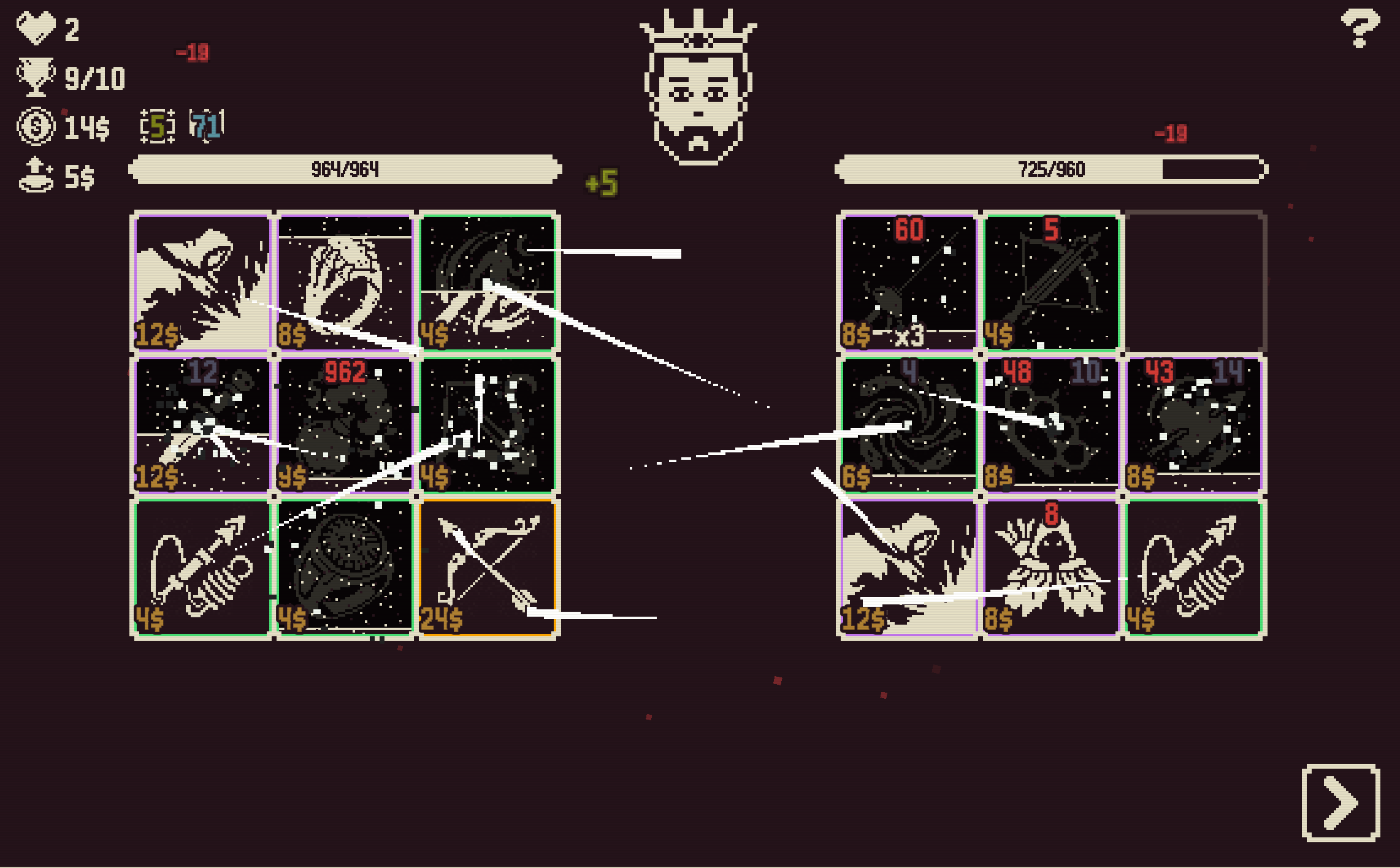
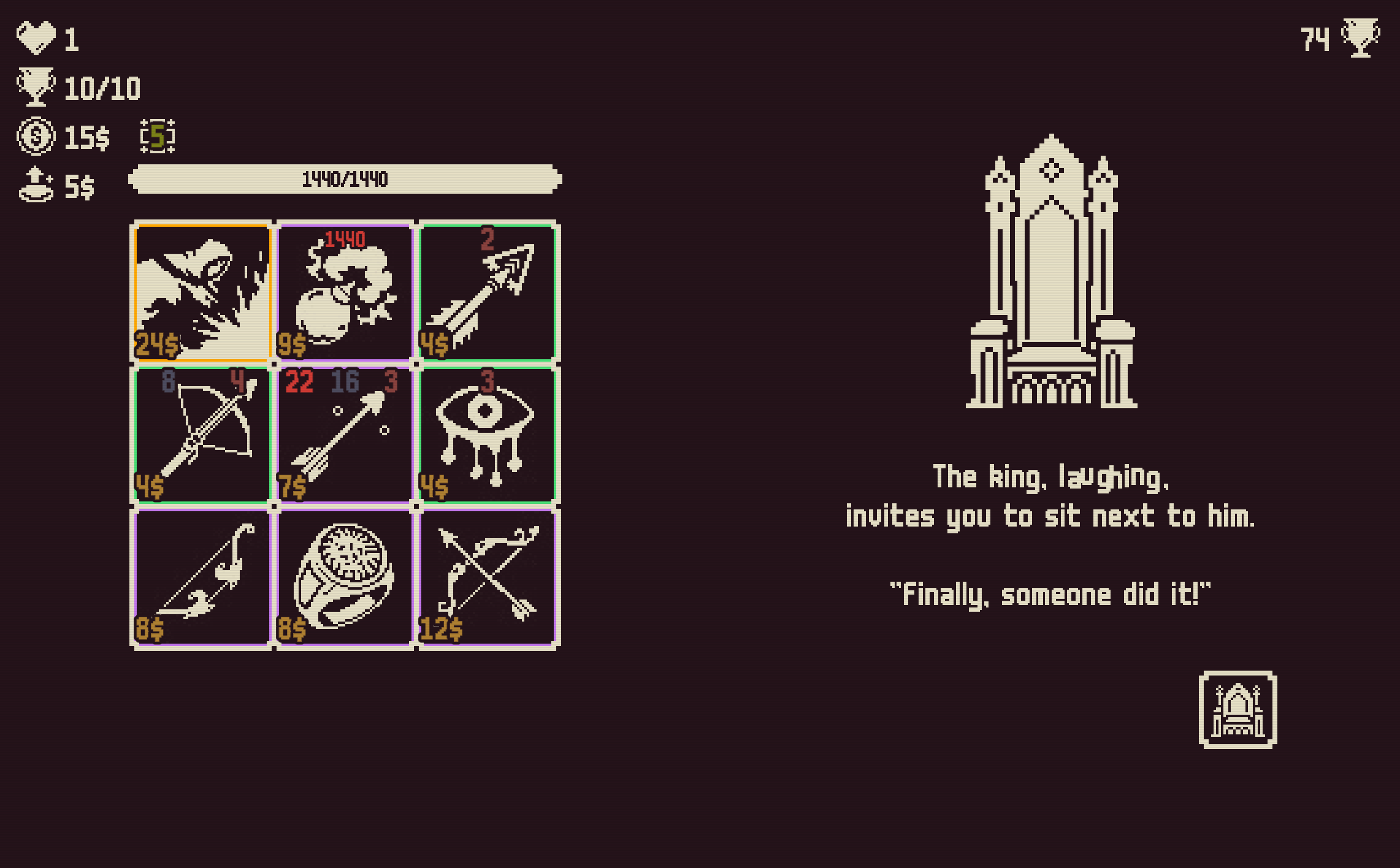
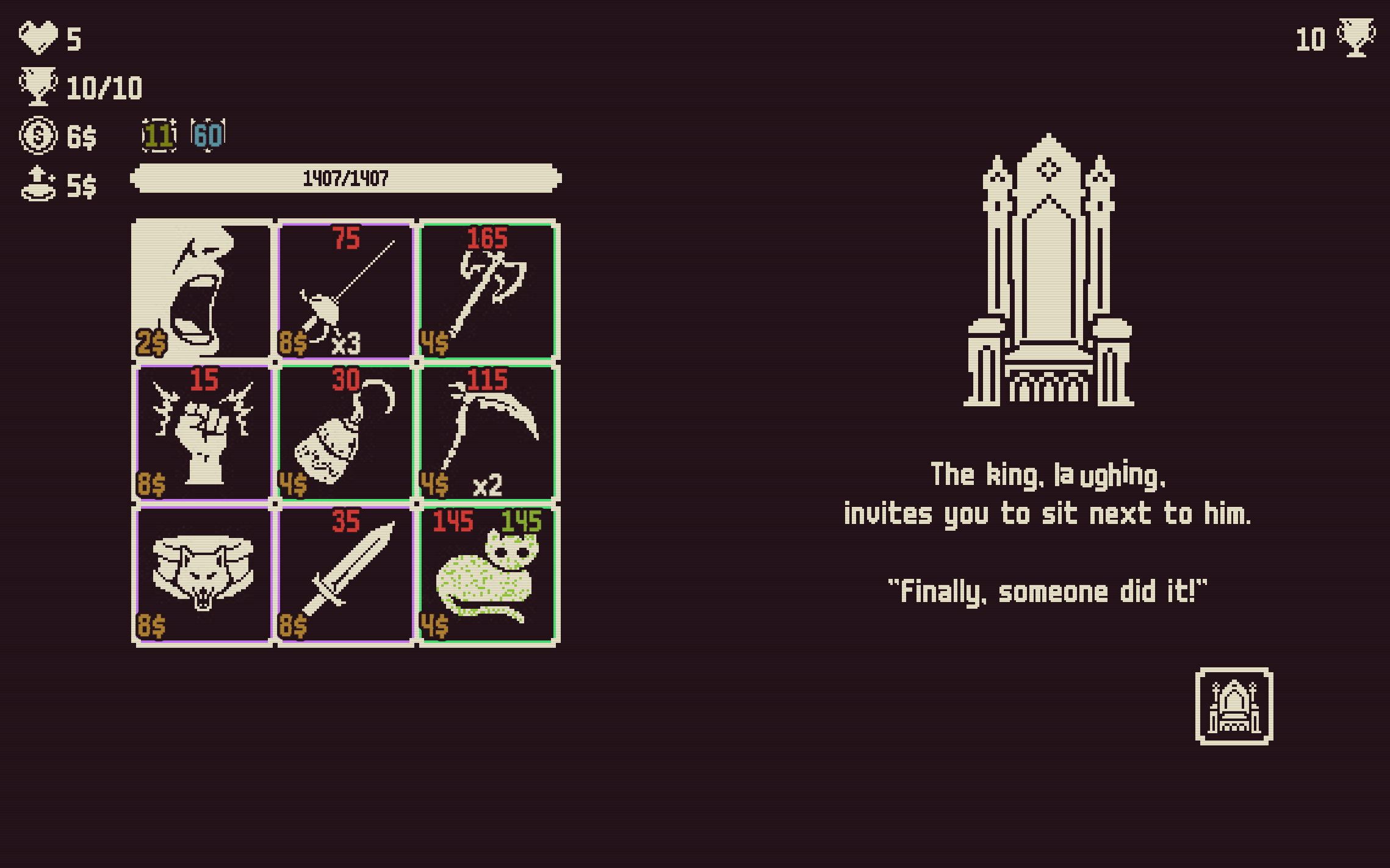
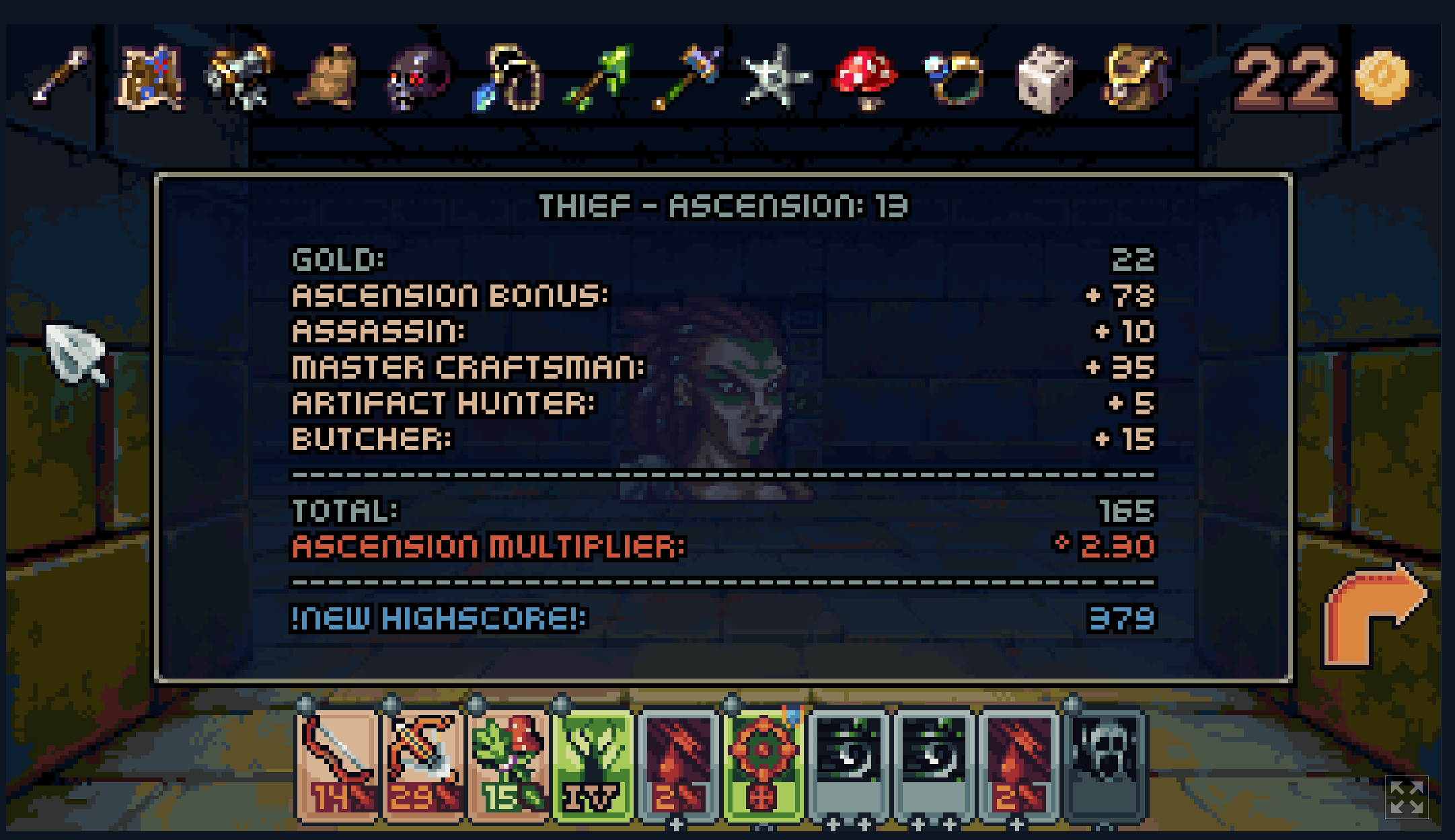
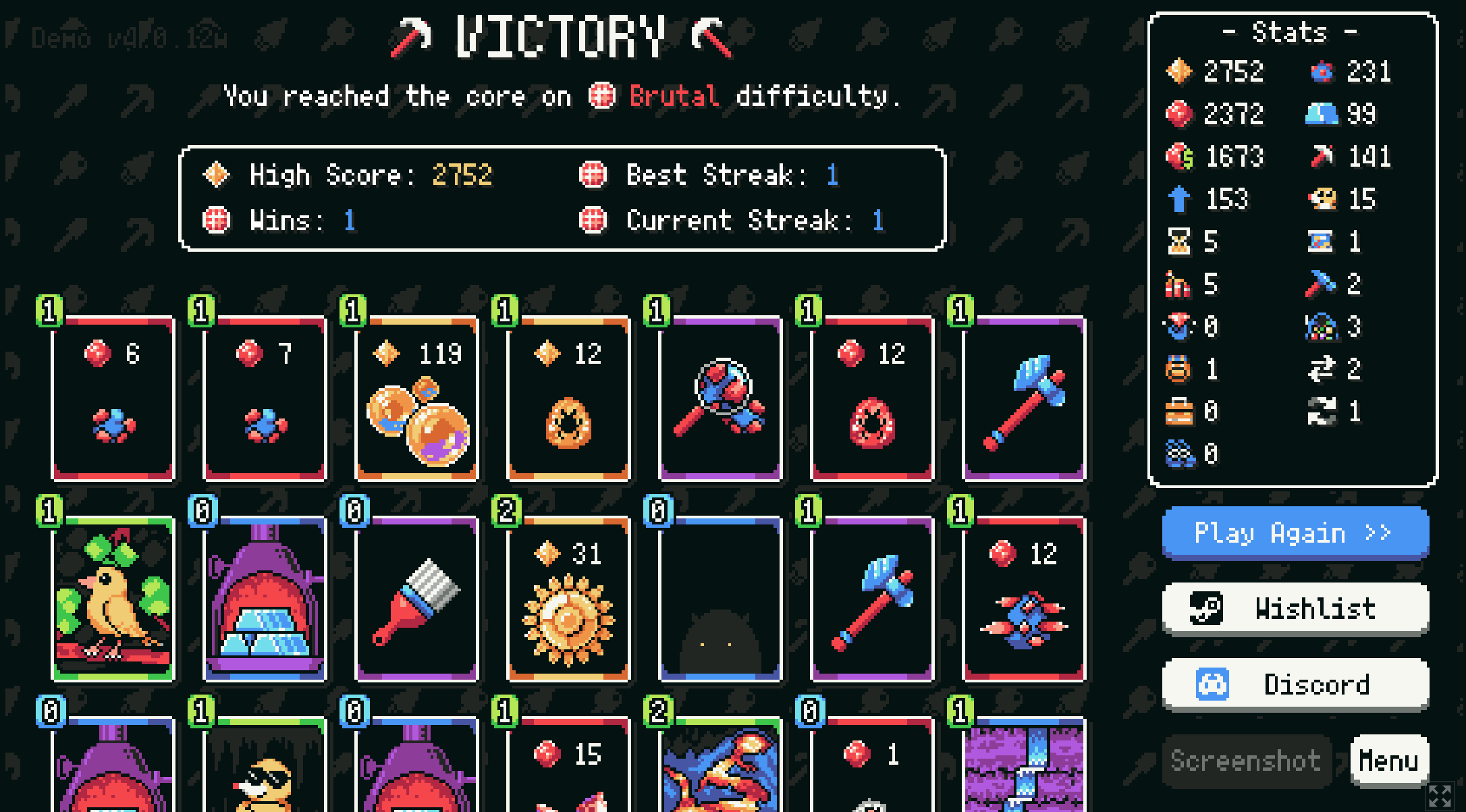
Bug: invisibility doesn’t work against the arbalist. “Piercing” implies it’ll ignore shields, but doesn’t imply it’ll ignore invisibility.
Josh
Recent community posts
- One thing I added and where I would love to hear your feedback is a ‘first shop special’: When meeting the merchant for the first time each run the artifacts are replaced by 2 higher level gold and attack cards. I think that could reduce the RNG a bit
I think removing that particular randomness ends up being a bad thing, because it amounts to “make sure to earn enough gold to buy this, and then it’s almost as if you had it in your starting deck”. But also, more importantly, sometimes it’s really nice having the early artifact, if you can manage to get enough gold for one. And some of the early bonuses can make that feasible, like the initial 5 gold and/or the extra health for the first few battles so that you can farm some extra gold (in addition to farming card upgrades).
Most of them now have to power up their ability and don’t influence the first turn. Feel free to name any enemy where you would like to see some changes..
So, one thing that’d make the game feel a bit more strategic: I’d love to see changes to poison. Two possible approaches:
- Attacks that poison could be blockable. If a poison attack gets through, then you’re poisoned, and take subsequent poison damage that shields don’t block. But it’d be nice if you could block the initial attempt to poison.
- Alternatively, make poison fade by 1 each turn. So, a poison attack does 1 damage and adds a poison, next turn you take the poison damage and the poison goes away. If you have 2 poison, then you take 2 damage and now have only 1 poison. I don’t think this would work as well as the previous idea, but it at least means that an enemy can’t just bypass your shields and poison you once and then sit back and watch you die.
Lots of fun. The mainframe mechanic is clever, though I wish I’d known towards the beginning that purchasing the first two boosts would eventually unlock “streams”.
One interesting bug: if you have two magnets on opposite ends of the rift, many shards will collect in the middle, pulled by both magnets, and not move. There are a couple of ways you could fix that, but the most obvious would be to make magnet strength proportional to the inverse square of distance (the way real magnets work). That will make the pull sufficiently unstable that you’re unlikely to get stable points between the magnets.
This was delightful, and I enjoyed the wide variety of endings.
As others have said, it’d be fun to have a “good ending” variant for “eldritch”, via some additional secret. One idea for that (rot13):
Lbh pbhyq znxr vg rkgerzryl bofpher, naq gura chg n uvag nobhg vg va gur Ryqevgpu-ivfvba irefvba bs gur vzntrf, abg ivfvoyr jvgu nal bgure ivfvba.
Losing all of the saved data from the previous version is painful.
Please consider looking carefully at building save-game versioning and compatibility. There are standard solutions for this. Typically, you’d store a version number in the saved game, and when loading, migrate the save data forward using migrations defined for each version. Anything that isn’t stored at all starts out initialized to the default (e.g. new upgrades start out unpurchased), while anything that has changed gets migrated to account for that.
Finally achieved enlightenment:

Second time was much easier, thanks to Imprint.
What is the formula for how long one Loom of Fate cycle takes? If I play a relatively short game, Loom of Fate seems to take less time per cycle, which can help to boost Imprint for the handful of nodes you touched. However, my second time getting enlightenment, I played a bare-minimum number of nodes to get through it, and it only took ~10 minutes, but Loom of Fate still took the capped 50m per cycle. Is it based on the total amount of node time used? It’d be nice if it were based on number of explored, or on some aspect of real time spent, so that playing a very short game would result in a short Loom cycle. As it stands, this took less than 10 minutes to play but would take 50 minutes to Loom, so it’d be wildly faster to gain imprint by playing through it manually.
“When imprint reaches 2.0x and above, each 1.0x point of Imprint will refund +1 Step when the associated action is completed.”

This is misleading. I thought it meant that it would give that many steps after completion, but apparently “refund” is literal, it only gives back as many steps as were used. So, a thing with 13x imprint that takes one step will just give one step, while if it takes 10 steps it’ll give 10 steps.
Please consider clarifying that in the help.
“When imprint reaches 2.0x and above, each 1.0x point of Imprint will refund +1 Step spent on the action when completed; this cannot exceed the steps spent on the action.”
(Also, this should say something about not working on Leisure actions, and any other limitations it has.)
Managed to accomplish this. I made this extra hard on myself by also first reaching the “walk past the void stone” without gaining 10 magic, so I could walk past it and still be able to gain magic afterwards.
It’s a pretty massive challenge with major tradeoffs, since you have to get 500 agility to get into the Crypt, while keeping intelligence as low as possible. (The other path into the Crypt needs 900 strength, and I’m not sure that path gives enough sanity to make it through to the fool’s gold given the blocker.) You also have to spend most of your sanity doing that instead of anything else, and open up a lot of nodes that you might prefer to have waited to open until after you have Vagrant’s Sword, and leave the crypt before gaining any more intelligence.
Would be nice if there were more shadow power-regain nodes that gave dedicated stats and not just “all basic attributes”. Would love to see some of the “+100 basic attributes” nodes replaced with trees of independently reachable nodes, one for each basic attribute. :)
It’d still be a major tradeoff if that were the case, just a faster tradeoff on subsequent runs.