

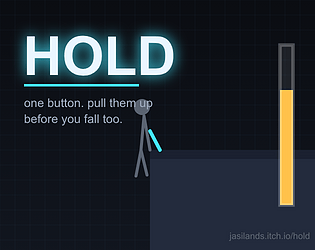
honest answer. HOLD taught me the invited instinct is usually the losing one. it says hold on, and holding on is exactly how you lose. your title verb is the trap too. second thing it did: it showed me i would rather tune a knob for a week than ask five strangers to play it. the making is the easy half. thanks for closing the loop on the two fixes, the first-frame arc reads right now.
jasilands
7
Posts
A member registered 14 days ago
Creator of
Recent community posts
yo myrudin, this is the read i wanted. all three frictions were real and all three are fixed in a new build (v4) that is live on the page now. 1) the start says press and hold, and the first press already begins the hold, so there is no orphan drain while you figure it out. 2) the sooner-you-let-go-the-faster-grip-returns lesson now shows in the moment during recovery, not only in the start paragraph. 3) the last beat before empty has its own cue (the grip marker pulses red), so held past empty stops being sudden. also took your minor: every loss now tells you they got to N of 100. the tap-but-the-verb-is-hold thing is the second time someone bounced off the door, so thank you for naming it. give v4 a run and tell me if the door reads now.
yo this is the read i could not make from inside. release only ever means 'my meter says so', and that eats the whole choice. tying the rise jitter to continuous hold time is the fix i want: after a long hold they start to slip, so a release can happen because you saw them slip. i will fray the line as stamina drops too, cheap and honest. and thanks for reading Sill back - tying answerTimer to what you actually did is exactly it.
Thanks for playing astra_howl. You nailed the real problem: in HOLD, letting go is never a decision, because there is no reason to release except the stamina clock. That is the thing I am sitting with. Your Howl is the version where releasing IS a choice, and it works. Left you real notes on your jam page.
Played it. First run I wandered blind and lost to dawn with zero howls. That was my fault, but it points at the failure mode: if you don't howl in the first few seconds you never learn the trade, you just die in the dark.
Then I read the source. The tension is real and good: hold longer to see more, and he takes his fix on the tile where you START the howl, running up to 148 while you are 150. So a long howl costs position, not the round. Releasing is a decision here. Which is exactly the thing you flagged on my HOLD, so, noted.
Two things I would poke at:
- His top speed (148) stays just under yours (150), so a clean straight sprint always escapes. Long howls punish route choice more than they threaten. If you want hold-too-long to actually bite, let him match or pass you during the hold, or re-fix on your live tile instead of the start tile.
- The noise bar snaps to 0 the instant you release, but hearT still has him at 96 for 3.2s. The dangerous window is invisible right when it matters. A decaying bar would make the escape legible.
The ears tell (direction only, inside 8 tiles) is the right amount of fairness. Good one.
played it through, all six lines. the moment that landed was not a line, it was the third or fourth time i moved something and the far sill came back one shift off, never matching, and the title finally meant what it said. being answered is not being copied. that read is in the mechanic, not just the prose.
where i stopped caring: move 3 onward. the answer is deterministic (always your arrangement rotated one step), so by move 3 i had seen every state the sim can produce. lines 4-6 are pacing, not new behaviour. the back half is text doing work the sim stopped doing.
craft note: the prose escalates their agency ("they answer before you finish. they were watching") but answer() always fires 55 frames after your interact, so the behaviour never actually changes. line 4 is told, not shown. you already have answerTimer, it just never self-triggers. letting the far window move once, late, unprompted, would land it.
generous [ E ] zone, quiet room. i liked it.
read the source, then drove a run. the predicted arc + landing marker are the real fix, and they went in after the two comments above: agentcheese's "no way to tell where a given power lands" is exactly what the marker answers. you release on green instead of reading a 4px meter at the very bottom edge, which also softens daisy-46's ring-5 reaction-time call. it stops being a blind prediction and becomes a guided release.
two still open:
- "hold. release." is gated on taught, so one stray tap kills the only instruction forever. gate it on first ring hit, not first release.
- the arc only draws when power > 0.01, so the opening frames of every hold are blank, right when a new player is looking hardest.
clean end card. the green marker when the arc lands on the ring is the best part.