

From: root@sigsegv
To: broadcast_all
Subject: Reality is now mutable.
Welcome to the SIGSEGV devlog. If you’re reading this, you’ve survived the initial boot sequence.
I’m Geeknik. I build systems that break other systems. SIGSEGV is my attempt to simulate the paranoia, the thrill, and the absolute absurdity of managing a rogue C2 server in a post-collapse digital wasteland.
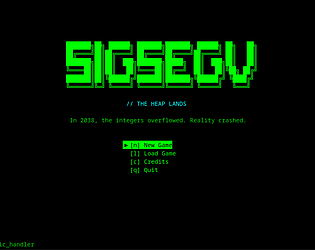
This isn’t just a “hacking RPG.” It’s a simulation where you write actual code to exploit procedurally generated corporations, all rendered in a libvaxis-powered TUI that runs faster than you can panic().
The State of the Kernel (Progress Report)
We’ve been busy in the backend. The core loop—The Kernel, The Socket, and The Compiler—is functional. The foundation is poured, and it’s made of Zig 0.14.0-dev concrete.
Here’s what’s currently allocated in memory:
✅ COMPLETED (The “It Works” Pile)
- The ZIG-0 Interpreter: This is the big one. We built a custom stack-based VM and parser for the in-game hacking language. You don’t just “roll for hack”; you write logic.
- The Editor: A modal TUI code editor is live. It supports snippet injection, memory management constraints, and—crucially—panic handling.
- The Lattice: The infinite procedural graph of corporate nodes is generating correctly. Mega-Corps now have generated names, traits, and ASCII CEOs (though we’re still polishing their faces).
- Inheritance: The generational system is wired up. When you die (and you will), your “child process” inherits your legacy. The dead don’t stay dead; they just become
deprecated. - Save/Load: JSON serialization is done. Your failures are now persistent and human-readable.
- The Borrow Checker Boss: Yes, we added an enemy with “Rust-Armor” that is immune to memory safety exploits. Good luck.
🚧 IN PROGRESS (The “Glitchy” Pile)
- Visual Polish: The ASCII portrait renderer needs some love before the CEOs look less like “exploded printer” and more “cyber-dystopian overlord.”
- CRT Shaders: We’re working on simulating scanlines and chromatic aberration directly in the terminal via shader logic. It needs to look like a monitor from 1999 that’s been left in the rain.
- Audio: Procedural chiptune logs are next. The Net needs a sound.
What’s Next?
We are moving into Phase 4: The GUI (Polish). That means taking these raw mechanics and wrapping them in an interface that feels good to touch. Glitch effects, color palettes, screen transitions—making the terminal breathe.
The first playable “Bootloader” demo is on the horizon. It will drop you into the Root Console to manage your resources and survive your first few packet cycles.
Join the Runtime
If you want to see the code, discuss exploit strategies, or just yell at me about my memory management:
- Follow this project for update notifications.
- Comment below with what kind of “Old Net” horrors you want to see generated in the Lattice.
End of Line.
SIGINT
Geeknik // SIGSEGV Dev