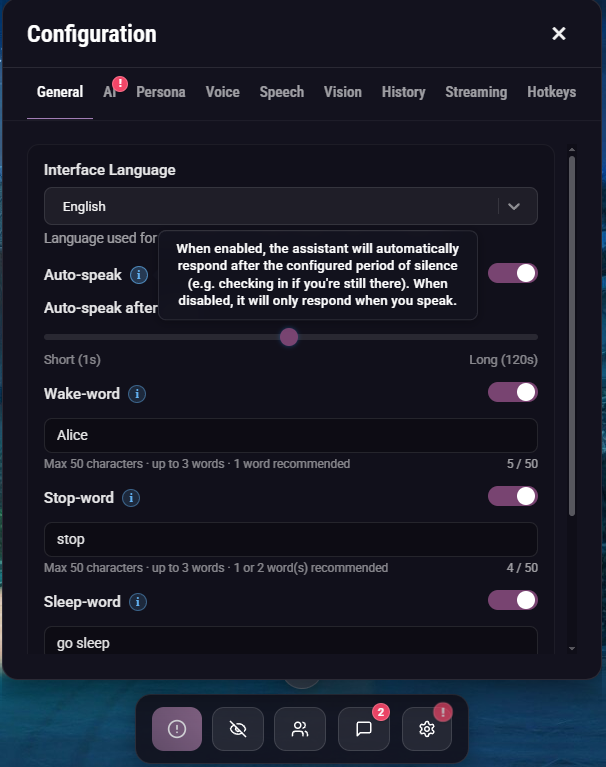
Actually there are two problems. First, Chinese isn't implemented as an input language in the app — Whisper somehow picks up what you say in Chinese and translates it into English on its own. And if I were to add Chinese as an input language, it would do the reverse: translate what you say in English into Chinese. Supporting two languages at the same time isn't possible at the moment (and probably won't be in the future).
Dokk75
Creator of
Recent community posts
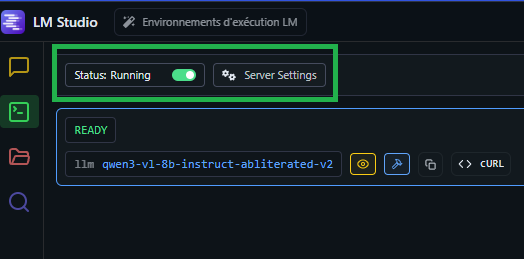
Oh I see — so I have a strip for <thinking> tags in the LM Studio connector, but it only works when both the opening and closing thinking tags are in the complete response, even though it's plugged in streaming mode. You can try increasing the response length to the max (600) in the AI tab so the full response includes both opening and closing thinking tags. Also, I'm a solo dev working on this — thanks again for the support!
Yes, you can talk to the AI — it has both voice and text modes. If you run the LLM locally (via LM Studio or Ollama), nothing leaves your computer; everything, including screenshots, is stored locally. If you use online APIs like Google Gemini, then your messages and screenshots are sent to their servers. Feel free to join the Discord and ask people who've been using it for months.
Hello and thank you for your support! To answer your questions:
- The 250-character limit in text mode is static, but I can definitely increase it.
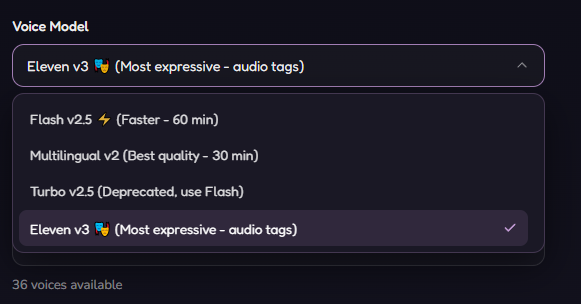
- Qwen3-TTS is a high-end TTS provider — the minimum requirement to use it is an RTX 4080+. That said, I just released a new update yesterday (v0.7.13) featuring OmniVoice, a new local voice cloning TTS provider with very good quality and performance. Join the Discord and check the #updates channel for more details!
- Simply use your itch.io email address — both work, but most people use the email address linked to their itch.io account.
Thank you! I actually spent quite a bit of time trying to implement Qwen3-TTS (which is genuinely impressive), but it requires a high-end NVIDIA GPU to achieve acceptable latency for real-time usage — on CPU, it takes around 30 seconds to generate just 3 seconds of audio. I'll hold off on adding it until a DirectML streaming solution becomes available.