There is no strategy; it's just buy anything as it becomes available. Could not detect any effect from "Personal Assistants". The second era appears to work exactly the same as the first. Various events happen but there's nothing you can do about them, so who cares.
The tutorial fails at the end of the first turn -- after attacking with Wildcats the dialogue advances directly to instructions for the second turn but does not allow clicking End Turn, so the second turn can't start.
I like this but it's got some problems -- mostly AI-UI trouble. I really like the simple graphics, but they're a little *too* simple; some buildings look very similar and most do not show what they do. All features and type are too small for me and there's no way to resize. Fixed-size, immovable report windows are a big UX drag, and they use too much space for what they're showing.
The goals are helpful for figuring out what to do next (and what you *can* do next) but sometimes leave you in the dark -- like when it told me I needed to grow tobacco there was still no Tobacco Plantation available to build and no way to find out what its requirements were. Eventually I caused something to happen so it showed up... but I still don't know what that was.
I got up to a decent population and then happiness started dropping. It turned out the citizens wanted cloth, which I had built two workshops for but those only had one worker each because the houses had all evolved to Settler and I didn't have enough Pioneers anymore. The auto-levelling housing is not a good idea -- it makes sense to build housing and then intentionally improve it; choosing to *prevent* it from improving -- and trying to build out enough total while blocking improvements on the right amount -- requires inside-out thinking.
Using warehouses as the outposts for territory expansion is sort of arbitrary and non-logical. If you're doing the sort of ruleset where territory is expanded by buildings, why wouldn't *all* buildings expand your territory? And then if all buildings do it, why bother about territory? Is there some game-economic benefit to restricting area that way? Or is it just a gratuitous constraint?
I couldn't find any information about the different terrains, so when Tobacco wouldn't build on the dark green inside my territory I had to guess that it might build on the light green, and then warehouse out to that. It worked! But I didn't need that warehouse.
And more or less finally, I didn't get any real sense of the citizens. It didn't seem like they were eating the food I was producing, and sometimes I hear they need more cloth or something but I don't know what they're doing with it. The citizens are just sort of a field-effect around all these buildings I'm putting down.
This is the kind of trouble that comes from AI-built systems. If you're a person building a game then you have ideas about little digital citizens and what they're like and what they're doing, and your idea starts from there and then elaborates the infrastructure and institutions around them. Your feeling about that is the idea that makes Civ III different from Populous or Warcraft. An AI "thinks" that a colonization game is like making resource buildings so here's a pattern of that, with no idea.
Just took a look again since the graphics update. I have to say, I could be the only person in the world to think this but I liked the look *much* better before. The new look is hard to read -- zoom out and the roads go invisible, zoom in and the background goes blurry -- and adds distraction instead of information. The old look had a few problems, like sprites going under labels, but it was clear about roads and coastlines and everything that matters. I don't need it to be hobbity and ochre for "immersion" -- that part is in my headbrain. But as I say, could be just me.
Yeah -- it would be unrealistic to try to make this more realistic. That being the case all you can do is make design decisions, and the ones you've made are perfectly valid. So, cool! It's a funny piece of work, and different from all the rest.
I like its crudity and simplicity but the red guy always comes around and gets me and I have no reason to think there's anything I can do to save myself.
Played the download version and found it easier to work. I was still usually lost though and never could find features that I know are supposed to be there. One thing happened in both plays that seemed weird: Fairly early I came (I think) to a hadron tree; shook it... and was then surrounded not by protons and neutrons but by He nuclei (as I recall...). That points to a bigger issue, that this is a game about particle physics without any physics. I acknowledge that mixing "realistic" scales and velocities and whatnot would be... tricky... and modeling interactions in this particle menagerie would be crazy. Just the same, it seems odd that electrons are wandering around among all these bare nuclei without organizing, and collecting loose individual quarks is *opposite* physics. I don't know what you do about this.
Another way to put it is that I've spent a couple hours with this, amassed maybe 180 types -- so just scratched the surface -- and my relationship to pions is the same as it's always been: I've heard of pions but don't know what the point of them is. What you've got here is attractive and partly great -- a game with a nuclides chart! -- and partly misses. From the point I've gotten to it would be hard for me to learn any more because I can't really do anything on purpose with my inventory, which itself has been collected mostly at random. Crafting is fun, but I've got 56 recipes (and where did I get them from again...? Are there more?), have done 40, and don't know how to get the pieces for the others. It would be dumb to shoehorn a quests mechanism or anything like that into this, but maybe a bit more causality would help organize the experience.
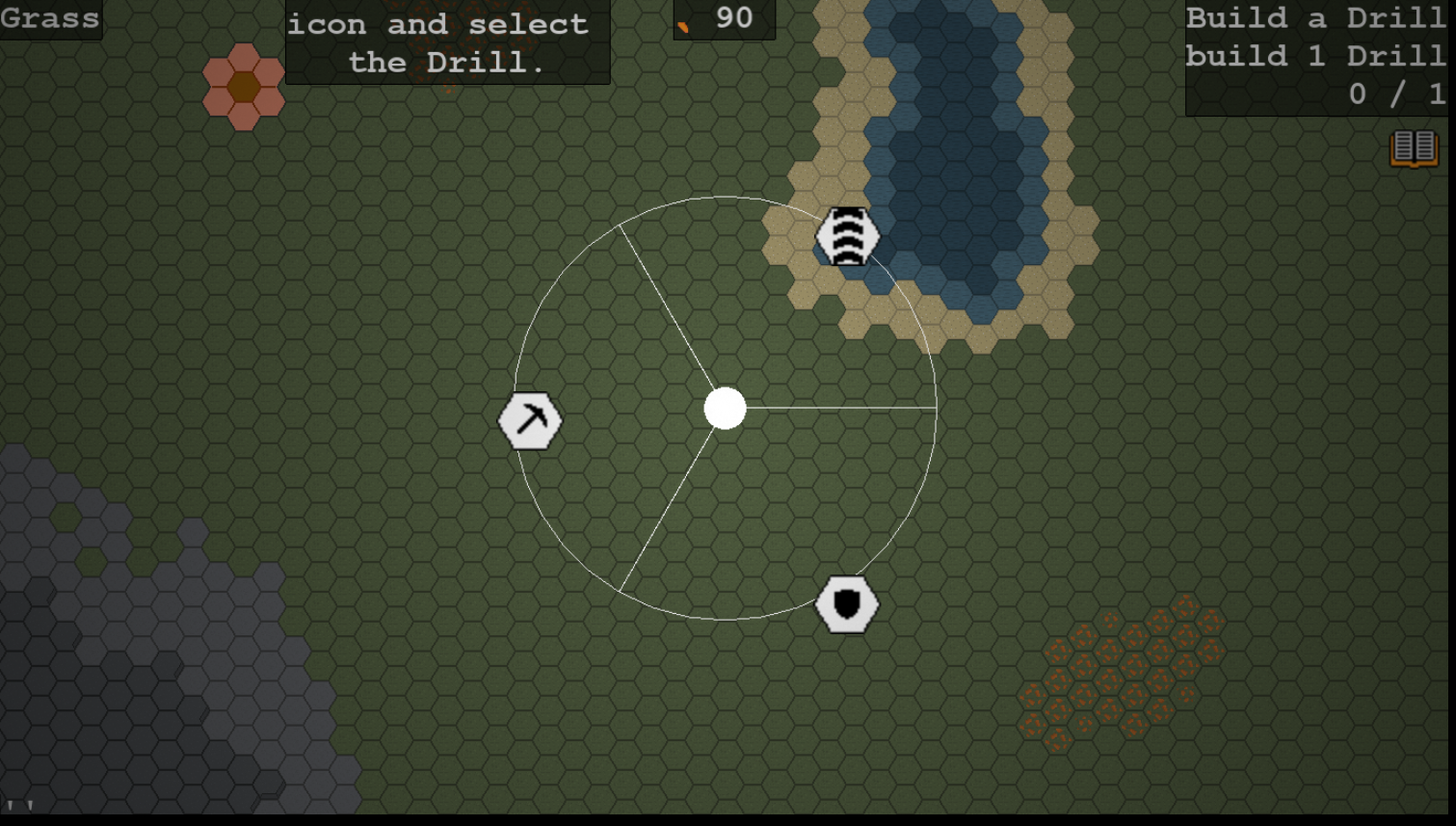
Seems interesting but can't play it as the UI is bollixed up; messages partly offscreen. Screenshot from the tutorial. What is the drill? The stack of chevrons pointing up?
The concept of "game" there does not work. Under "Gather" you can hunt, farm or mine, but mining doesn't work (I did buy the license for that so it should). You have to make a substantial investment to farm but it never makes sense to do that instead of hunting. Under "Empire" there are three things to purchase plus hire laborers; once you've bought them there is nothing more to do there. Under "Market" the one thing that makes sense is to sell meat in winter. The two things uner "Industrial" are both supposedly "under development" but your last update was 75 days ago -- and it's not like this is super-complex development. But hey -- what does work is "VIP Bank" where we can go to PayPal and... give you money for more gold? Why? At this point the only thing I can do with my gold is buy more warehouse space or hire infinite peons to hunt for me.
How is that a game? It's not even a thing. This is a partly functional HTML form. You should take it down.
Cool -- if you get it playable I'll probably play it a lot!
There seemed to be a lot of scrumble around horses, inventory and capacity. I thought I had figured out the mounting business but had a horse disappear when I unmounted it. When I bought a cart it threw my pack away -- why would I do that? Also in the trading screen if you select one of the greater numbers like 10 and want to hit it four times because the quest wants 40, it pops back to 1 every time you hit Buy -- leading to confusion and odd numbers.
This seems potentially great but suffers badly from vibe coding. I bought two horses; tutorial wants me to buy a horse and doesn't recognize that I've done that; I can't buy another horse because I'm a peon; I sell one horse and buy it back (at a loss); the tutorial is satisfied but my rebought horse never shows up again. Many things like that. Bad case of AI UI -- menus full of information but not rationally designed; flow from one choice to another or going back all messed up.
This seems like a cool idea but I can't manage to really get what's going on or how to do things on purpose. Competent steering is hard (for me anyway). Found and activated a synchrotron but couldn't figure out how to work it; seemed like I needed more inventory so I drove off collecting... but then I couldn't bring up the synchrotron anymore... did I need to be at it to work it? Went looking for it but couldn't find it again. Engaging landscape but I didn't get any sensation of compass direction or where things were relative to each other; I have no idea what path I've driven or what shape the world is or whether I could just drive straight indefinitely and eventually find everything. Found a shrine to Higgs; liked that idea. F and TAB sometimes did things and sometimes didn't; sometimes I could jump and other times not; what other controls are there? Couldn't tell. Got into a couple of dialogs/views that were hard to get back out of. Many different things happen and I can't tell which are phenomena and which are bugs. Liked the particle info cards. Everything suffers from that attractive-but-tiny text that seems to go with a lot of vibe-coded games these days.
Seems really interesting! Just needs better control (and information about controls). My two star rating is not bad -- three is my "perfectly okay game" and five hardly ever happens. I think most of my twos are something like "idea, but underdone", and the idea here seems good enough to be worth the effort of sorting it out.
So like the start menu has a Play Tutorial option... but it doesn't do anything; just goes back to the start. The inactive tabs in the nav bar (like Tech) are so dim they're invisible. There's (apparently) no Next Unit button. I had one warrior (?) unit start in the water. Why are the hex tiles overlapping instead of adjoining? Repeated terrain icons (and all the hex borders) clutter the map and make it hard to read. Just a lot of things that give the impression that you have not actually gone through and played the thing yourself from beginning to end and tested all the controls. Instead, maybe you just let a bot whip it up for you and decided it was done -- I don't know.
Hey -- Well, there it is; all the comments I've got are above. I don't have any deeper comments because the UI difficulties keep me from getting anywhere with it. The UX definitely has the smell of vibe-coding -- basically attractive but undesigned; unintended for humans. Seems like the kind of thing I'd enjoy... I just can't tell.
This is quite nice but it needs at least one more degree of complexity. As it is you learn a good sequence once and then that will work equally well on every map. Maybe add a layer of adjacency effects