I passed that on too!
If you have more suggestions, feel free to pop into the Discord, we have a whole section for that!
Workout streams sound like a good idea! I'll make a note of that suggestion.
Holiday events are not in yet, but will definitely be added eventually. We(the contributors) have been discussing all sorts of crazy ideas for them, and there's already a few bits sneaking through into the main game - there's cat ears and a tail you can buy now.
https://www.reddit.com/r/CourseOfTemptation/comments/18r44m7/could_someone_pleas...
We kind of forgot to mention that we have a reddit now XD
The uniform is: "esports jersey with white swirls", "F-K University sports bra"(if character has breasts), "Joggers", "Boyshorts"(if female), "Boxer-Briefs"(if male/nonbinary), and "Sneakers".
It should all already be put together for you in an outfit you can change into in your closet.
Edit: so we discovered that the joggers were bugged and were, uh.. assless. The uniform check was just making sure all parts were covered, and everyone was running around with their butts hanging out, so if the player wasn't wearing underwear the uniform check would fail. xD
It is a very silly bug but it will be fixed in the next update.
Could you give me some info on how you got Twine's "Save to Disk" and "Load to Disk" functions to work when the game is exported to an app via Monaca, or how to update the game so that saves carry over? I'm trying to export a Twine game to a APK and that's the only issue I am having - there's no way for save games to carry over to new versions.
After playing the game a bit more, I definitely agree that the more "obscure" sexualities are much better as inclinations.
High friendship before sexual relationship happening more than a few times = considering they might be demisexual, and high friendship before romance = demiromantic consideration. Genderfluid could work here too, with the player even toggling if they are presenting more masc or fem.
Also, can trans NPCs PLEASE PLEASE PLEASE reveal to you that they're trans once you become friends with them? I don't want the opportunity to "reject" them, the player can just stop talking to them if they want, but there is the very harmful trope that trans people are trying to "trick" people and this game kind of does that by you not finding out if someone is trans until you hook up with them. A quick, casual conversation where the player is just like "Okay, thank you for telling me!" would go a long way!
This is probably the best sandbox life sim game I've seen on Itch. I'm so happy with the non-binary inclusion, both for your character and NPCs.
There's really only two things I'd love to see! Maybe pansexual and demisexual/demiromantic identities? They're easy enough to roleplay, but it would be nice to see dialog involving them, just like the extra dialog that enby characters get! Sexuality is a spectrum in general, and it would be nice to see some more experimentation with that, especially in a setting where people are starting to open up and explore who they are maybe for the first time. The ability for sexuality and gender to change during the game would be great - actions that push the character one way or the other may trigger a "self-reflection" scene where the PC goes "I like feeling more masc/femme. Could I be trans?" or "I've never really felt this way about this gender.. could I be queer?" etc.
The second thing is I'd love an ability to choose a visual representation of our character or others - not any complicated pixel art or paper dolls, but just selecting a image file on our hard drive. We could do this at the start for the PC to assist in roleplaying a specific character, and do it for others to help remember who they are. These photos could then be displayed in their profile when we click on them. The possibility exists that we "unlock" this function by taking a picture of a character, too - with the concept being that the profile photo is the photo you took of them.
All in all, though, an absolutely fantastic game, I think it's already better than DoL.
Oh, whoops, I'd completely forgotten about this! It desperately needs reformatting and everything!
Three players seemed to be the sweet spot in playtesting. It works really well in Solo Play, especially after you've built up a series of characters, items, and NPCs so it feels more like a world. I had a lot of plans for this, including an additional board game format and a few preset themes, including Overwatch and RWBY. It would be fun to get back to!
Tomb Raider/Indiana Jones
Exploring ancient, crumbling ruins, full of traps and danger. This could work well as a "push your luck" game, where it's harder to heal and you're more seeing how many treasures(beacons) you can acquire before you escape or perish.
Jurassic Park
Abandoned structures, broken cages, dense jungles, and forgotten roads. The beacons could be generators, radio towers, etc - a mechanic where you had to visit them in a certain order might be good here, where you get parts from an equipment shed, restore the power, radio for help, repair a vehicle, and so on.
Your encounters would be dinosaurs, of course, possibly ranked by size/deadliness. A pack of raptors would be equivalent to a T-Rex, stuff like that.
Thank you! The whole thing was typed up in like an hour so I'll hopefully go back and reformat/expand it a bit later, because the doubles rule was me going "RPGs are usually all about the Impact of your actions, but these kind of stories often have chain reactions and interesting accidents.. what if something occasionally increased the Scope instead of the Impact?"
I like to think of it as echoes down a hallway alerting a distant enemy or a character lifting a weapon to strike and hitting the foe behind them that they didn't even see coming. Playful twists of fate, more or less.
Three ideas, all generally small, so I might do all of them!
Summer Slasher Movie, with the players trying to survive and discover the truth/a way to escape.
Battle Royale, where even if you die you can carry on as a different character.
Space Outlaws just trying to do jobs and get by.
I've also created various minor mechanics for these ideas, and I'll bundle those together as well and try to release that first so other people can use them if they want!
If you're asking "What is Charge about?", well, the answer is Charge is about whatever you want it to be. It's a RPG system that hits that wonderful sweet spot where it's both simple to use and adaptable to any setting. You could take the basic 12 actions and start up a game in five minutes, charge things up with the Momentum mechanic, add Talents and the Progression mechanics for longer campaigns, shake up your plot with World Forces.. Charge is a like a lego set, something that can be used to play a quick one-shot, a series of games, or even be built into your own, original world.
While other games might resist being hacked or fall apart once you start pulling on threads, Charge was CREATED to be modified. Change the names of actions! Make it so players have 3, 6, or 9 actions instead of 12! Create playbooks or character classes! Adjust dials so things are harder or easier! Grab a bunch of community-made Extras and throw them into your game, then make your own!
The whole point of this SRD is for you to copy it, rip it up, break it apart and reassemble it, and make it something that's unique to you and the story you want to tell - and there's a community willing to help you out, too.
If this game looks even the slightest bit interesting to you, pick it up - there's far more to it than meets the eye. It's not quite a board game, not quite a deduction game, not quite a storytelling RPG.. instead it's a crazy mix of all of those put together.
The rules are actually incredibly simple - everyone has the same list of basic actions, and no weapon is more powerful than any other. But the more you play, the more you see the deeper strategy behind everything. Your Secret card gives you special moves, yes, but it also influences your character's personality and relationship to others.. but it ALSO is something you want to keep hidden at first, because if someone else guesses your card, they get a bonus.
Which means that there's a Clue-like vibe to the game, where the cards that have been revealed provide a hint to what cards your opponents may be hiding..
And on top of EVERYTHING else is the superb roleplaying aspect, where you're encouraged to embrace the dark humor, bad puns, and the flamboyant, larger-than-life personalities of the genre.
OH, and did I mention that even after your character dies you influence the game as a ghost, wandering the mansion and spooking others.. and perhaps more?
AND the game even comes with suggestions on how to hack it into other settings, with multiple "Deceased playbooks" that describe different locations to kill and be killed in, some with special, interesting rules!
It's like the silliness and dark humor of the Clue movie with the secrets of Knifes Out meshed with the grandiosity of Vincent Price. It's absolutely amazing and I highly recommend it!
A good minimalist RPG is a lot like a good magic trick - it seems stylish and simplistic at first, it is only later that you realize that there's more than meets the eye.
Dividing a magician's skills into only a few stats is no easy feat, yet this game has and has done it well!
All that's required is 2d6, a few friends, and a impossible heist to pull off - and this game even suggests a few good ones, like pranking the Summer Olympics or taking a cross-country trip to steal cheese!
I suggest people try this out if they like Ocean's 11, Now You See Me, or just the idea of being cool thieves pulling off cool jobs.
**Reserved for Trait Examples**
Traits are a property of Specialized Assets which can add new options to the narrative. Like Situational Talents from the base SRD, they allow for certain actions at certain times, or describe what types of actions the asset can take.
It is recommended that Common items get 1-2 Traits, and Uncommon and Rare items get 2-3 Traits.
Following are the traits that I have written so far:
Automated: This asset can carry out basic actions without direct control, commands, or intervention.
Destructive: This asset can cause widespread damage, both to property and people. Examples: explosives, large animals or tools.
Durable: This asset is tougher than average, able to take several blows, dents, and impacts before it breaks.
Elemental(Type of Element): Branded with or has the ability to cause a single lasting elemental reaction. May blaze with fire, freeze at a touch, etc. When this Trait is chosen, indicate the type of element that's connected to the asset(ice, nature, fire, etc).
Extension: This asset is attached to the user, normally in a physical manner. It is not technically part of the user, but is instead an extension of their senses or abilities. It is relatively simple to detach and reattach at will.
Flexible: This asset lashes, entangles, trips, and binds.
Flight(Assisted): This asset has the ability to fly, but must have a individual guiding or controlling it. (Examples: Jetpacks, Hanggliders, Magic Amulets)
Flight(Personal): This asset has the ability, skills, and equipment necessary to freely fly though the air at will. (Examples: Birds, Hoverbots)
Heavy: Difficult to carry, but will have a greater impact. Hard to block, and will still have an effect even if the collision is deflected somewhat.
Holy: Has a religious significance. May cause those evil, demonic, or damned to flee at the sight of it. It may cause great harm to such creatures as well.
Integrated: This asset is physically or biologically part of the user. It can be considered a part of their own body, and cannot be detached without great difficulty and perhaps not without causing damage to the user.
Kitted(Type of Kit): This asset carries the tools and materials needed to accomplish a specific task. When this Trait is chosen, indicate the type of Kit this asset carries (Lockpicking, Hacking, First Aid, etc).
Linked: This asset is connected to the user magically or mentally. It can receive commands and execute orders with as little as a thought or a gesture. If this asset is injured or disrupted in some way, the damage may backlash to the user, causing pain or disorientation.
Medicinal: This asset creates/emits a substance, spell, or byproduct that can be used to heal others or sooth pain.
Piercing: This asset has the ability to stab, pin, or puncture objects or people. It can easily pierce thin materials and cause a large amount of damage to armor as well.
Protective: Defends the user. Deflects and mitigates damage. May possibly allow for disarming or bashing blows.
Ranged: Can make attacks or manipulate objects at a distance. Usually has an optimal range, beyond which will cause less damage or have less effect.
Rapid: This asset is faster than normal, able to rapidly accomplish actions, move at high speed, and swiftly attack.
Resistant(Type of resistance): This asset provides a firm of protection against something specific or a general environment and will alleviate or possibly even completely negate negative effects. When this Trait is chosen, choose what this asset resists(fire, biohazards, the cold void of space, etc).
Restricted: This asset is illegal in some way - either it is unlawful to own, or it is simply banned in certain areas, locations, or countries.
Secretive: This asset is small, disguised, easily hidden, or inconspicuous in some other way. It may possibly be masked from various means of detection, both magical and technological.
Sharp: May cause bleeding, deep cuts, or even server limbs. Can cause a massive amount of damage to biological material, and can chop and cut at harder substances as well.
Shining: Emits a bright light or glow, radiant enough to cover a small area or unleash brief, blinding flashes.
Shocking: Can create a shocking or electrical discharge. Can stun creatures and overload technology.
Stylish: Looks impressive and unique. Draws the eye and attracts attention.
Terrifying: This asset appears threatening or frightening.
Thrown: A collection of identical objects, made to be thrown, lobbed, or tossed for best effect. Usually has a short range, directly related to the user's strength and accuracy.
Venomous: This asset can inflict others with a lasting poison. Those inflicted will suffer deliberating effects, up to and possibly even including death.
**Hacking this Extra**
A few concepts were mentioned in the "Dials and Ideas" section above, but this Extra is meant to be highly modifiable and easily expanded. By adding more Traits or removing some of the ones below, a GM can make this fit into almost any genre. Because the Charge RPG offloads so much of the gameplay restrictions/openness onto the narrative, a few simple words or phrases added to the description of a Specialized Asset can do a lot of heavy lifting. For example:
- Adding a Type to an asset can be as simple as calling it a Weapon, Equipment, Companion, or Artifact. But what if you go deeper than that? You could call it a Melee or Ranged weapon right from the start. You could go deeper, and define if it is bladed or not. The basic generator for this Extra defines equipment as being Mechanical, Biological, or Ethereal, and also notes if it was Crafted, Grown, or Summoned. These terms have no effect on the rules or mechanics of the game, but the GM could use things like this to add flavor or restrictions.
- One could add Traits onto other Traits, if they wished to make things more complicated. "Ranged(Venomous)" could indicate the asset has a poisonous spit attack. "Secretive(Automated)" could mean the asset automatically cloaks when not in view or tends to stick to the shadows. Adding onto the "Kitted" Trait would indicate what type of kit the asset carries, sure as "Kitted(Medicinal)" being a first-aid kit or "Kitted(Elemental)" being a alchemist's kit. And of course, one could add on to the "Ranged" trait to state exactly what the range of an asset is, such as "Ranged(Short)", etc.
- By simplizing this Extra even more, a GM could stat out the basic weapons and equipment in the world. As an example:
Basic Pistol
Quality: Common - Starting Condition 4
Ability: You may damage this asset to gain a better effect for a personal roll.
Normally, this wouldn't be needed. A GM could just say "You have a pistol, so you have a better effect" and the item wouldn't even have to be noted beyond that. However, some players like having equipment with stats. This could also work well in a genre where equipment is scarce or hard to come by - in a post-apocalypse world, having a pistol could be all you need to end a dangerous situation quickly.
- One could allow Specialized Assets to be modified. For the example above, the basic pistol doesn't have a Boost or any Traits. Giving players a "baseline" version of equipment and then allowing them to customize it and find more parts for it would be perfect for some genres. If the player finds or crafts a "scope", the pistol could gain "You may damage this asset to gain +1d6 to a Shoot Action." If the player creates intricate carvings on a weapon, it now has the "Stylish" trait. Adding and removing Traits from assets is an easy way to show the nature of the player's journey and growing power.
- "Roloading" was created as a way for players to quickly restore the condition of an asset in the heat of battle or in the middle of the action. However, it may cause some confusion for some players, or players may want more versatility in their assets. If this is the case, the GM may consider making separate "Ammo/Charge" and "Condition" clocks for assets that need them. If so, "Ammo" would be what can be restored without downtime, and "Condition" would require downtime to repair/restore.
- To expand upon the notion of assets having multiple/separate clocks, I'm going to post a suggestion by Hobblin from the Fari Games Discord here. I do not think a GM should jump to this level of complexity immediately and I'm sure other Extras will come along that can represent this better than mine does, but if you wanted to use this Extra to have more complicated assets you could do the following:
"..it make sense that an asset can have a limited number of "resource slots" depending on the type of item. For each resource you have one skill to reset and one description of what happens when it runs out.
A magic sword has:
- Durability, resets with tinker, breaks when exhausted.
- Fire charges, resets with focus, stops being magic when exhausted.
An attack dog has:
- Trust, resets with Bond, stops listening to commands when exhausted.
- Energy, resets with Time, takes damage when exhausted.
- Health, resets with Tinker, dies when exhausted. And so on."
(Note: This more-or-less completely replaces my Personalized Weapons Extra, which is briefly touched on in the "Dials and Ideas" section of this Extra. There is also a basic generator for this Extra.)
# Specialized Assets
This Extra adds rules for creating permanent Assets that have various impacts on the game world.
## Differences from base SRD
In the Asset Extra, an Asset is described as something "that you can use as an alternative to pushing yourself or adding tension to a scene to get a bonus die when making an action roll." They are normally used to get "a +1d6 or increased effect on an action roll" and can be gotten through the Loot or Boon mechanic.
This Extra keeps the above, but also adds in a new type of Asset - "Specialized Assets". Specialized Assets are less generalized, usually only adding dice to specific action rolls, or allowing for many different functions as long as one pays a cost. One can still create a Specialized Asset from a Loot Roll or receive one as a Boon, but their more powerful nature requires careful thought by both the players and the GM to keep things from becoming too unbalanced.
## New Rules
When a Specialized Asset is created, the GM and the players should collaborate and assign to it the following properties:
A **Quality**, which is a 4-segment clock that represents the Condition of the asset.
A **Boost**, which is the primary power of the asset. This is normally adding 1d6 to a specific type of Action roll. The players and the GM should come up with a short phrase or term that identifies how this asset adds to that action roll, such as "Grappling Hook" if the asset adds to Move actions, or "Scoped" if the asset adds to Shoot actions.
A **Ability**, which is a weaker power of the asset. This is usually something along the lines of giving the player/an ally an increased effect on a roll, or giving the player/an ally a better position.
A **Repair Action**, which is the action a player needs to roll to repair the asset. Repairing items is detailed in the Attachment Extra.
One or more **Traits*, which, like Talents, are narrative modifiers that allow for certain actions at certain times, or describe what types of actions the asset can take.
If the asset is an item that can be reloaded, recharged, etc it is recommended to also choose a **Reload Action**. This is an action the player can take during the course of the campaign to quickly regain the Condition of the asset. For example, reloading a gun might be a Finesse action, channeling magic into a artifact might be a Focus action, and urging a companion to fight on might be a Command or Sway action. Due to this action taking place outside of Downtime, it would be less effective than a repair action.
A Reload Action would:
Partial Success: No Effect
Full Success: Repair one segment of the asset's Condition clock
Critical Success: Repair two segments of the asset's Condition clock
Note that this can only be done if it makes sense narratively. A Reload Action won't repair a broken or damaged item.
Optionally, additional properties may be assigned to the Specialized Asset, such as what type of item it is or even what abilities it might gain if "leveled up" in some manner. Examples for these have been created, and will be listed later on.
To use a Boost or Ability, the player must *damage* the asset. One does this by filling a segment of the asset's Quality clock.
Lastly, since Specialized Assets can be damaged, they can be assigned as Attachments to a character, which would allow the player to "break" the asset to cancel a consequence. Being used as a Attachment does not remove the normal boosts and abilities of the asset, in essence, it adds a new ability. However, once a Specialized Asset is broken, the boosts, abilities, etc. assigned to it can no longer be used.
## Dials and Ideas
To make Specialized Assets more interesting, they can come in different rarities. Common, everyday assets would still have a 4-segment clock for their Quality. Uncommon, hard-to-find items would have a 6-segment clock. Rare and unique items would have a 8-segment clock.
To add more flavor to boost or ability use, the GM may decide that certain functions of the asset may only be used if it is fully repaired, such as a magic sword only able to do one mighty blow before it has to recharge or an ally who is able to cast a powerful spell when they're fully rested. This could balance out an ability being a second "+1d6 to this type of action" power.
In a campaign setting where people normally craft their own weapons and equipment, it would make sense for the players to collaboratively create a starting Specialized Asset for each of them. It might be best for this starting asset to be of Common rarity, although Uncommon items could work for a more heroic campaign.
The boosts, abilities, and costs listed here are some of the most basic, common ones, but there's lots of other concepts that could work just as well. What about a Specialized Asset that had the ability to give the player a point of Momentum, but they had to damage the asset three times or break it altogether?
## Examples
[Add an example of collaborative creation here]
## Credits
Pretty much everyone in the Fari discord helped with ideas and with inspiring this Extra, but LynnJones, Nugat, and Hobblin were especially helpful.
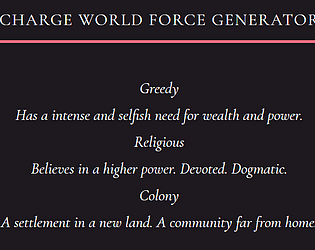
World Forces are a very interesting part of the Charge TTRPG, and I think every GM should use them. Unfortunately sometimes creativity fails even the best of GMs, or a game starts spontaneously with little time to prepare. There's also the issue of creating new World Forces when your old ones are disliked, defeated, or simply ignored by the players. And so, I've started to put together a generator. It uses Perchance, so you can freely look at the code and even edit it to create your own version.
The generator can be found here. It will generate three random words each time you use it, and each of those words has a short description to elaborate on their possible meaning and to assist with inspiration.
I will be updating the generator over time, adding more words and ideas as I think of them. Hopefully, I can eventually expand it to make a Goal and Method generator as well!
Following is a demonstration of the Generator!
Let's say I'm putting together a new campaign. I've decided that it's going to be set in the modern day, in a world where magic and monsters exist but are hidden, à la Supernatural or the Dresden Files. I'm going to to open the Generator, click randomize three times, and try to make a World Force out of each randomization.

This is a very good start. A world of secret mages and wizards needs a few secret bases, and a Ancient Rogue Tower fits perfectly. I'm going to say this is one of the first buildings in the city the players reside in, a landmark in the historical district that's been recently closed to tourists. A group of mages who refuse to follow the Order's increasingly dogmatic and rigid rules have taken up residence there, and are well-known in the secret parts of the city as people you can turn to when the law has failed you. Okay, next World Force!

Oh, wow. Now that's a World Force! Elemental makes me think of the four classic elements, fire, water, earth, and air. But how would that work with Deceased? Hmm.. Let's say one of the ways mages get their power is by drawing it from the elements, but when they do so, they have to destroy the element. So to use fire, a flame needs to be snuffed out. To use water, you must drain it from somewhere else. But where does an element go when it's used up? Enter Ungaia, a collection of every single wasted element. Over time, these adrift, formless entities have formed a singular consciousness, and it is not happy about being used without consent. I think we found our first big bad! Honestly, the whole idea of mages being attacked by "ghost flames" is really interesting to me. ..also, I noticed I misspelled "entity". Whoops. Okay, the last World Force!

This one almost writes itself. This could be one of two things - the "official" Order of Mages that our tower mages have separated from, or a new Megachurch in the city, the first one in the area. I think I'll go with the second one - a huge, money-loving church who believes that magic is evil and unholy is the perfect annoying World Force for the players to constantly run into and even have to take jobs from sometimes. After all, something that big and powerful will step on more than a few toes, and if the city already has well-established covens, packs, and clans..
Hello all! I've been a bit inspired lately, so I'm slowly putting together a new Extra for the Charge TTRPG.
This will be updated as I add new things. Feel free to post feedback, thoughts, or ideas on this!
Here's the official text so far. Words in [brackets] are my personal thoughts and notes.
Personal Weapons is an Extra that adds personalized weapons with various boosts, skills, and abilities to the world of the Charge RPG. Such weapons will be a major part of your game's fiction, as often these weapons are created with great passion and losing one is akin to losing a part of oneself.
Such a weapon is unique and may have been created by or heavily modified by your character. You may have trained with it or simply have an innate connection to it. At the very least your character has spent enough time with this weapon that they know every little thing about it - know how it is balanced, how strong it is, and any weaknesses it may have.
Your character's personal weapon will have two major things that make it unique: Boosts and Tags.
Boosts are things that modify the rules of the game. Boosts may allow you to roll extra dice, to resist consequence, gain advantages, and various other things.
Tags are things that modify the narrative of the game. Your weapon may be destructive, or armor piercing, or can change shape. These do not usually allow you to roll extra dice or anything of that sort, but they may adjust how your character approaches a problem or how they find a solution.
At the start of the game, your weapon will have one Boost and three Tags. Your weapon will gain more of both over time.
If your weapon is ever lost or damaged, you may spend Downtime to replace or repair it, as detailed in the Attachment Extra.
To create a personal weapon, first imagine it's general shape and type. Is it a huge blade, as long as you are tall? Is it a stylish sniper rifle, gleaming and catching the eye of all who see you? Perhaps it is something more exotic, like a sword that transforms into a bladed whip? Discuss ideas with your GM and fellow players, and look at the Tags for inspiration. Looking to media that frequently features unique weapons can also help. Both RWBY and Soul Calibur were influences on this Extra and might be a good place to start.
Once you have a good idea in mind, choose your first three Tags and your first Boost. These will represent your weapon's "base" state - what is most obvious about it, what someone could easily see on first glance. As your character grows in experience they will become more capable with their weapon, or they will modify their weapon to become more functional and effective.
The following are the base Boosts you may choose from:
[Adding examples of types of weapons for each Boost is a good idea and will be done soon.]
"When I use my personal weapon to make a Muscle action, I roll an extra die."
- choose this if your weapon is a large, heavy weapon that makes mighty blows, or if your weapon is reinforced enough to use as a wedge to force open doors and containers.
"When I use my personal weapon to make a Finesse action, I roll an extra die."
- choose this if your weapon is small and easily accessible, or if your weapon would often be used for stabbing and thrusting rather than for slicing and crushing.
"When I use my personal weapon to make a Move action, I roll an extra die."
- choose this if your weapon could easily be used to propel your character or to help them reach new locations, as in a whip, grabbling hook, or even the recoil of a shotgun blast.
"When I use my personal weapon to make a Stealth action, I roll an extra die."
- choose this if your weapon is subtle or unassuming, or if your weapon is particularly made to stay quiet and out of the way. A hidden blade at your wrist or a gun that is strapped to your shin are both examples of weapons that could assist with your stealth.
"When I use my personal weapon to make a Shoot action, I roll an extra die."
- choose this if your weapon is scoped, highly accurate, or is perfectly balanced for throwing.
"When I use my personal weapon to make a Tinker action, I roll an extra die."
- choose this if your weapon could be used as a common tool, or if provides extra kits, gadgets, and gizmos.
"When I use my personal weapon to make a Study action, I roll an extra die."
- choose this if your weapon has a rich and storied history, or if having your weapon nearby keeps your character calm and focused.
"When I use my personal weapon to make a Notice action, I roll an extra die."
- choose this if your weapon emits light, has a scope, or enhances your natural senses in other ways.
"When I use my personal weapon to make a Bond action, I roll an extra die."
- choose this if your weapon has a recognizable emblem or crest, or if your weapon has a unique, peculiar design.
"When I use my personal weapon to make a Command action, I roll an extra die."
- choose this if your weapon is flamboyant, impressive, or deadly-looking.
"When I use my personal weapon to make a Focus action, I roll an extra die."
- choose this if your weapon is magical or has a connection to another world.
"When I use my personal weapon to make a Sway action, I roll an extra die."
- choose this if your weapon requires great skill to wield, or is something that appears to be useless or impractical at first glance.
"When I use my personal weapon to make a Determination roll, I roll an extra die."
- choose this if your weapon can easily be used for defense, such as when using a shield or a parrying dagger.
Tags from the other Extra I'm working on, ported to this Extra:
Destructive: This item can cause widespread damage, both to property and people. Examples: explosives, large animals or tools.
Venomous: This item can inflict others with a lasting poison. Those inflicted will suffer deliberating effects, up to and possibly even including death.
Piercing: This item is made for stabbing, pinning, or puncturing. It can easily pierce thin materials and cause a large amount of damage to armor as well.
Shining: Emits a bright light or glow, radiant enough to cover a small area or unleash brief, blinding flashes.
Protective: Defends the user. Deflects and mitigates damage. May possibly allow for disarming or bashing blows.
Ranged: Can make attacks or manipulate objects at a distance. Usually has an optimal range, beyond which will cause less damage or have less effect.
Thrown: A collection of identical objects, made to be thrown, lobbed, or tossed for best effect. Usually has a short range, directly related to the user's strength and accuracy.
Heavy: Difficult to carry, but will have a greater effect. Hard to block, and will still have an effect even if the impact is deflected somewhat.
Sharp: May cause bleeding, deep cuts, or even server limbs. Can cause a massive amount of damage to biological material, and can chop and cut at harder substances as well.
Shocking: Can create a shocking or electrical discharge. Can stun creatures and overload technology.
Stylish: Looks impressive and unique. Draws the eye and attracts attention.
Holy: Has a religious significance. May cause those evil, demonic, or damned to flee at the sight of it. It may cause great harm to such creatures as well.
Elemental: Branded with or has the ability to cause a single lasting elemental reaction. May blaze with fire, freeze at a touch, etc.
Secretive: This item is small, disguised, easily hidden, or inconspicuous in some other way. It may possibly be masked from various means of detection, both magical and technological.
Personal Weapons are unique.. but just how unique are they? If you are playing in a setting where each player has created their own weapon from scratch or has heavily modified them, it may make sense to consider each personal weapon as "keyed". This means that if anyone besides the weapon's creator/wielder attempts to use it, the weapon will be much less effective than normal. This can easily be represented by the following:
- If a Personal Weapon is used by anyone besides the player who created it, the weapon is considered to have no Boosts. The weapon's Tags can still modify the narrative, but no dice rolls may be modified. Optionally if the GM considers the "borrowed" weapon to be similar in style, class, or category to the user's main weapon, they may allow the user to access the first Tag assigned to the weapon as well.