

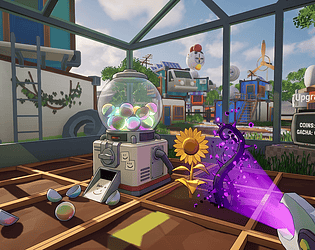

The game's art style is undoubtedly one of its core highlights, delivering outstanding visual appeal. It features cartoonish assets paired with watercolor-style backgrounds. This distinctive aesthetic choice not only gives the game a highly recognizable look but also perfectly aligns with its calming, healing, and eco-friendly tone, making it instantly soothing to the eye.
Alexhu258
8
Posts
A member registered Feb 11, 2024 · View creator page →
Creator of

Recent community posts
The core concept matches the climate theme exceptionally well. Playing as the owner of an indoor planting yard while dealing with environmental toxins and climate disasters perfectly captures the real-world issue of food peril. Using infographic animations to spread awareness makes the game's message both relevant and impactful. The gameplay loop sounds like it will be very interesting. Managing the garden by watering plants during the day and surviving unpredictable weather events at night creates a solid rhythm. Balancing the collection of fully grown food against the constant threat of consuming all your food storage adds a great layer of engaging survival strategy. While the foundation is strong, the game's innovation needs to be improved. The current mechanics, such as utilizing various plants and managing fertilizers with specific active days, are quite standard for the farming simulation genre. Introducing more experimental or unique mechanics would help the project stand out and feel completely new.
The gameplay loop is straightforward: explore, encounter an obstacle, discover a solution, and use that solution. This is a standard formula for point-and-click games. However, "The Last Seed" introduces the "Page Burning System," which slowly sections off portions of the screen as the player moves, adding a time pressure element to the exploration. This mechanic is a clever way to integrate the game's theme of complacency into the gameplay.
The core concept of the game is wonderfully straightforward, which makes the gameplay highly accessible and genuinely fun. It’s easy to pick up but keeps you engaged!
The pixel art style is incredibly cute and cohesive. All the visual elements blend perfectly together, creating a charming and relaxing atmosphere that fits the garden setting flawlessly. I love the direction you are taking with the environmental theme. As a small suggestion to further elevate the impact: if you want to strongly emphasize the "invasive species" concept, consider designing the monsters/enemies based on specific, real-world invasive species (like real-life invasive bugs or weeds). Grounding the enemies in reality would significantly boost the game's educational value and make your environmental message much more thought-provoking and inspiring for the players.
Ahn-Tar-tis’s Odyssey : The Battle for Zeta jam comments · Posted in Ahn-Tar-tis’s Odyssey : The Battle for Zeta jam comments
This project feels highly reliable and exceptionally well-conceived. The core concept aligns perfectly with the Climate Jam's theme, and it demonstrates a clear understanding of its target audience.
Theme & Educational Value Framing the gameplay around the exploration of a future ecological museum is a brilliant narrative choice. It provides a natural, immersive environment that effectively helps players absorb environmental knowledge. Instead of forcefully preaching to the player, the museum setting allows them to intuitively understand the complex cause-and-effect relationships within an ecosystem through observation and discovery.
Mechanics & Feasibility The core game mechanics—focusing on walking simulator elements paired with the "Echo Lens" mechanic—are elegantly simple. By keeping the mechanical complexity low and focusing on a few meaningful interactions, technical implementation should be very straightforward. This significantly reduces development bottlenecks and ensures the team can actually deliver the experience they pitched without being overwhelmed by technical debt.
Scope & Production Plan The project's scope is perfectly scaled for a Game Jam. The production plan is outstandingly detailed, providing clear sprint breakdowns, target features, and milestones. Most impressively, the inclusion of a concrete "Minimum Version" and a realistic "Cut If Needed" strategy shows a highly mature understanding of development constraints. This level of meticulous planning guarantees that the team can pivot safely if they run out of time, ensuring they submit a polished and complete game.
The entire project appears to be very interesting and highly inspiring. Allow players to engage in the act of selling seeds while also enabling them to effectively acquire some knowledge about seeds and agricultural environmental protection. The scope of the entire project appears to be very reliable. It seems like a project that can be completed within one month. The only drawback might be in innovating the mechanism for selling the seeds, distinguishing it from "good pizza great pizza".
Let players take on the role of a surviving farmer in the post-apocalyptic world of 2099, maintaining their livelihood by cultivating mutated plants. This core concept is very solid. However, the overall design to some extent relies on the existing framework of traditional survival games like "Don't Starve". Although concepts such as alchemy and plant mutation have been added, there are still some innovative mechanisms lacking in the core loop that could completely break the norm. Theme & Impact
This project perfectly aligns with the core demands of Climate Jam. The design document states that players need to use specific plants to withstand specific extreme weather conditions, such as using aloe vera to deal with extreme heat, or using switch grass to cope with strong winds. This design is highly inspiring. It ingeniously transforms the dry agricultural and climate knowledge into an interactive gameplay, allowing players to deeply understand the importance of plants in harsh natural environments as they manage the ecological system themselves. Scope
There is a great deal of doubt about whether this project can be completed on schedule. The document describes an extremely large and complex system network: including dynamic extreme weather systems with time limits, animal and plant combat mechanisms, alchemy variation systems, water consumption systems, and a player's own health/hunger management system. To master such strict algorithmic underpinnings, numerical balance, and resource economic systems within the extremely short development cycle of the Game Jam, it is a huge challenge for the team's technical implementation capabilities, and it is highly likely that the project will not be completed. Production Plan
Compared with the huge scale of the development, the current production plan of the project appears to be too hasty. The task decomposition lacks granularity. For instance, only broad descriptions such as "conceptualize the agricultural system" or "complete player movement and collision" are used to summarize the workload. Moreover, the team's preparation for risk control is insufficient. They merely mentioned "some gameplay mechanisms might be removed", but did not provide a clear priority list or a scope control strategy. Aesthetic
The team chose to present a post-apocalyptic world destroyed by global warming through colorful and slightly cartoonish pixel art. This contrast is extremely impressive. The document clearly designated "Stardew Valley" as the visual benchmark. If the art team can actually complete the drawing of all plant mutation forms and floor tiles (such as cracked soil, farmland, etc.) as planned, and the final effect can match the quality of "Stardew Valley", then the visual expressiveness of this game will be extremely excellent.