Indie game storeFree gamesFun gamesHorror games
Game developmentAssetsComics
SalesBundles
Jobs
TagsGame Engines

ajfirecracker

9
Posts
A member registered 5 days ago

Recent community posts

"It honestly feels like 80%+ of the card pool are either useless or actively detrimental to your ability to win."
I had the same initial impression but gradually more of the card pool opened up to me.

My picks for "Trash tier"
either Quartz
Ore that costs energy / wants lots of buffs
  (Quartz Ore is my pick for single worst card)
Treasure Map
Wrench

Semi-Trash
Upgraders not named Prospect/Lens
Axolotl, Pet Rock

Everything else I think is fine (or at least interesting to make work & feels good when you get there)

I think you'll find a wider range of cards than you realized are good for Prospect grinding (especially +Energy, buff targets & enablers), and many of the others can be built into viable decks that are not mostly about Prospect grinding.

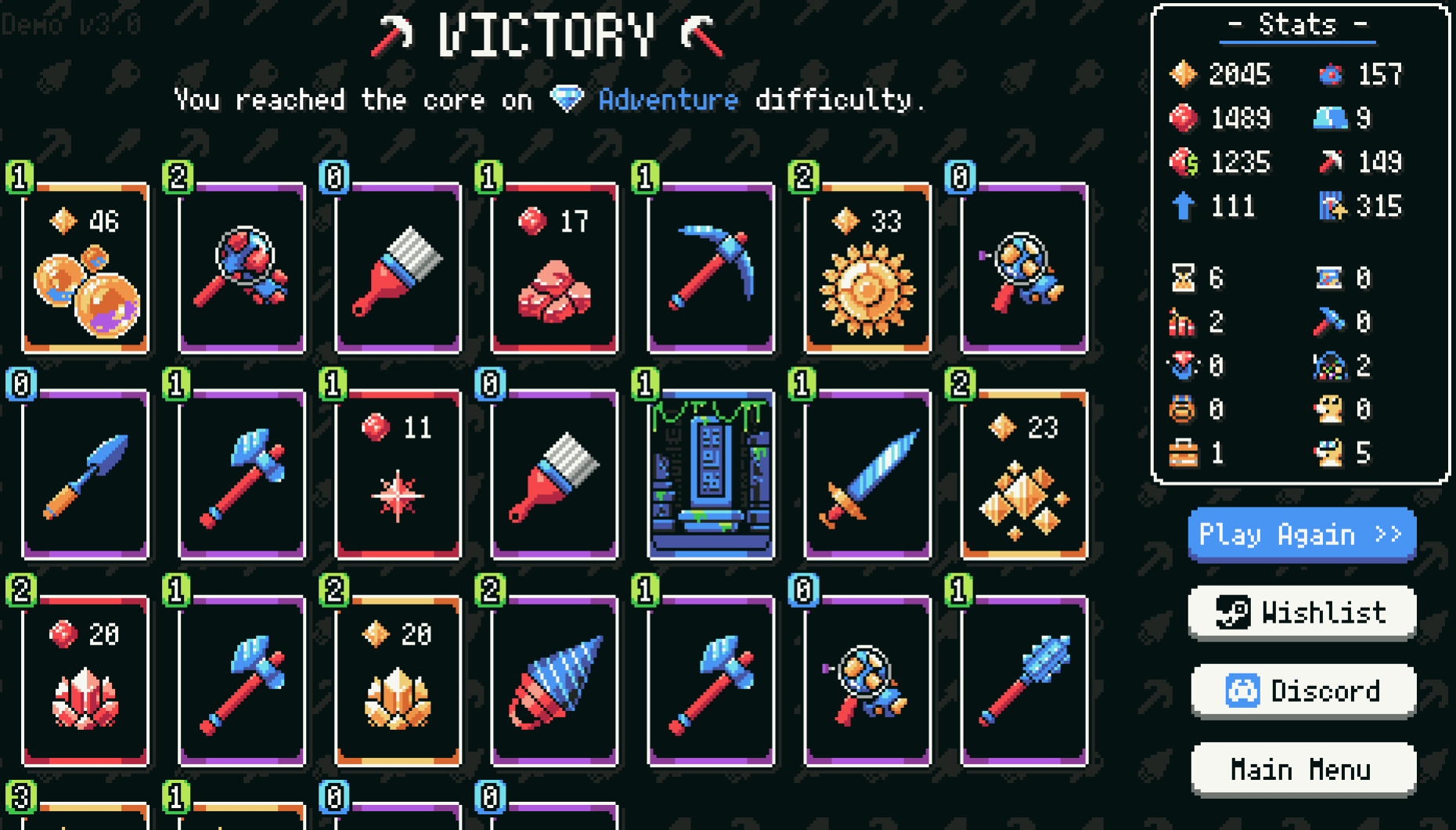
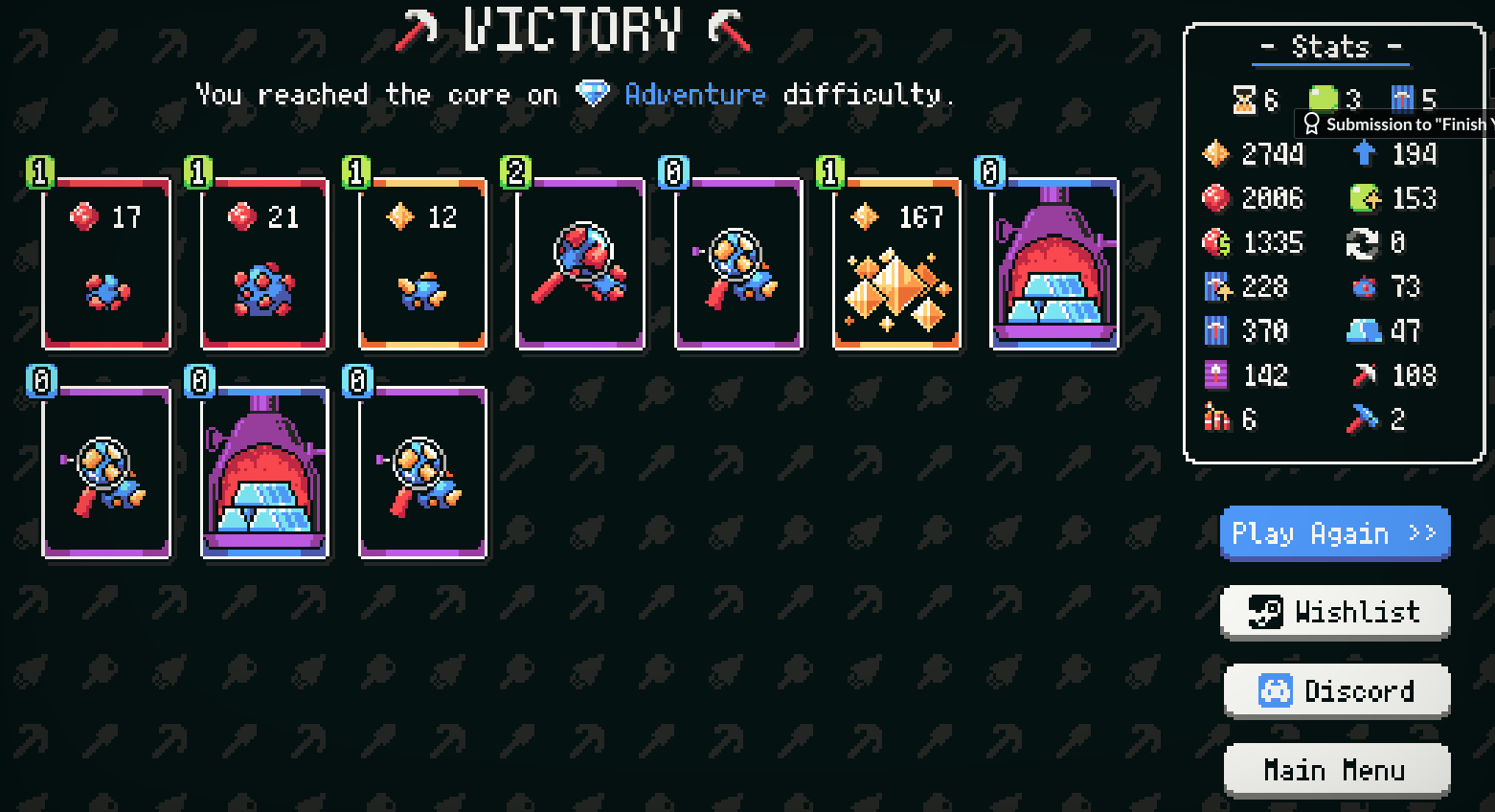
I'm not Capri but my biggest resource was a 167.

He's going Lens almost every turn + lots of Prospect along the way too.
You can see he ended the run with over 200 ore remaining, so probably a lot of that upgrading came during the final stage as well.

He has 6 cards that don't draw cards, so occasionally the minecart will be on the bottom and he doesn't get to play his whole deck.
But usually he'll have the option to play the whole thing each turn.
So once he finishes the final stage score he has the option to go "draw whole deck, play Ore, Prospect Scorium" to run up the numbers for the screenshot.
Maybe he will reply but I would guess something like 15 or 18 of the buff points came from the final stage, and probably 12 in the stage before.
Once you get the deck very streamlined you can strongly accelerate the size of the resources because you can buff your best one (and play it if needed) every turn.

Will do - thanks for the reply.
It's good to know you've seen it.

(6 edits)

I have a long post below talking about card balance and strategy.
I will write a long post here about the systems / design of the game.

Prospect:
The most consistent strategy I've found so far (see my long post below) is to rely heavily on Prospect, buy useful cantrips like Ingot or Lens, buy a very small number of enabler cards like Amber(s) or The Creature and nothing else.
Unless I'm trying to make a build work just for the fun of experimentation I am ignoring the vast majority of non-cantrip cards as well as the expensive minerals.
I think starting with Prospect in the deck pushes me in this direction.
If my 10th special card were randomized from a special pool of unique starter cards (or maybe I get to pick 1 of 3 which are drawn from a larger random pool), it would be fine for Prospect to power a very consistent strategy, because I wouldn't always get the Prospect to use.
I think it would be more interesting if my special starter card has different synergies depending on which one I get and which pushes me in different directions in terms of shopping and how I play my turns right from the start.
If I get Prospect every run it has to be powerful enough to really make a difference, but this risks it becoming the entire focal point of the game.
If I don't get it every run it's fine to warp certain runs around it because I have plenty of other runs that are about other things.

Re-rolls:
I didn't even see the re-roll shop button for the first few runs.
I think it should be a large icon in the row with the cards.
Even after I saw it, I almost never use it because it's just too expensive.
I think it should have a fixed and mounting cost within each shop visit (maybe 5 -> 10 -> 15 etc) so that it's tempting to re-roll a bit but you might not find anything and it's expensive to re-roll a lot digging for particular cards.
It's also nice if I get to feel rich later in the game when I am rich.
If you scale up the costs of almost *everything* I never get to really feel rich.
Maybe the cards scale up more in cost than they do at present but the re-roll stays cheap. (edit: as depth increases)
The high cost of re-rolling contributes to my "no synergy" Prospect approach, since I know it's very risky to take cards early on that will require specific synergy later.
If I post a victory screenshot and it shows re-rolls it's usually because I was about to start The Core and there's no more reason to save Ore, so I might as well roll for Helmet, Scorium Geode, etc.

Shop presentation:
I really like the way that the shop gives 1 random Ore and 1 random Scorium.
I apologize if this is already the case & I just didn't realize, but I think it would be nice if the shop had "slots" for Tool and Action plus a wild slot that could be anything.
If certain cards are really unique or powerful maybe they only show up in that wild slot so they don't appear too often.
(Edit: Also if re-rolls are cheaper you don't need to give so many slots of Shop).

Utilities:
The utilities all scale up in cost.
For Hourglass as you get more Hourglasses probably there's some diminishing returns, but it's such a powerful effect and I get so few that I don't think this is a problem at all.
I think 350->999 is pretty steep and it's more interesting at like 500.
If you just want it to max out at 350 then just don't give me the option to buy it again at all. (edit: maybe it says SOLD OUT instead of a price)
Showing Hourglass at 999 when that's not intended to really be an option is kind of spiteful.
For Dynamite it's not a super powerful effect but the value scales up as you get more (first you eliminate 10% of your chaff, then 11.1% then 12.5% etc)
For Hammer, though, the value scales down (the buff is a smaller and smaller proportion of the value of the deck; initially I have 3 energy twice on 5-point cards so 30 points and the 3-point Hammer is 10%; quickly this reduces to negligible).
In most builds I could play, I'm taking the 15-cost Hammer on my best Ore for early economy, then I'm only ever touching Hammer again if I'm rich or I really need to buff a particular card.
I think it would be more interesting if Hammer was at a fixed cost (maybe 20) and its declining usefulness came from the fact that it's a smaller and smaller % contribution to the deck's power.
A fixed-cost Hammer would also reduce the reliance on Prospect for upgrading cards.
(Edit: also you might consider allowing multiple Hammer uses in a single shop visit similar to what I'm proposing for re-rolls, either at a fixed cost or an increasing cost within that 1 visit, ie 20->30->40 but then if you come visit the shop at the next Depth it's 20 again).

UI
Maybe I'm just dumb, but it took me a lot of runs to understand the Depth and Hourglass icons.
I was surprised for a while that I kept getting extra turns until I figured out that 0 counts as a turn, so the hourglass icon on the HUD is how many extra turns you have not counting the current turn (rather than how many total turns you have counting the current one). This might just be my fault - you have to do it one way or the other and either can be interpreted wrongly.
When shopping it wasn't always clear to me what depth I'm about to start.
Unless I'm mistaken I think it shows the depth of the level I just beat rather than the one I'm about to start, so when a run was going really smoothly and I wasn't thinking about depth sometimes I was surprised to start The Core.
We also go from fight to shopping without seeing the world map (which saves a screen compared to doing map both before and after).
I think if the a certain depth is map -> shop -> fight I get all the relevant information when I need it  in the same number of screens as current at the cost of the flavor hit of separating the map and the expedition.
I would much rather be told to prepare for a certain flavor of level with a certain score goal then do my shopping.
Maybe I can check the map from the shop screen?
(Edit: maybe the go-to-fight button has the difficulty icon from the map screen?)
I think the Hourglass icon and Depth icon are kind of in conflict (assuming I've remembered and interpreted them correctly). The turn counter shows how many future turns I have, while the depth counter shows my previous depth.

Edited to add:
Another thing - I think it would be cool to track "overkill" on level score so I can see that I did 250/225 or whatever.
Even if this isn't tied to any reward in the game, it feels good to see how powerful my Scorium is getting.
Right now my major power fantasy reward is from making lots of Ore but not really from making lots of Scorium.
"Woah, I've got 500 Ore to spend, that's crazy" feels really good.
"Woah my Huge Scorium beat that level in only 3 turns" feels good but there's not a lot of gradation of experience, especially once you get good at the game and something like that is a routine event.
It's also helpful to the player to know exactly how strong he is, but that's quite secondary IMO; the player needs to be challenged so not everything that helps him is the right design.

I think the Geode cards are balanced by low ore cost in the shop.
I consider Scorium Geode generally a higher buy than Helmet for this reason.

I've had poor results with Quartz due to the blocked draws.
I've won (on Adventure) with pumping Scorium Quartz as my main strategy but it felt more like I was winning despite the Quartz than because of it.

I've tried Cave Cat and never won with it. I think generally anything that costs 2+ has to be pretty bonkers to be viable. Cat can get large but if you're pumping your deck full of random junk to make it happen then you draw the Cat less often.

I think Lens & Prospect pretty much cover upgrades & I don't buy any of the other upgraders unless I have some unusual build that really needs them.

I've had great success with the upgrade-heavy small-deck style.

If you scroll down to my long post you'll see a winning run on Adventure with a Scorium Amber as my only purchase, and several other variations powered almost purely by Prospect.

Prospect usage:
Focus your Prospects on 1-2 cards of each resource as much as possible rather than splitting them around.
Do use Prospect to buff both resource types.
Do buff your starting resources; I am typically leaving the opening expedition with one buff on one Ore and on one Scorium.
Early on you want to prioritize using Prospect again on your already-buffed cards over actually playing multiple buffed cards, unless you're going to miss a Scorium goal or you're trying to hit a particular Ore threshold (like 50 for the first Hourglass).
Do consider moves like Prospecting one resource card but playing a different resource.
Do focus buffs on special resources (in your screenshot that Geode should be at 10 and once you get 1 Scorium Pandorite almost all the buffs should be on it).

Shopping:
I very rarely re-roll the shop.
I like the 15-cost Hammer early on my most-buffed Ore but I'm not taking further Hammers unless I have a specific reason or I'm mega-rich.
I take as many as I can get (in roughly this order) of Hourglass, Lens, Ingot (until the last few rounds), Dynamite, Brush & both Geodes (but only once the Geodes I already have are buffed to 10).
If I'm rich or struggling for Score or starting Day 10, I consider Helmet.
I'm also looking for a few build-defining cards like either Amber, Scorium Pandorite, Scorium Meteorite, Smelt or The Creature. I don't necessarily take more than 1 copy of any of these and usually my build will end up with 1-2 total of these cards.
I often end with a deck that is effectively 5-7 cards plus however many cards I can play for free and which replace themselves (like Ingot and Lens).

Mineshaft isn't ideal for this style of build but as an effectively 10/10 mineral that *might* turn into a self-replacer it's worth considering also. It provides good economy early in the run so if you're running out of steam in the middle turns a 1st or 2nd shop Mineshaft might help.

Unless I'm deliberately trying to make some other build work I'm generally not taking any cards except the ones I just listed. Instead, almost all my money is going into Hourglass, Dynamite and cards that replace themselves for free while giving some benefit along the way.

The fewer non-replacers you buy the smaller your effective deck and the more money you have for Hourglass/Dynamite, both of which will mean you get to Prospect more often.

I basically start the game Prospecting every other turn and often by midgame I am able to Prospect every turn. It only takes a few combats of putting out +18 upgrades to get a couple of resource cards very large.

Again, I do think it's fine to have stronger and weaker cards/strategies.

If you wanted to even out the overall power level (while leaving some things stronger and weaker depending on the situation)

These are the changes I would test:
Axolotl - current effect + draws 1 card
Screwdriver - cost 0 energy for current effect
Corkscrew - cost 3 energy but gives an absurdly large buff, like +7 or +10
Aquifer - current effect + if you only have minerals in hand +2 energy
Jebroa - cost 0 energy, give a random resource +3 (or even +4) then discard a random resource
Scorium Pandorite - (but not Ore Pandorite) either current effect + cost 2 energy or at least current effect + premium price in shop.
Katzite - cost 2 energy + gives bonus equal to its own resource value for each prior mineral (so you can scale the bonus).
Ingot - current card + premium price in shop
Amber - current effect + cannot be upgraded beyond 30
Cave Cat - current card + cheap pricing in shop
Compass - current card + cheap pricing in shop
Pet Mole - current card + cheap pricing in shop

Hello! Thank you for making this Mr. ccdg; I've tried it this weekend & had great fun exploring your game.

I've only tried Adventure difficulty so far, and I've gotten to the point where I can almost always win.
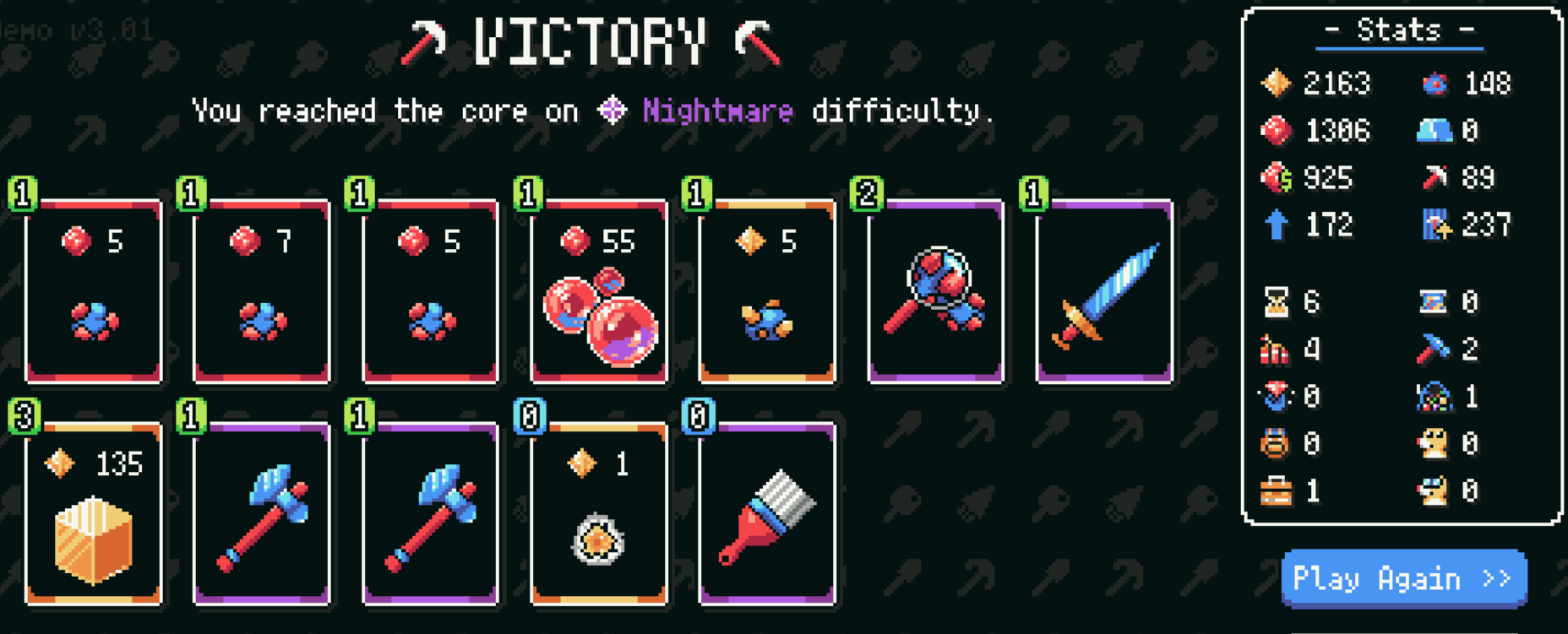
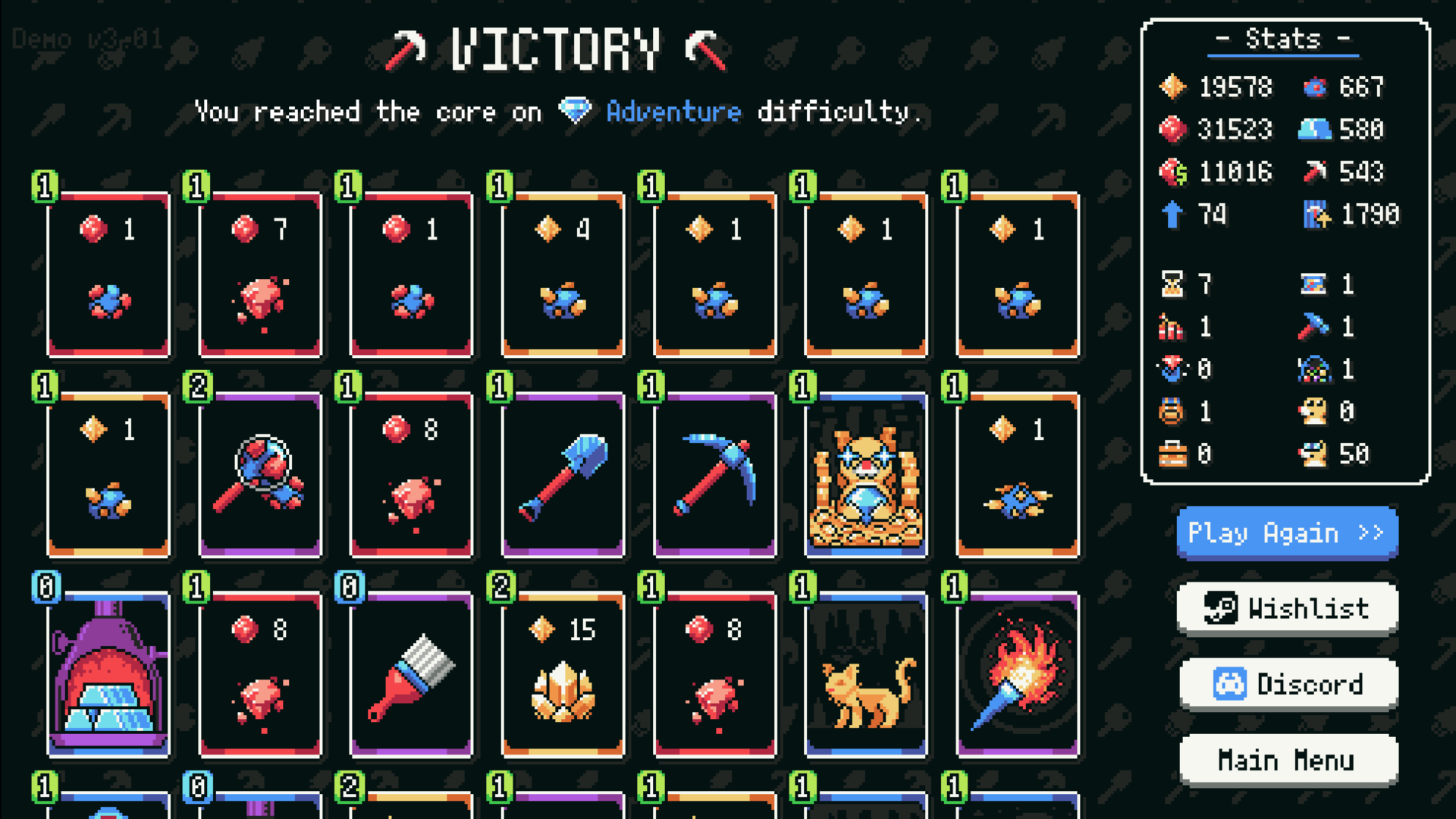
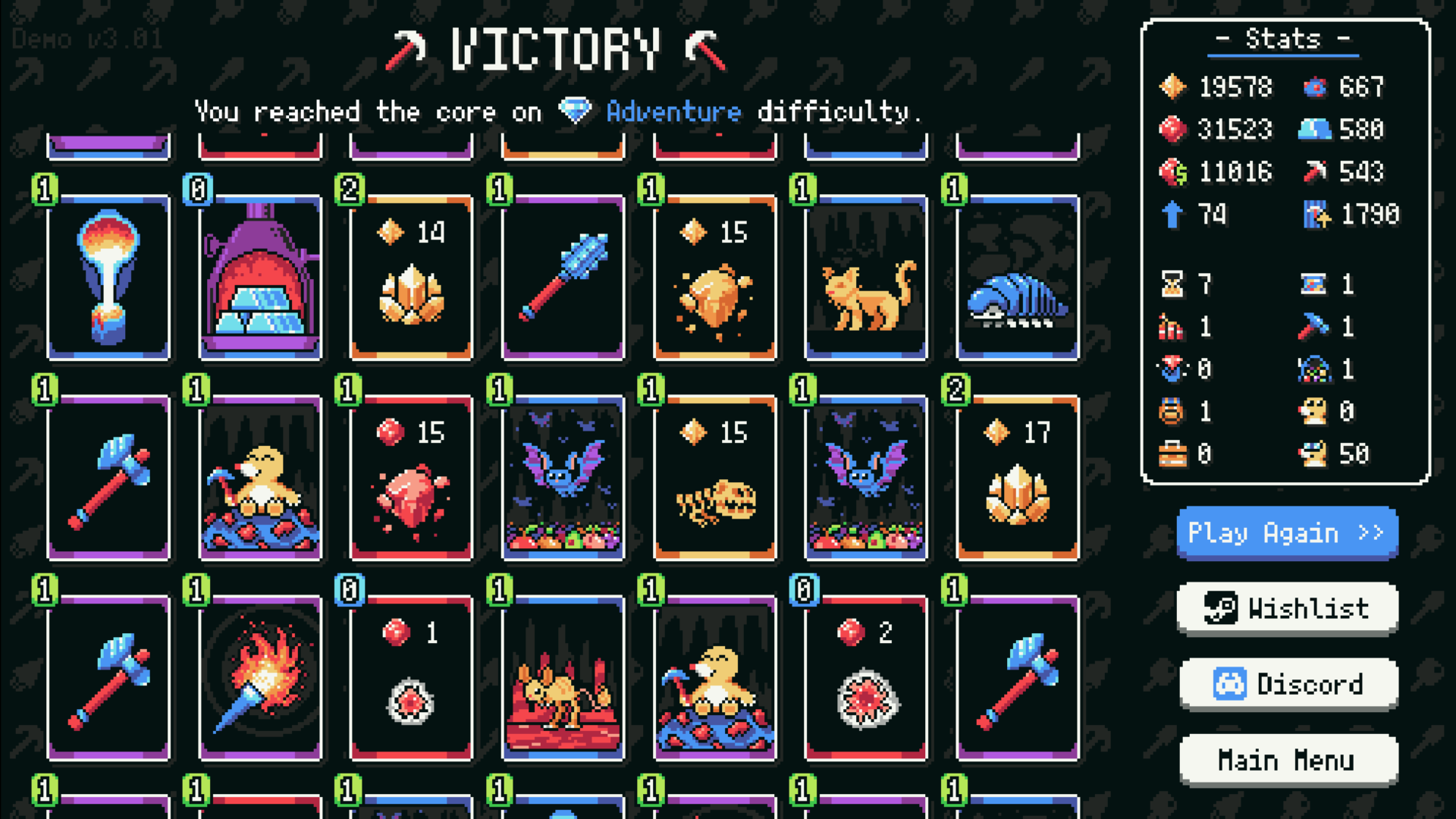
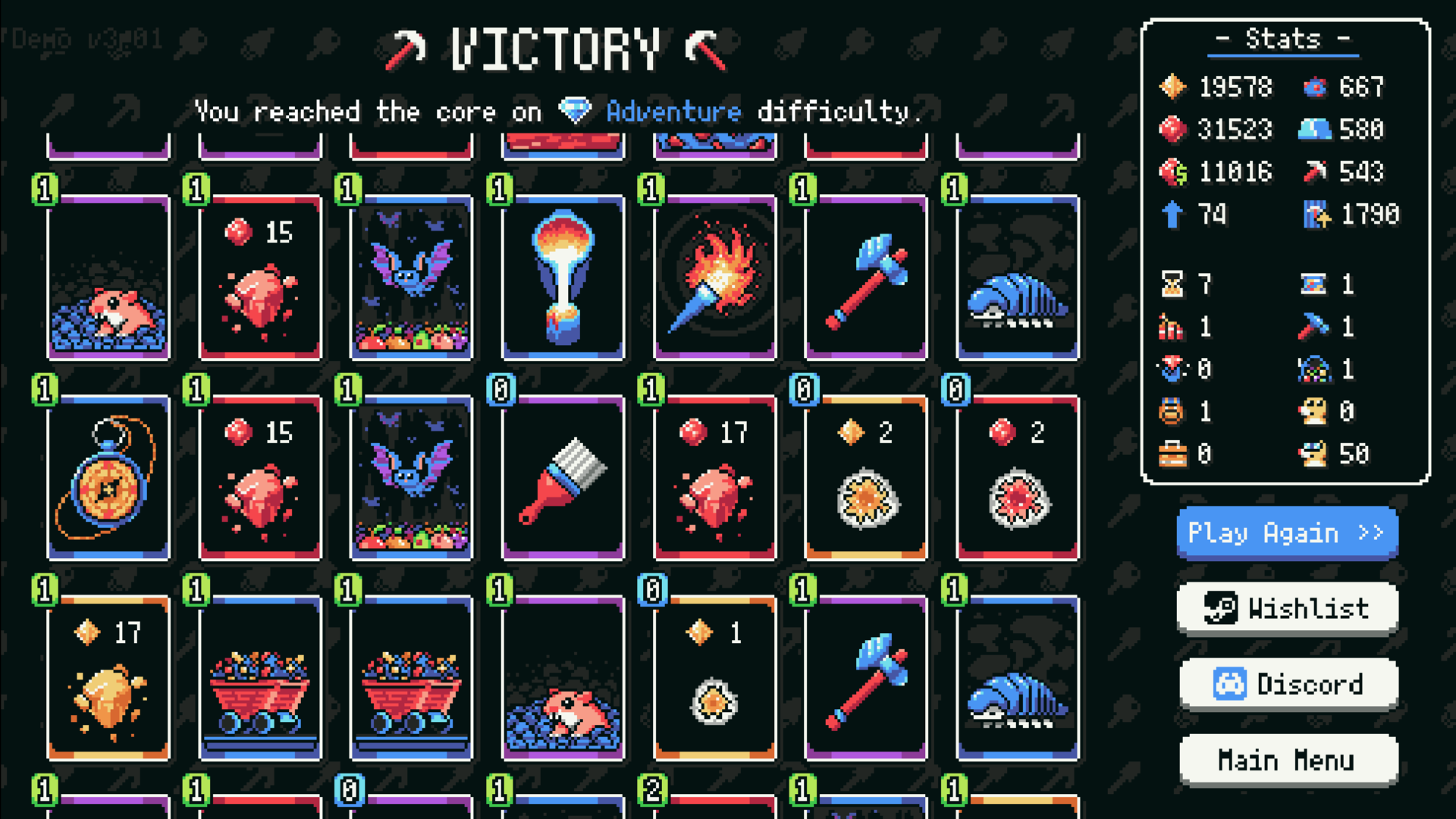
I'll post some screen shots below to discuss.

My thoughts on the game as it stands now...
I am not necessarily advocating for any nerfs or buffs.
I think it's fine to have stronger and weaker cards/strategies.

The zero-cost cantrips (Helmet, Ingot, Geodes, Brush and Lens) are quite strong and can go in basically any deck. If I don't have any direction yet or I have a completed build these can be close to auto-purchase for me.
Ingot in particular guarantees good ore economy while asking very little of me in terms of deck construction or game actions (unlike say Ore Geode where I have to upgrade it or the tools where I might not always have the right mineral in hand).

You start the game essentially flooded on cards with insufficient energy to play everthing. This makes the card draw less than stellar, and it seems you really need to assemble some sort of synergy (like Sword or Mineshaft) to justify investing in card draw.

I've had very poor results with most things that cost 2 or more energy, including the Cat, Corkscrew, Drill and the expensive minerals. I think the culprit here is what I was just discussing with card draw - you start the game essentially flooded on cards and choked on energy. If you need special synergy (like expensive minerals + tools to mine them for you) you run the risk of not finding the cards at all plus the risk of failing to draw the right combination of cards.

I've tried several times to use the sits-in-your-hand minerals (that give you half the value and are retained across turns, sorry I forgot the name). Blocking a draw slot is such bad celerity that I've never had this look promising.

I've generally had bad results with the upgrade tools other than Prospect/Lens. I don't think there's anything objectively wrong with Screwdriver, Corkscrew, Aquifer or Jebroa but the fact that I already start with Prospect and it's already so energy-hungry makes it hard to justify other upgraders. If I'm building a big deck (so Prospect is lost in the shuffle and I might like to have other upgraders) probably I'm looking to spend resources on other things like Shield or Cat and I'm going to run into situations where I upgrade something and don't get to play it that turn.

Axolotl is my pick for the weakest card.
Early on you shouldn't really need +Scorium and later on the card typing (no mineral synergies) and lack of scaling are issues.

***
On to some results (with screenshots)

I think the starting deck is close to winning.
My opening plan is to Prospect both ore and score, trying to get one or two of each large while I dynamite the rest of my starting minerals throughout the game.
If I can get an early The Creature, any Amber, Scorium Meteorite or Scorium Pandorite (which cover in various ways the heavy energy cost of Prospect) I consider that a complete build (or close to it) from a single purchase.
I haven't played around much with pure Smelt but perhaps that's sufficient to make the starting deck winning also.

Prospect:
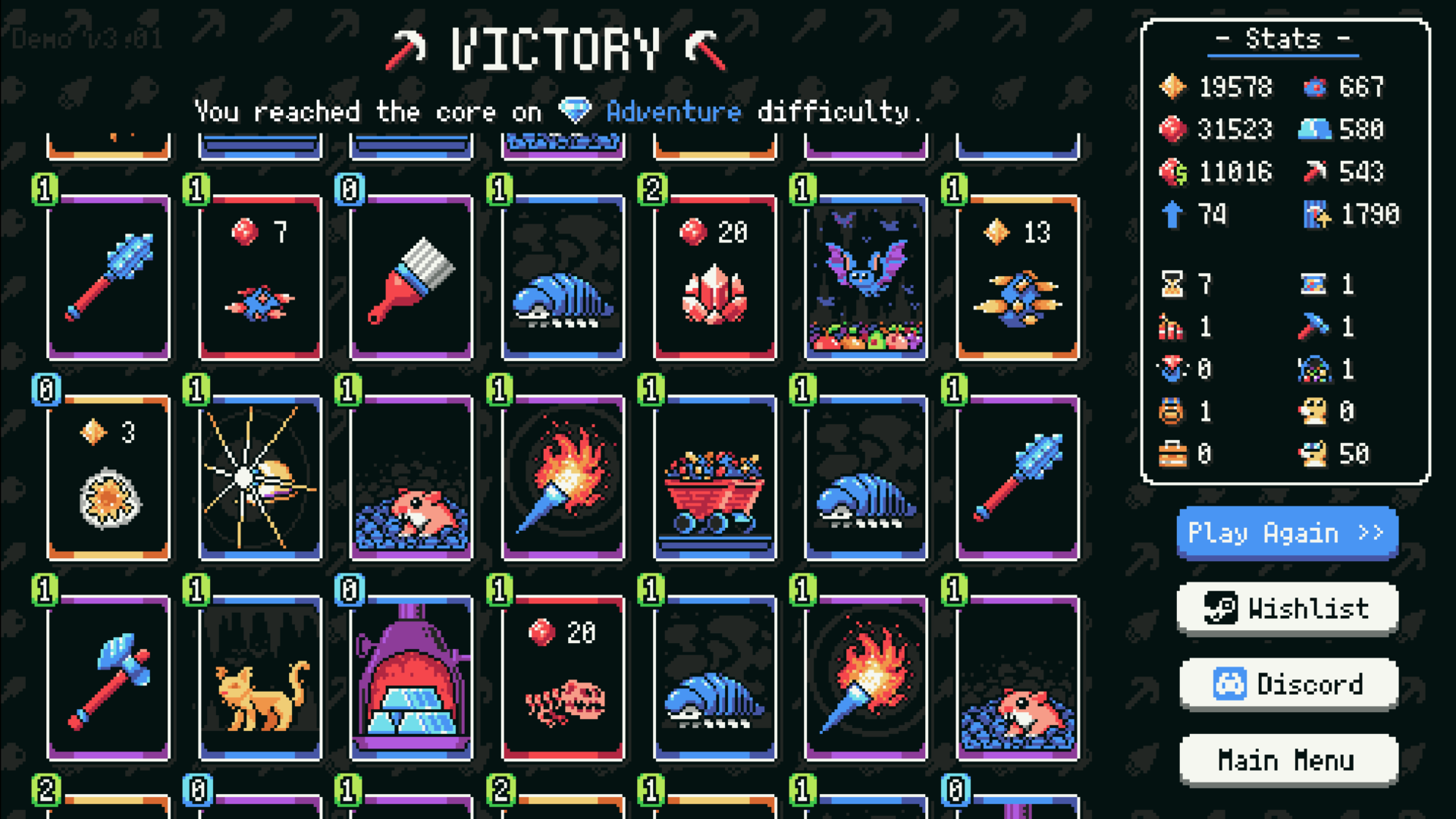
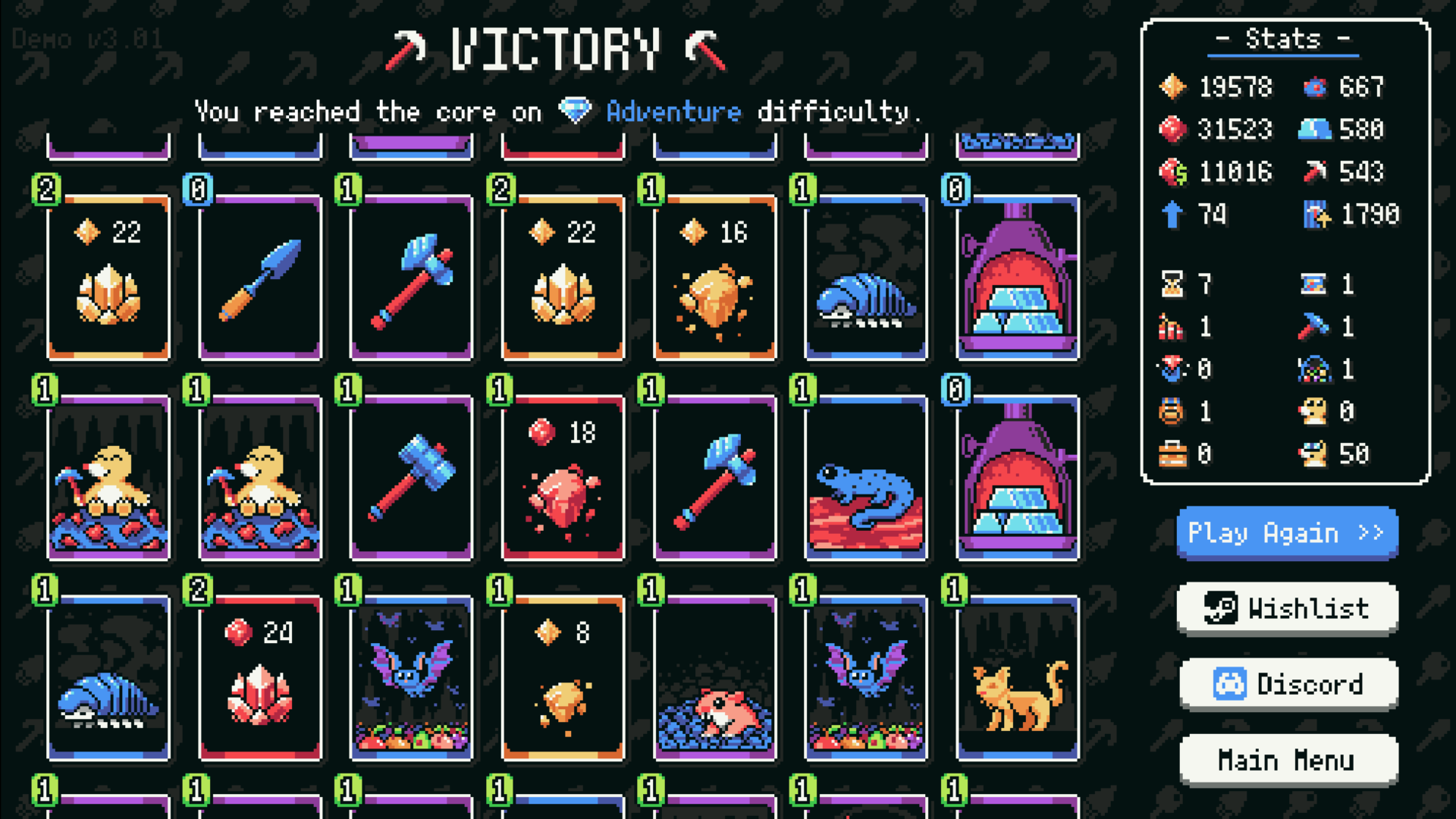
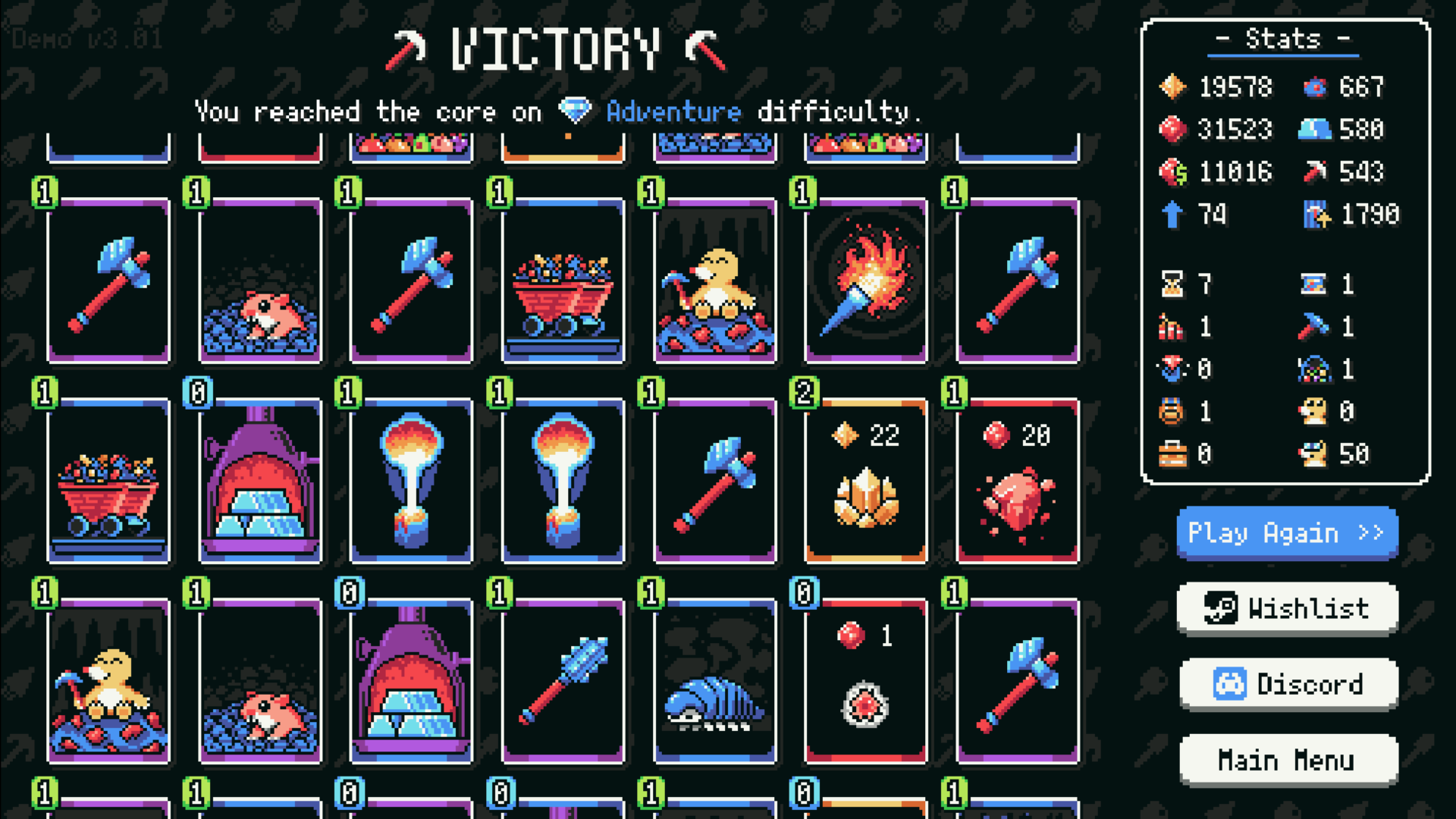
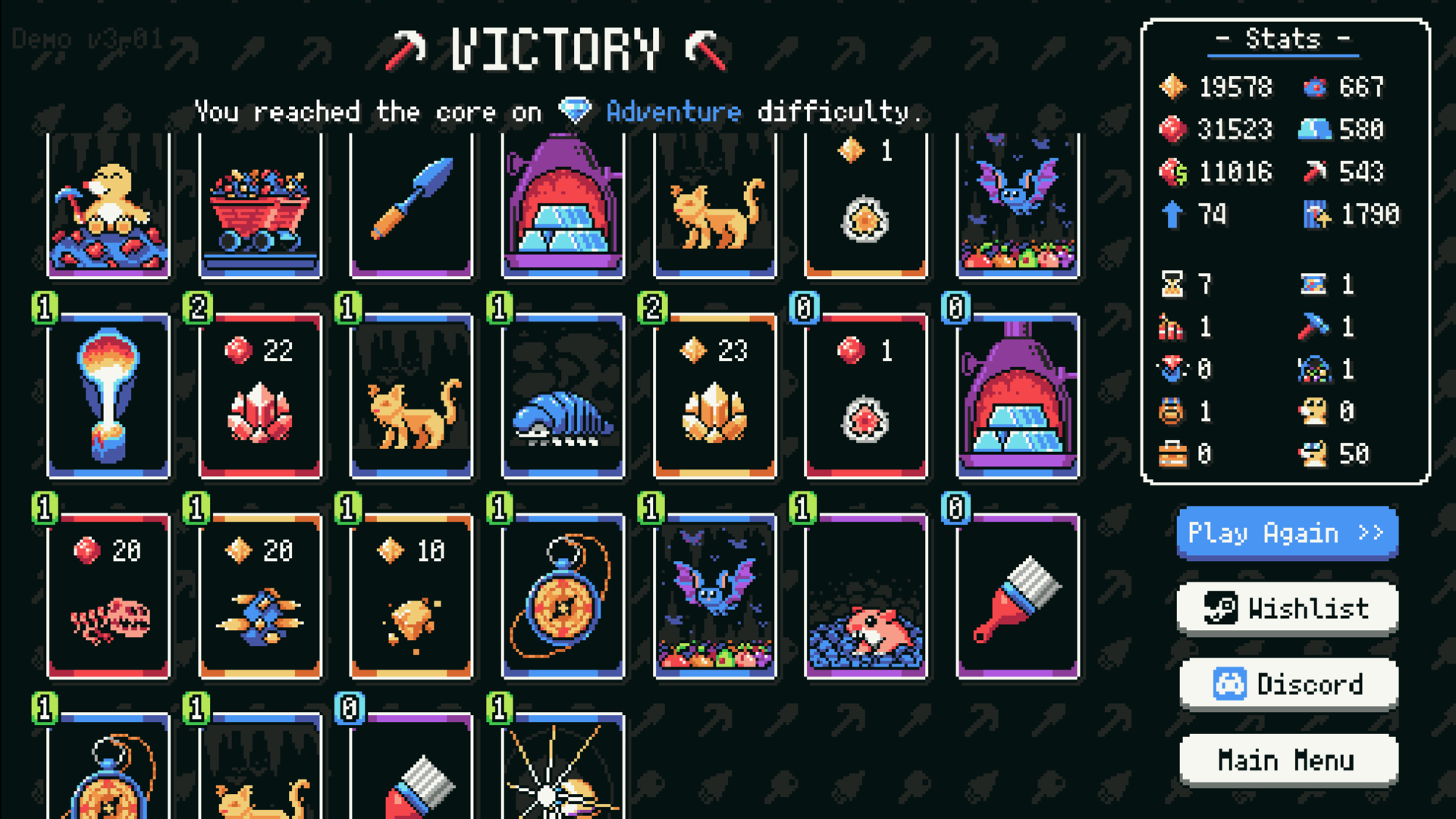
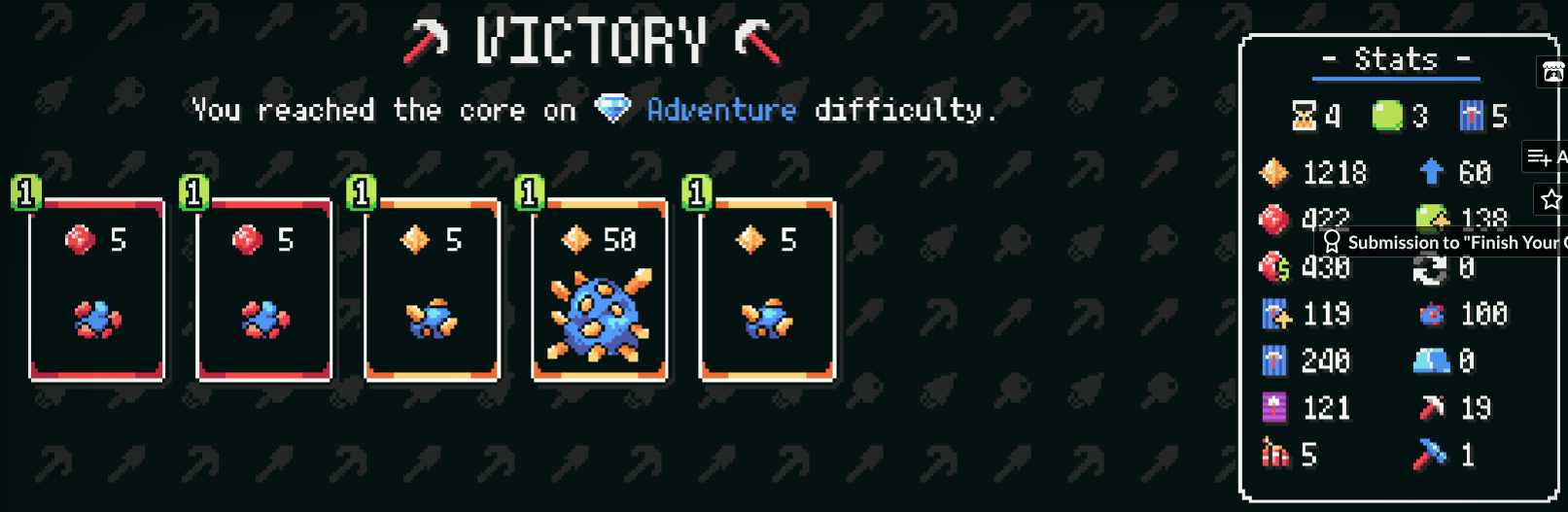
You can see in the screenshot below I struggled with ore economy (700 is incredibly low for a winning build in my limited experience), but with Amber Scorium as my only purchase I was still able to buy some hourglasses and dynamite and take a comfortable win.
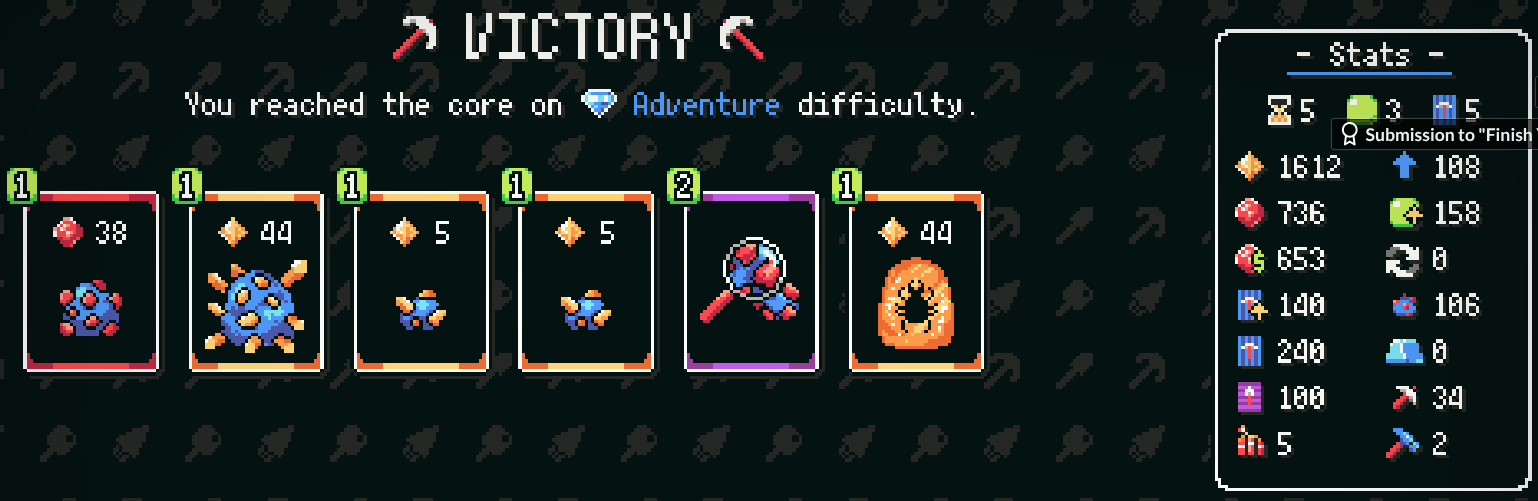

The Creature:
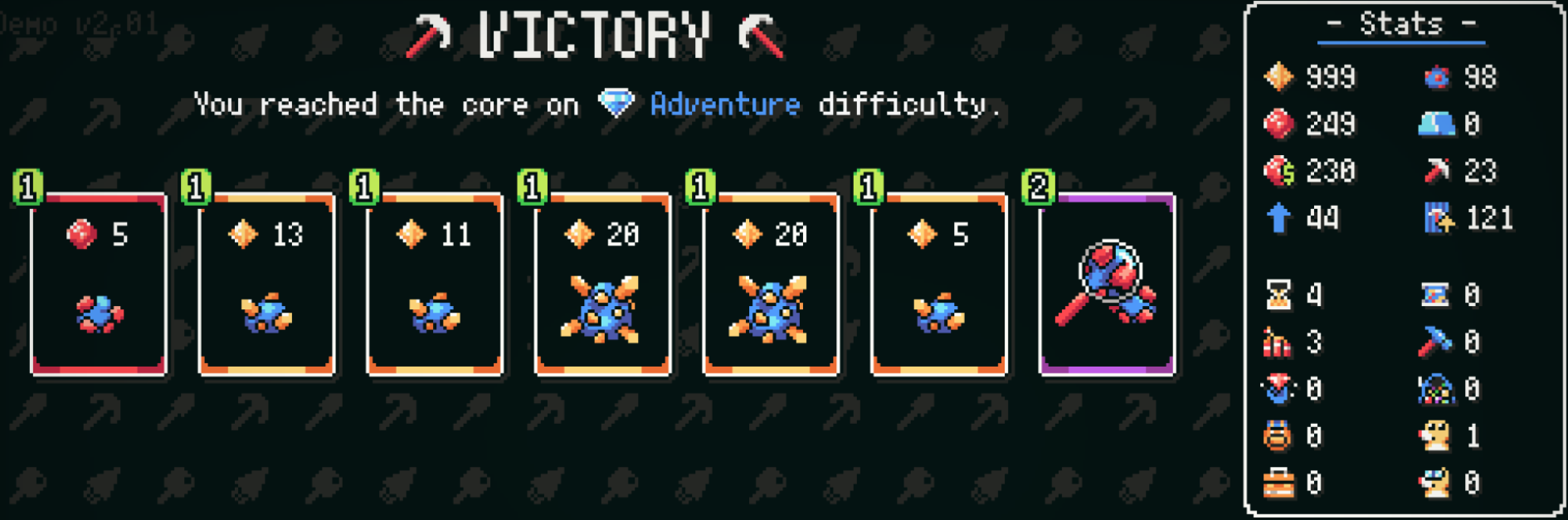
Here's another victory with low economy, this time with a Meteorite + The Creature to help offset the cost of Prospect. I think The Creature is quite strong even without Meteorite, but the Meteorite helps keep up the tempo by allowing me to Creature and then Prospect and still have energy to play the Prospect-buffed card. In contrast if my only build enabler is The Creature I'm frequently going Creature then Prospect on a card that I don't get to play that same turn.

Scorium Pandorite:
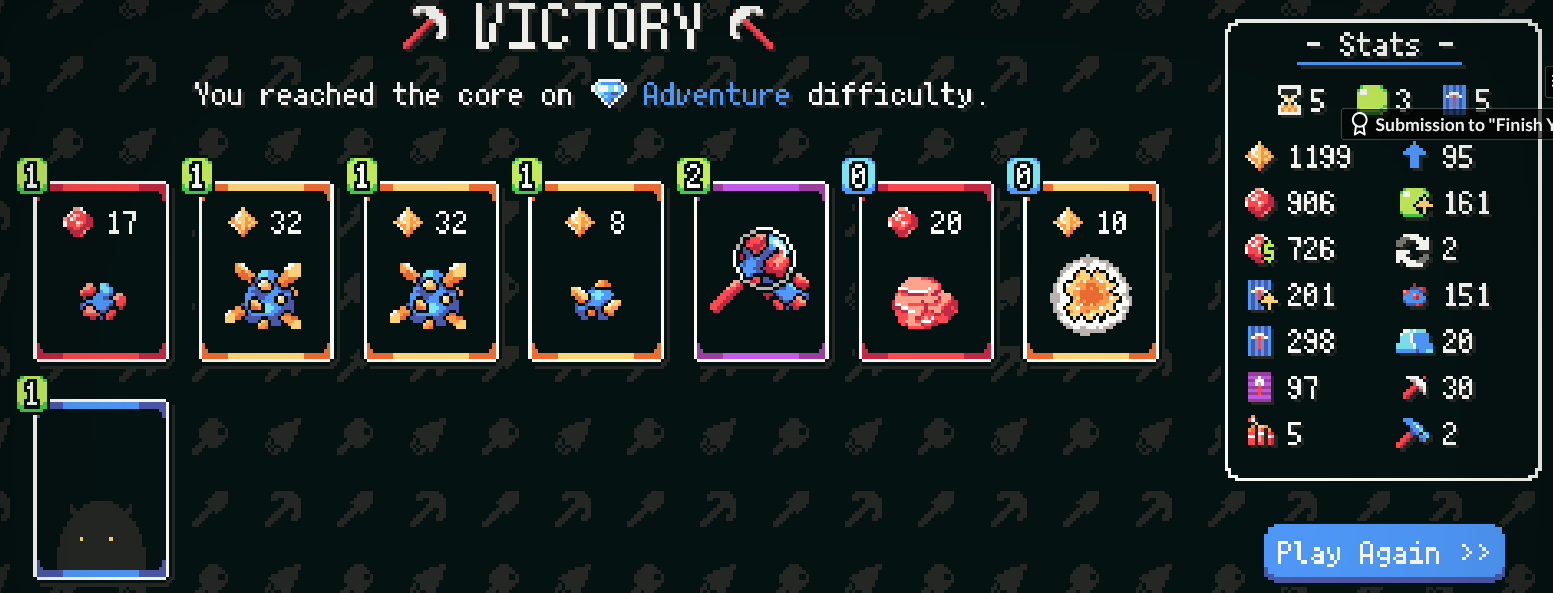
This isn't my best Scorium Pandorite run (you can see barely 2k income; I know I've had over 3k) but it ended on the biggest Pandorite.
I think Scorium Pandorite is incredibly strong since your mineral upgrades effectively give you both score & ore. If I get an early Scorium Pandorite I commit to upgrading it heavily, which can lead to a bit of a lull in ore economy before it surpasses the base ore (which I'd have been upgrading before as you can see here), but then it really launches. The fact that I'm upgrading a Score mineral heavily tends to make this whole process feel pretty safe.

Sword:
I haven't played a lot of tools so I was surprised at how smoothly this went the first time I tried Sword/Axe. The Wrenches were quite bad because my other tools put the minerals in play where the Wrenches can't see them anymore.
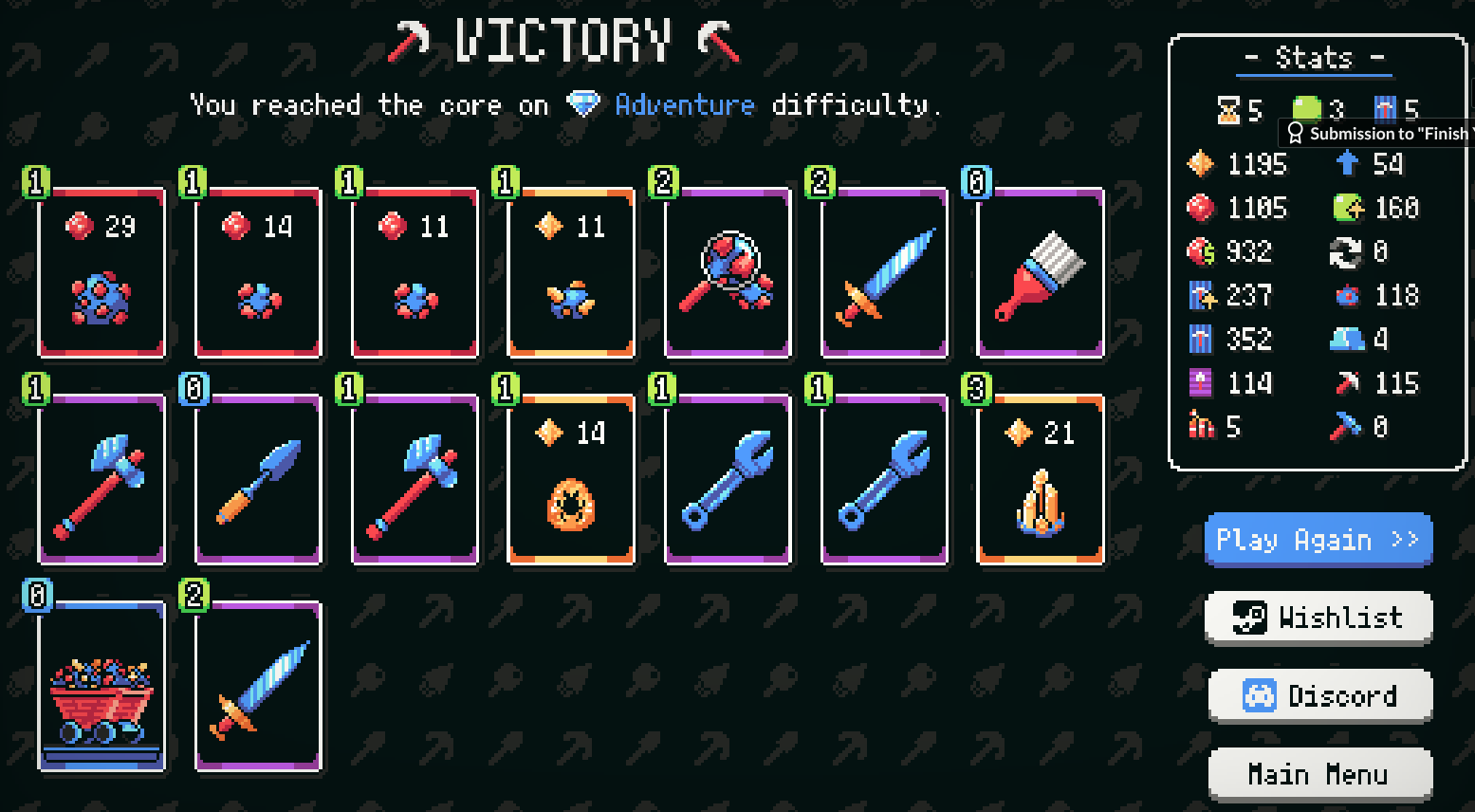

Mineshaft:
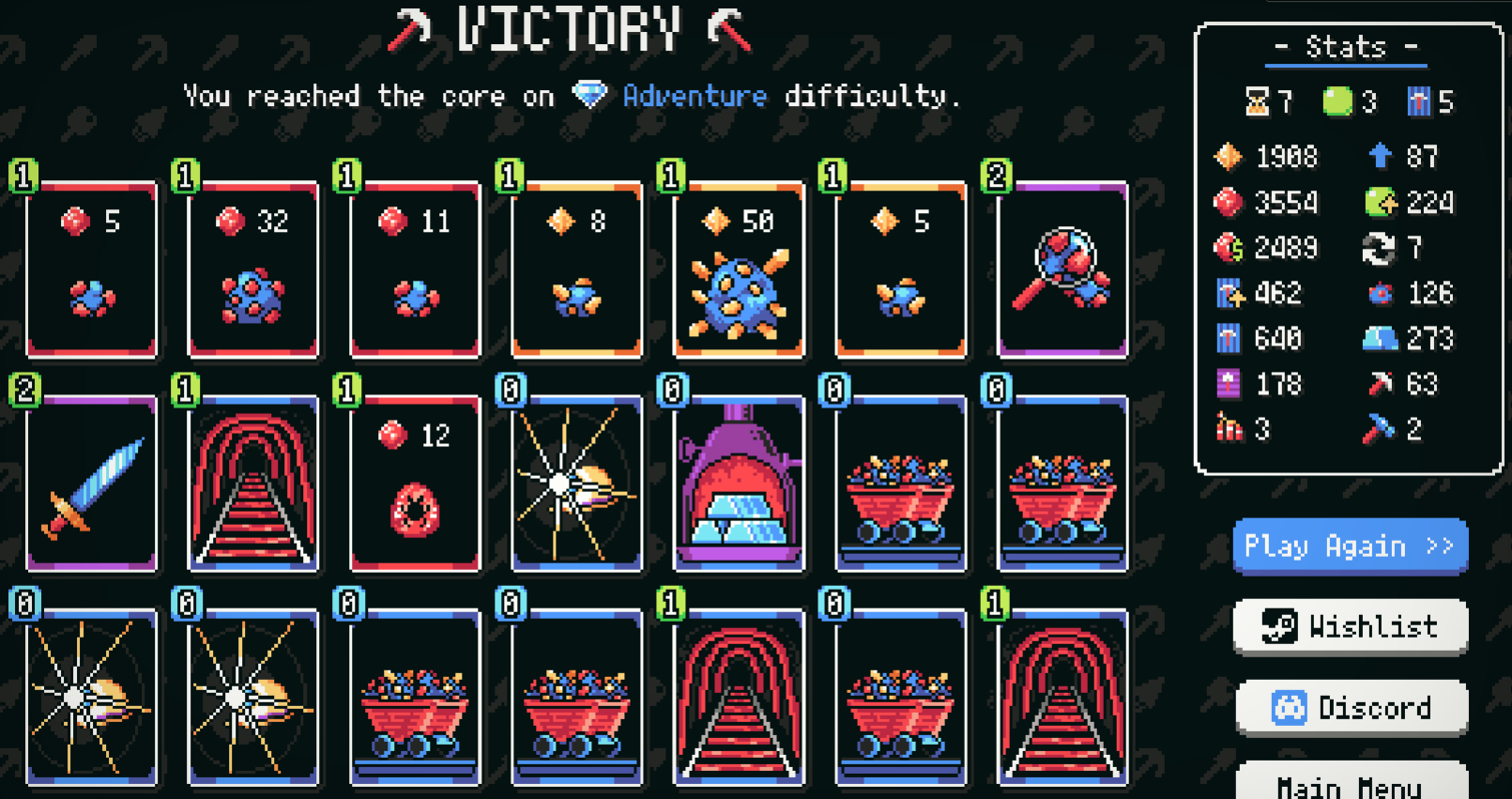
This was a fun run but felt very unusual in terms of shop RNG. By the time I got more than 1 Mineshaft the challenge was already gone. I don't think the Mineshaft "combo" can be assembled particularly easily/consistently. More frequently Mineshaft is an early-game play for 10+10 resource generation and I just accept that it's going to fall off as the game goes on.