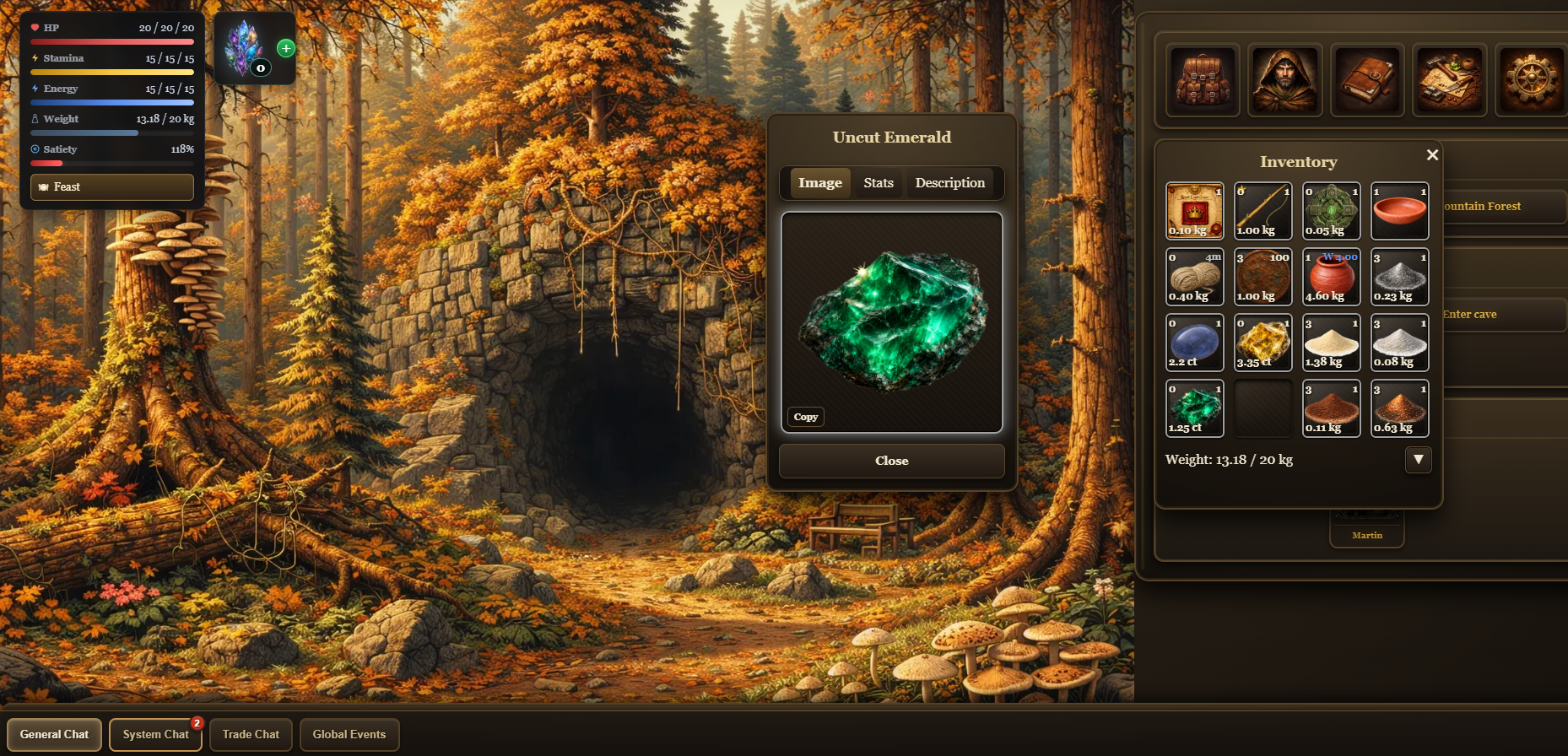
Quick follow-up to the mining post, because the chain finally reached its far end: the jeweler.
It starts back in the mine. When you wash the rubble you dig out — the same rubble you'd otherwise toss — you sometimes turn up gold, and every so often a raw gemstone. Ruby, sapphire, emerald, topaz, diamond, amber. They're rare, and a rough stone tells you almost nothing on its own. It's a lump. You don't know what's inside until someone who knows stones takes a look.
That's the first job — appraising. A trained eye reads the stone: what it's worth, what it would give you, and how much of it is dull, ordinary, or clear. Because a gem isn't one solid thing. It's got patches of dull and clear scattered through it at different angles, and a good appraiser can see them. A bad one is mostly guessing.
Then you cut it, at a simple bench on your own land. This is the part I like. Cutting isn't "press button, get better gem" — it's carving. You grind away the dull patches to expose the clear stuff underneath, and the clearer the cut, the stronger the stone. But every gram you grind off is weight you lose, and weight is what unlocks a stone's power in the first place. So you're always trading: shave it down for a purer, sharper bonus, or leave it heavy and keep more of what it does. Push too far and the whole thing can shatter into dust — though the dust isn't wasted either, it ends up as pigment. Get it wrong early on and you'll crack a lot of stones. That's the cost of learning.
After that it goes into a setting — a ring, an amulet, whatever you can build — and the metal matters. A rich stone in a cheap setting gets choked; it can only give as much as the setting can carry. Match a good gem to a good setting and it opens all the way up. And what does it give? Depends on the stone. A ruby leans into strength and health, an emerald into agility and dodge, a sapphire sharpens the mind and helps you learn faster. Rings and amulets are how you shape your character beyond just eating well — this is the mid-game, the stuff you chase once you've got your footing.
I've been posting these mining updates piece by piece, so here's the wider picture now that it all clicks together.
The chain is closed. It starts in the mine — you dig, you wash the rubble, you turn up ore, coal, the odd gemstone. The smelter melts the ore down and cleans it into metal. The blacksmith takes that metal and makes your tools and gear. The jeweler cuts the gems and sets them into rings and amulets that actually change how your character plays. And it loops: your worn-out pickaxe goes back to the smelter as scrap and becomes metal again. Nobody in this chain stands alone. The miner needs the blacksmith's pickaxe, the blacksmith needs the smelter's metal, the smelter needs the miner's ore. Four jobs leaning on each other.
Each one is its own thing, not a menu of recipes. Mining is that minesweeper-ish game of reading walls and bracing before you dig. Smelting is hauling ore and coal into a cocoon, feeding it peat, pouring the melt into a mould — and slowly learning to refine metal cleaner and cleaner, which matters more the deeper the game goes. The jeweler's cutting table is the one I keep coming back to: a rough stone hides dull and clear patches at odd angles, and cutting is carving away the dull to expose the clear, trading raw weight for a sharper bonus, one wrong slip away from cracking the whole thing to dust.
Under all of it, one thing you won't see but that holds everything up: every skill in the game now levels the same way. Generous when you're new, slower as you climb, no hard ceiling, and better materials teach you faster. One law instead of the four tangled ones I had before.
Some of this is live, some is still rough, and a few pieces — the forge, the furnace, armor, steel — are scaffolded but waiting their turn. But the shape is here. And honestly, once this settles, it's about half of what I want Runelight to be. The bones of the world are in.
There is a huge amount of work ahead, but I am very pleased with what is already here. I am even afraid to imagine how all this will have to be tested for balancers.