
Indie game storeFree gamesFun gamesHorror games
Game developmentAssetsComics
SalesBundles
Jobs
TagsGame Engines

The making of a quirky Wild West dialogue game - a devlog

A topic by SectorDweller created 6 days ago Views: 63 Replies: 2
Viewing posts 1 to 3

This story is treating itself pretty oddly.

On its first draft, it protested because it didn't feel like a game. It had 1,000 words back then, and now it has 10,000.

The story chooses to lean into the abstract in an otherwise grounded atmosphere (if you're standing on your tiptoes).
At one point, it wanted me to sing like cowboys used to sing to their herds. Out loud. Making things up along the way.
It wanted my guitar to sound like a banjo, and now that it gave up on the idea, it wants other objects. I have things that can make sounds and I'm not afraid to use them.
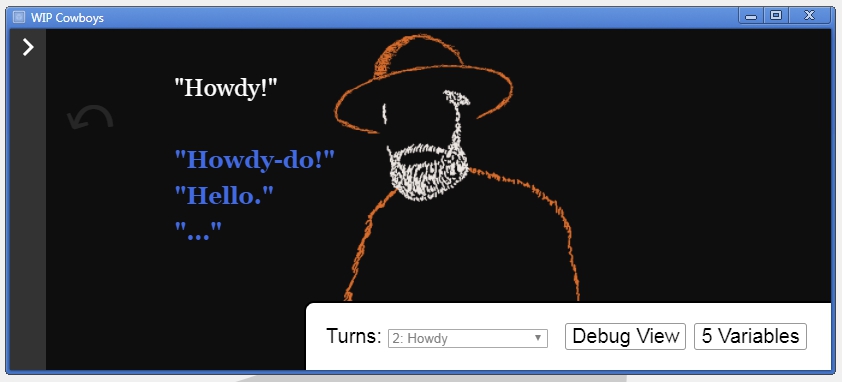
Its art: primitive. I literally met a three-year-old who draws better than myself. The story contains a few drawings to make player orientation easier. (And because, who wouldn't want their game to have visuals?)  

Meanwhile, here's another absurd feeling.

When I was a child, people who made my games were 1/3 of a planet away. By the time I was in high school, at least I shared the same continent with some of them. My hair is starting to go gray now.

When I clicked "start game" on this thing, a character greeted me, three dialogue options were there to choose from, music played, and a picture showed up. All at once. None of these were made by somebody else. I stared at the screen for an hour. And now I'm writing a devlog.

(2 edits)

Two things done today. One of them was creating sound effects, and the other involved implementing them as parts of a journal mechanic.

The game is only intended to have three SFXs: scribbling, drawing a circle, drawing a tick. So, I plugged the cable in, lay down my guitar, squeezed a T-shirt between the fret board and the strings, and I set to work.

When I put a notepad on the guitar's soundboard, the microphone only picked up faint sounds that could only work if heavily boosted inside the DAW. That could've only meant trouble - hiss galore, mighty morphing aliens invading the audio. 

Putting the notepad nearer to the microphone did produce a volume I could sort of work with, especially when pressing harder into the notepad or there were less pages on the soundboard, but the microphone picked up sounds of wood. It was still a writing sound, if you're into writing on wood. 

So, Plan Random it was. Taking another T-shirt to tuck it underneath the strings by the bridge, I placed a notepad over the strings themselves, directly above the hole.

The sound was actually pretty clear! If you make sure that the strings are muted, the sound travels pretty well! I could hear the playback very clearly!
If I jacked my headphones all the way up.
Some digital audio magic is making that work, though. (Note to self - test that.)

If you're wondering why I'm wasting time with a guitar to record scribbles with a microphone, it's because the guitar is the microphone. Or more specifically, the teensy little thing strapped to the inside of the guitar - meant to record sound based on physical vibrations. You strum the strings, the vibrations travel through the saddle and then the wood it's attached to. It's the only microphone I have.

On to the computer! And boy, was this going to take all afternoon.

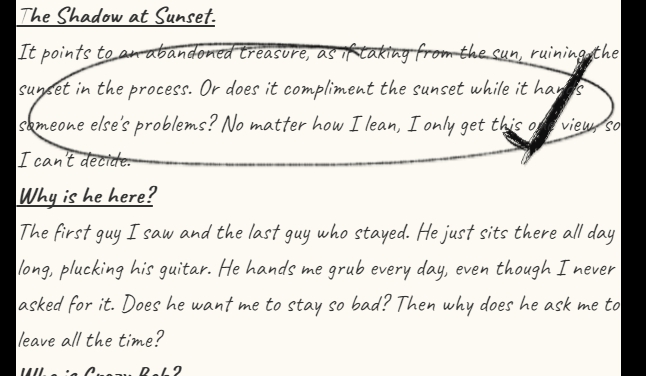
When you play the game, you have a journal where quests get noted and updated. The idea is that, when you're going through dialogue and there comes a point when you trigger a quest, you get yoinked to the journal, the scribbling sound plays, and the journal suddenly gets a new entry.

When you advance in a quest, you get yoinked again, the circle sound plays, and you now see that a quest is circled. Now, the quest is ready to be turned in.

When you interact with the two NPCs in the game (I should actually finish my first game, okay? :P), you can bring up the journal and talk about any entry with them. When you turn in the ready-to-be-completed quest to one of them. by clicking on its title (not the whole text, as I want that area click/touch-immune), you talk with them, you get yoinked to the journal page yet again, a tick sound plays, and now the entry is both circled and ticked. Quest complete.

Playtesting will tell whether all of this yoinking is useful or jarring, but in a game where text is all you have, I get the feeling that the visual feedback will help.

At the moment, the journal itself is made up of software letters and a simple HTML background, while the circles and ticks are images with transparent backgrounds that let the text through. It could be all images instead but, as images are set to scale based on device resolution, I wouldn't want to gamble with the actual legibility of the journal.

In the end, half the afternoon was spent telling the system to circle each paragraph regardless of size and layout, while the other half involved squabbling with the Harlowe Audio Library to implement the sounds, more due to my own ignorance than anything else. (I'd still appreciate it if they'd mentioned the forward-slash problem in their manual, though.)

It does have its aesthetic problems. The parts with the circles and the ticks load faster than anything else, and the few attempts to get it all to show at the same time resulted in different jank. There is also a QOL issue I didn't realize until I saw it: there is no immediate tell to show which entry got newly circled. They're all just statically sitting there. The journal is too long to fit on the screen, so you need to scroll to find a quest, too. I'd be like, "Is there something that wasn't circled before? Do I recall all of the things written here, or is there something new?"

A working solution would be this:
- Make gifs. Put those into the system, making sure they only play once per quest with a variable.
- If you trigger a quest state and you get the journal shown to you, as you scroll through the journal (the 'close' button is at the bottom anyway) and the entry becomes visible on your screen, the gif plays over the paragraph, the sound plays, and you unambiguously spot what's going on.

But this is a task for future me. Right now, I'm focused on getting the game to a working condition as soon as possible. The journal exists, its mechanics work. The next log should address the thing this game absolutely cannot do without: the text.


(1 edit)

If there's one thing I've ever learned from writing with people for well over a decade, it's that no matter how much you write, you'll always think your past work sucks. Congratulations if you're the exception to the rule (really, you're having it easy), but the usual truth is, the more stuff you write, the more experienced you get in creative writing. And when I say "more stuff", I literally mean, when you write a single sentence, you're a better writer than you used to be before you wrote it. While it's a blessing, it's also a curse.

I'm no stranger to it and I'm certainly no stranger to seeing other people in the same sauce. The first manuscript I ever wrote went through a complete rewrite the moment I laid my eyes on it again. The key is to treat it as practice: You learn how to recognize where it shines and where it fails to do what you hoped it was going to do. You push through it, cut through all the spots where you were trying to brute force your way into writing, expand on things you want to dive into, and then you write new stuff when you're done.

After a while, you get to a point where you realize it could keep you there forever. You get a what's-done-is-done mentality. You keep your edits to an absolute minimum so that you don't rewrite a single world five times where you could've written five other stories you wanted to write. And besides, you've put enough skill points into it that you feel more secure about your writing now. You already know what to watch out for when you write.

This is my first game, though. A branching game. My inner editor has seen lots of text, my own and others', gave lots of advice, and it's seen me play games my whole life.

The good news is, I already went over the whole text. Aside from a minor tweak to wording, there's no point overthinking it. The text says what it had to say, it points where it needs to point.

The bad news is... well, good or bad depending on who you ask. Branches. THIS is a first. I treated it as a chance to do things that I couldn't do in linear writing, not even in roleplay. All the times I needed to choose where to go with a story, with only one way forward, were now free to throw all their frustrations out the window and write whatever they wanted. 

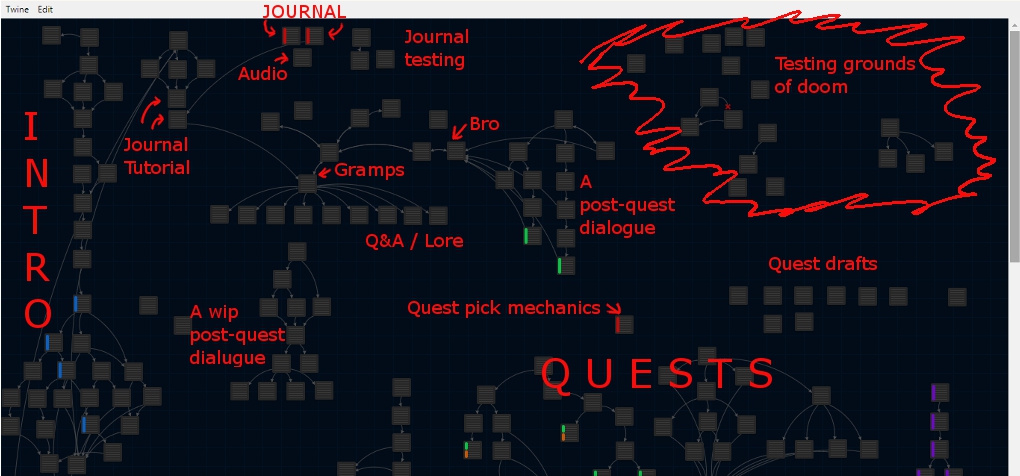
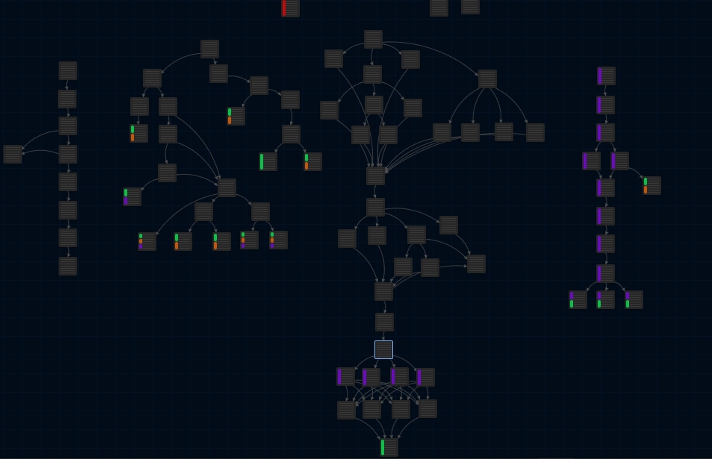
Let's just say I got a little overexcited. Behold: Branches!


So, let's dive into the story.

You find your brother in a ghost town. He's completely out of it, and the one other guy in town tells you about the disembodied voices that drove everyone out. (It's not a horror story, mind.) Your job is to solve the things that trouble your brother, preferably while keeping your sanity intact. The more you stay, the more you lose it. The more things you solve, the saner both you and your brother become. 

The dialogue side quests are actually the meat of this game, because it's the voices you'll mostly have to deal with.

There are currently four side quests, one of which will be sprinkled throughout the story. You hear them every time you go to sleep. If I have it my way, there will be additions to both types of quests, but I'd like to finish this game while we're still relatively young.

The current development stage is very straightforward: paste text into a node, tweak text and choices as needed, cuss as needed, move on to the next one. It's the conveyor-belt side of work but it takes time.

The only real difference is that I'm doing this without friends around to watch it evolve. There's the writing, the branches, the audio, the coding, everything. I'm used to having a shared creative process with people, whether we're working on the same thing or not, but I'm afraid I'd just bewilder anyone this time around. It feels very odd.