Indie game storeFree gamesFun gamesHorror games
Game developmentAssetsComics
SalesBundles
Jobs
TagsGame Engines

Reverie -- Balatro-like

A topic by Connor created 2 days ago Views: 105 Replies: 7
Viewing posts 1 to 8

REVERIE

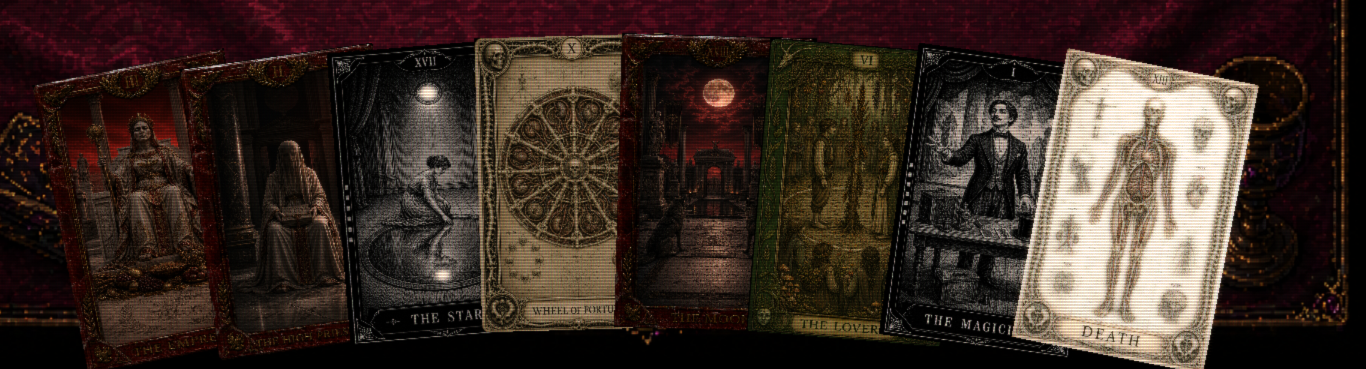
A tarot roguelike about cards that remember, patterns that answer, and a game that slowly begins to feel like it is reading you back.

Reverie is a dark occult card roguelike where tarot is no longer just a theme on top of math.

The tarot is the machine.

You build a deck. You cast cards. You collect relics. You chase points and multiplier against escalating supernatural pressure. At first, it feels familiar: a roguelike scoring game about making the number bigger.

Then the patterns start.

A card keeps returning at the wrong time.
A strange phrase unlocks in the Grimoire.
A certain set of cards begins behaving differently from the others.
A run starts to feel paranoid, mournful, watchful, or dreamlike.
The math still works, but it starts to feel interpreted.

The question stops being:

“How do I score more?”

And becomes:

“Why did that happen, and can I make it happen again?”

THE CURRENT FOUR-SET SLICE

For now, Reverie is focused around four active tarot sets.

That was intentional.

I had more sets planned and prototyped, but the game became stronger once I narrowed the playable slice. 

Four sets gives Reverie enough variety to show the core idea while keeping the game readable, testable, and polishable.

Each set is not just a visual skin. The long-term goal is for each set to feel like a different symbolic faction — a different way the game thinks.

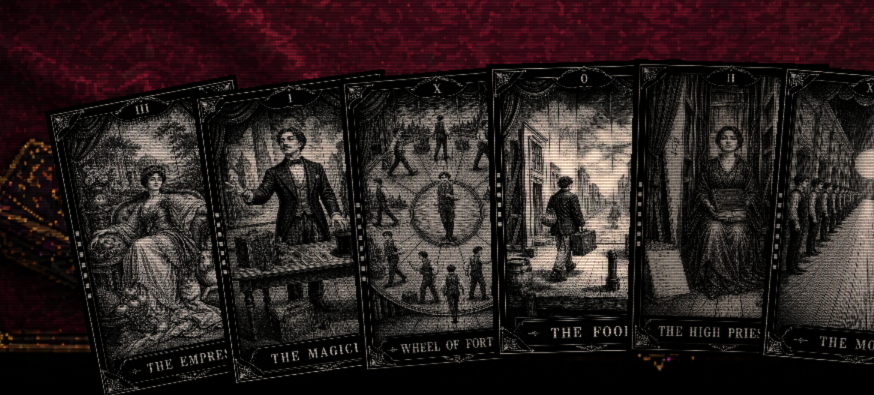
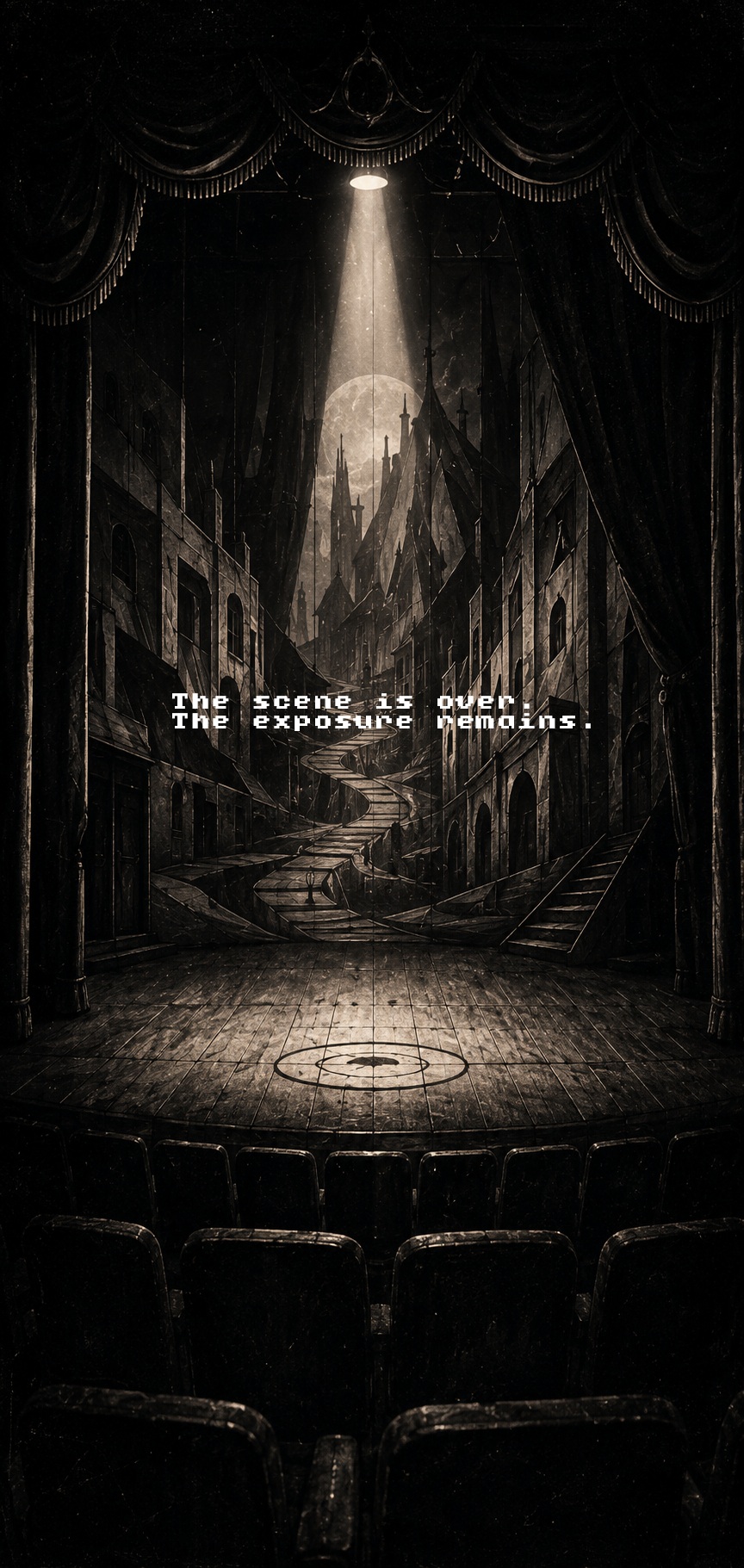
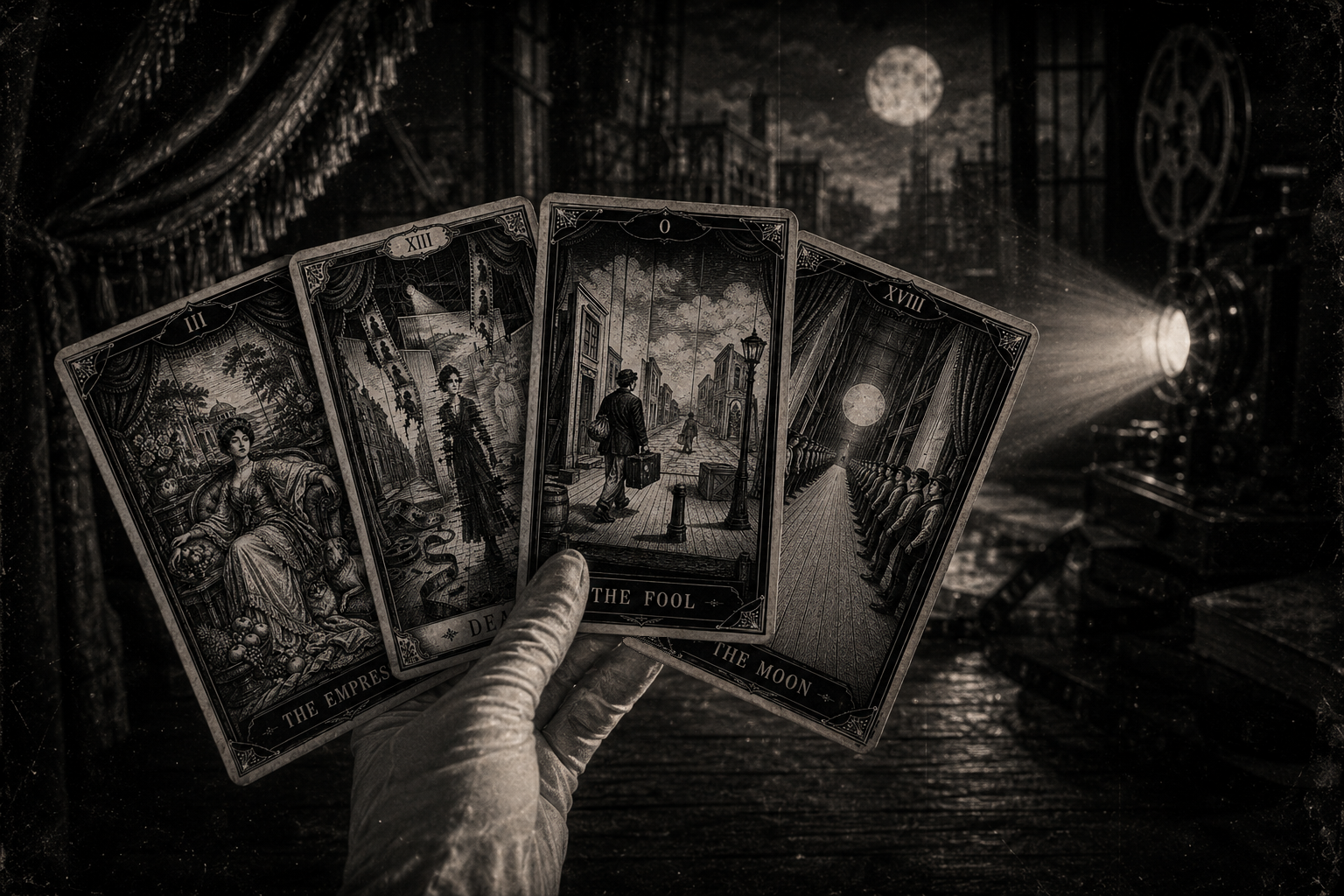
The Silver Nitrate Dream
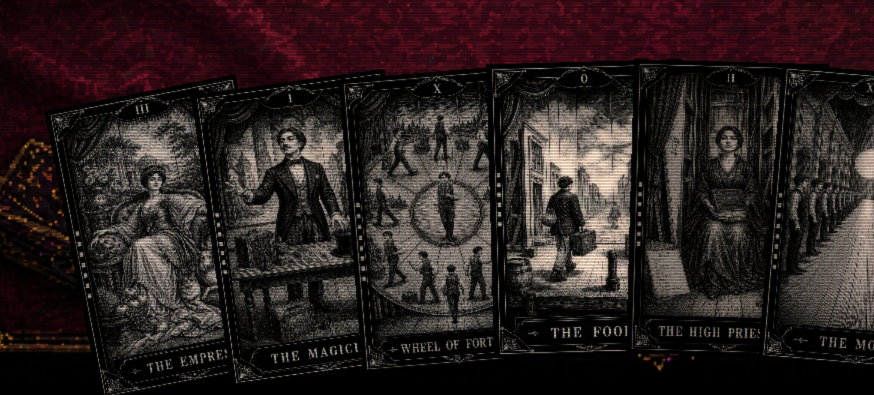
Old silent film, haunted cinema, damaged frames, lingering exposure.

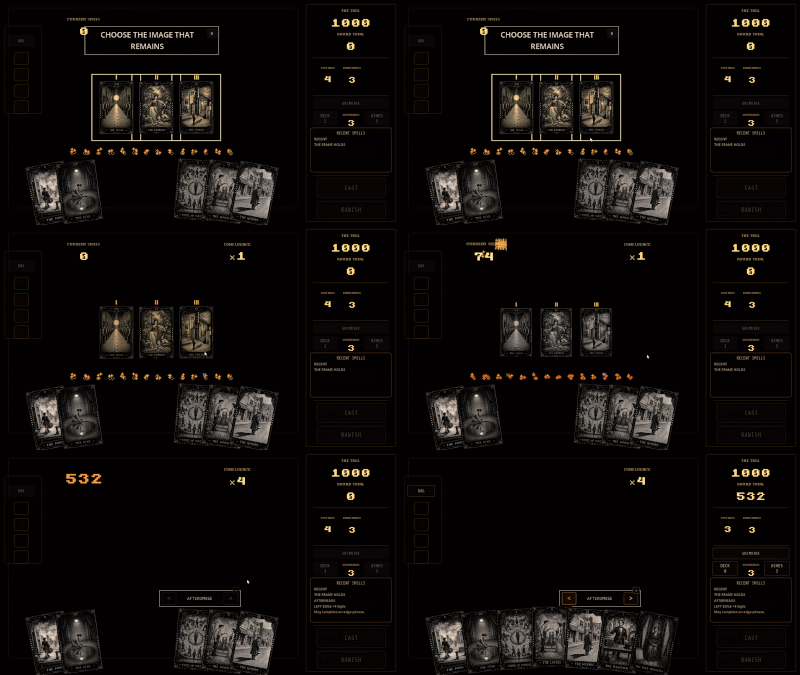
This is the first set where the idea really started becoming mechanical. Silver cards can create Second Exposure, replaying part of what was already cast. Strong Silver castings can leave behind an Afterimage, letting the player choose which image remains and place its ghost beside the next cast.

The set does not just look like old film.

It behaves like old film.

It preserves.
It replays.
It haunts the next scene.

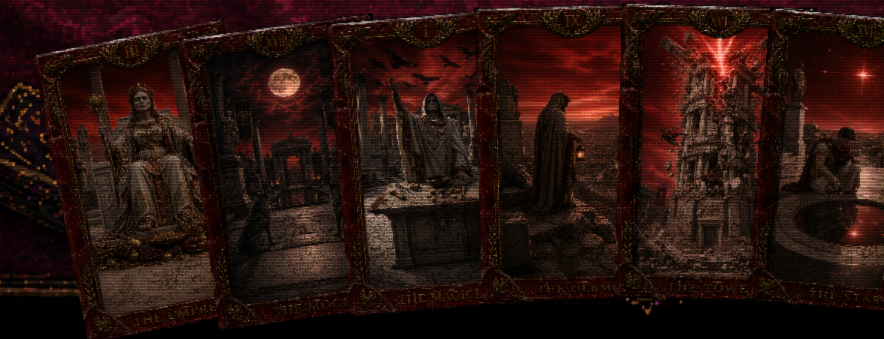
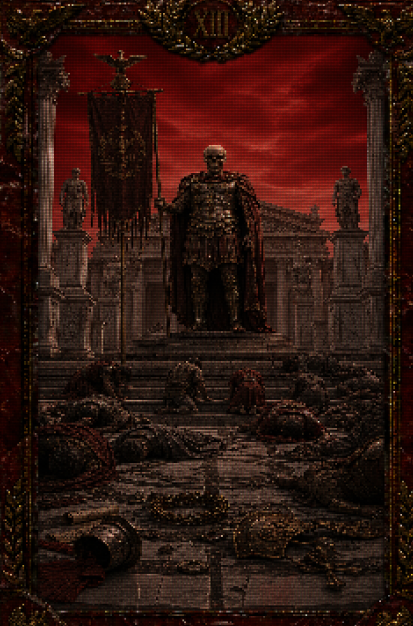
The Imperial Augury
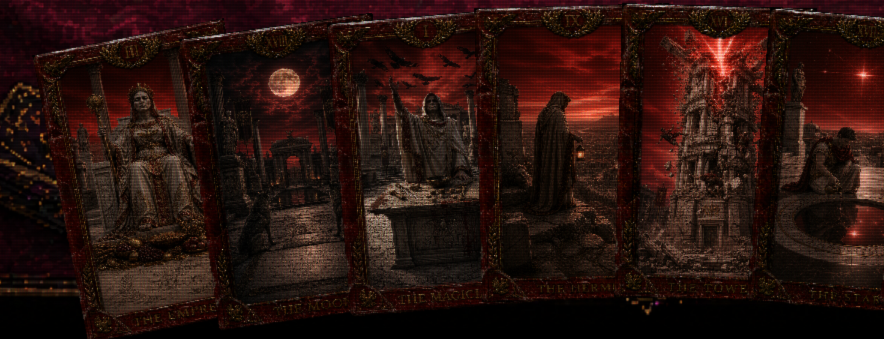
Ancient Rome, prophecy, empire, banners, soldiers, monuments, and divine authority.

This set is about order, conquest, ceremony, and fate being turned into state machinery. It gives Reverie a harder, more imperial symbolic language: power, command, hierarchy, omens interpreted by institutions rather than individuals.

Where Silver feels haunted and fragile, Imperial Augury feels declarative.

The cards do not ask.
They decree.

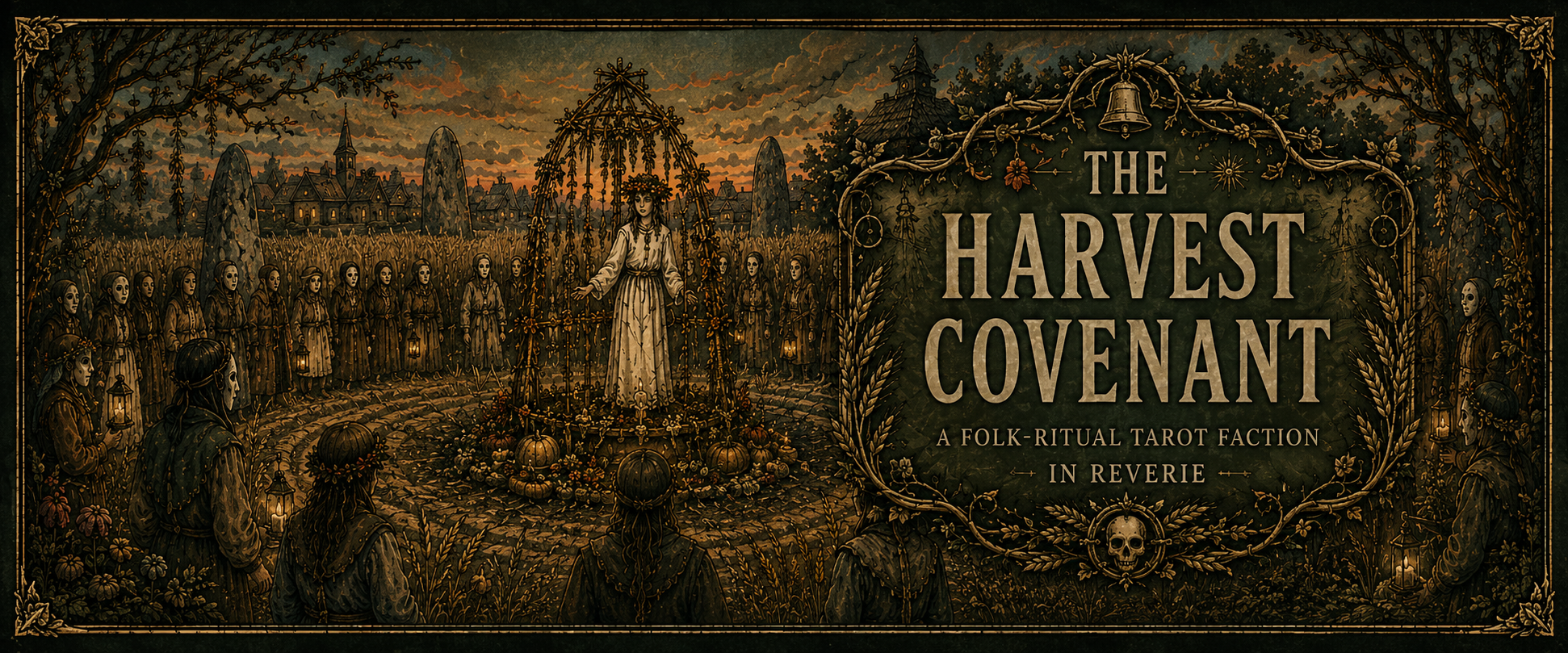
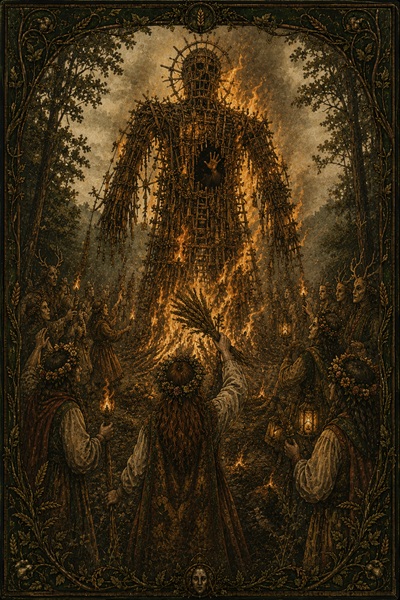
The Harvest Covenant
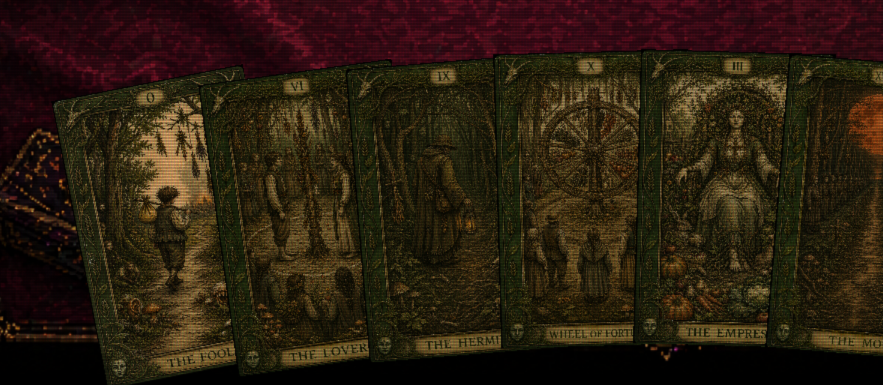
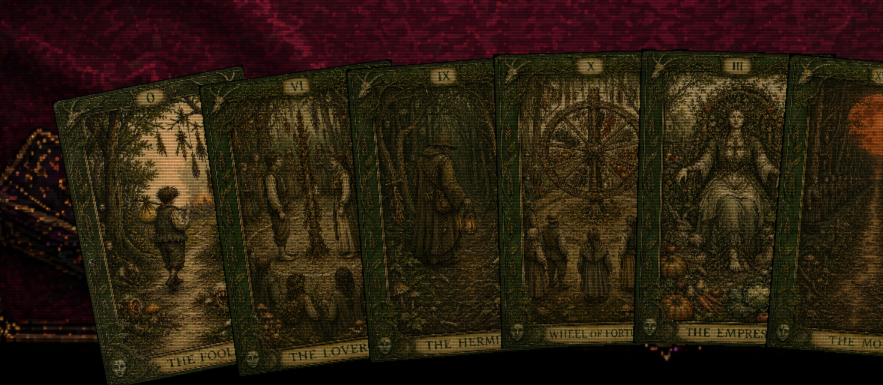
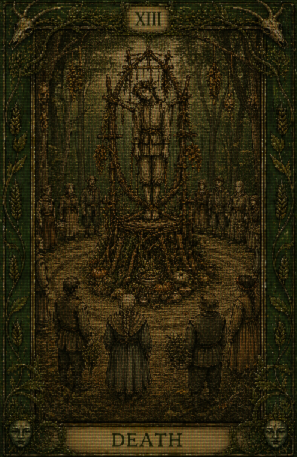
Folk horror, rural ritual, seasonal debt, fields, bells, offerings, and things buried under tradition.

This set brings Reverie into cycles: planting, reaping, sacrifice, return. It should feel older than the player, older than the rules, like something communal and agricultural that has been happening long before you arrived.

The Harvest Covenant is not clean horror.

It is obligation.

Something was promised.
Something is due.

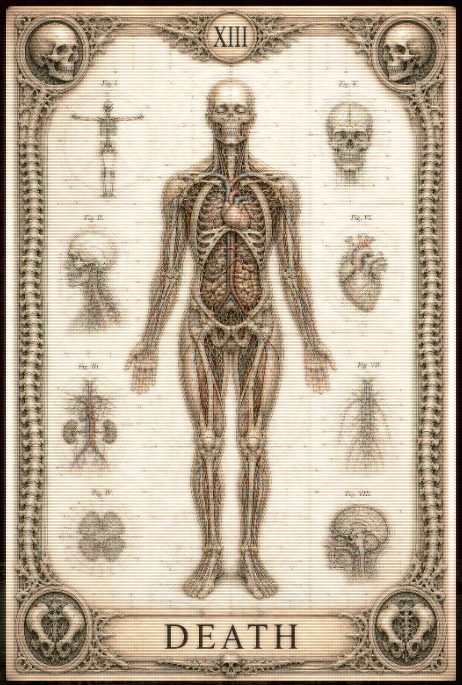
The Disclosed Form
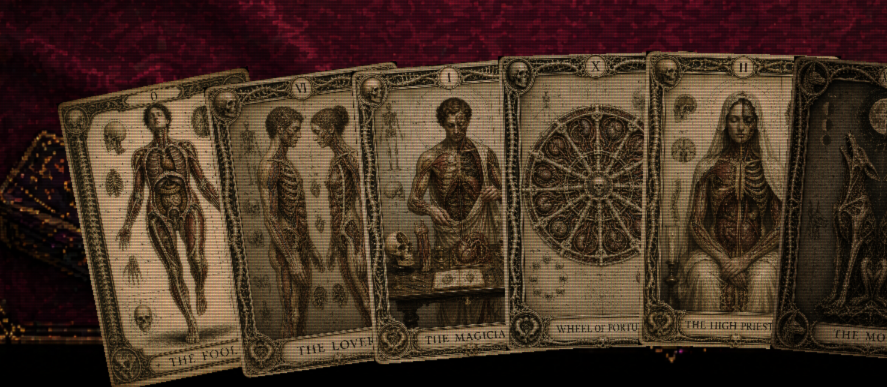
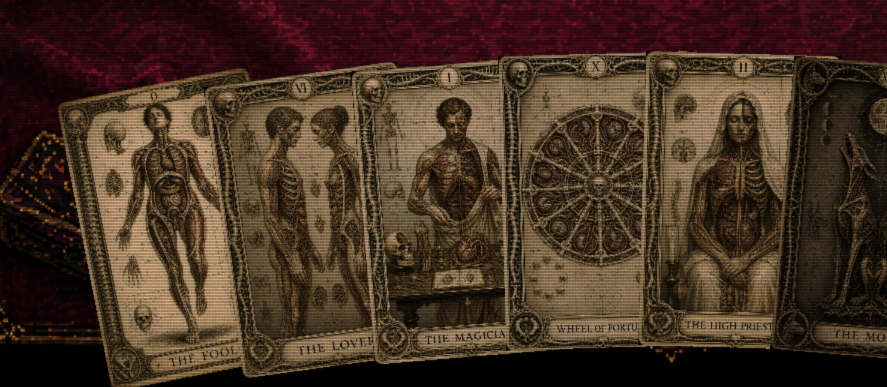
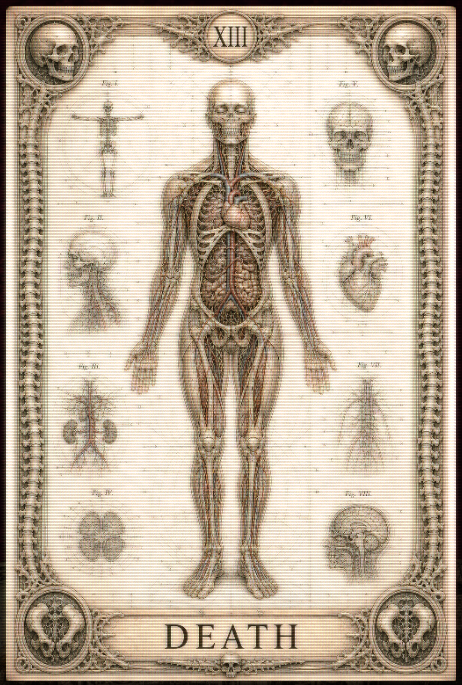
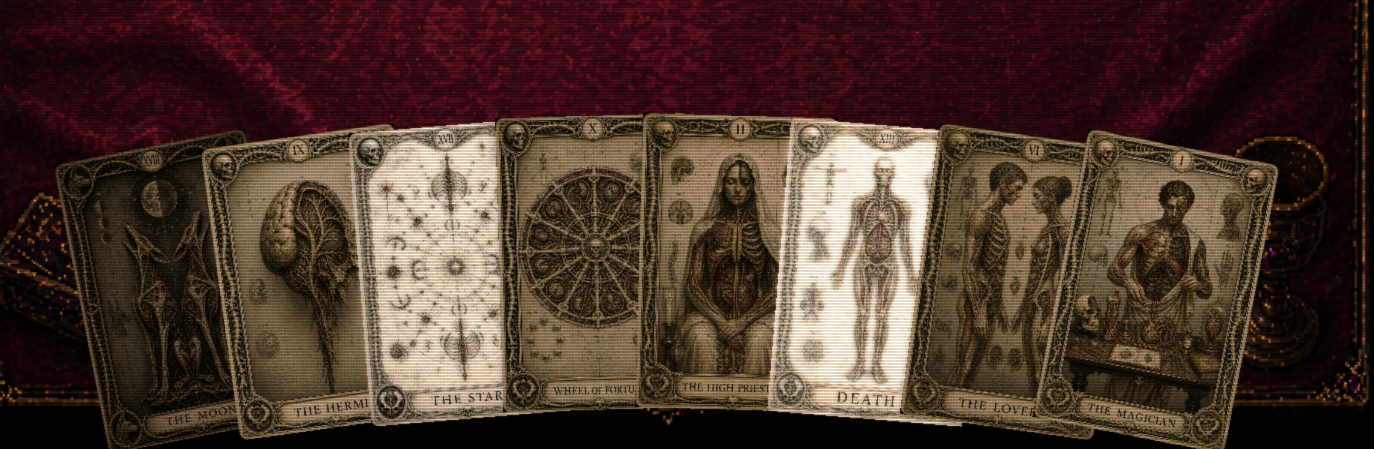
Anatomy, medical plates, exposed systems, sacred geometry, and the body treated like an occult instrument.

This set turns the human form into a diagram. It is clinical, strange, precise, and inhumanly organized. It feels less like mysticism and more like being studied by something that has mistaken anatomy for prophecy.

The Disclosed Form is not about gore.

It is about revelation.

The body opens.
The pattern underneath answers.

WHAT YOU ACTUALLY DO

In Reverie, you cast tarot cards into scoring patterns.

Cards generate points.
Relics bend the scoring rules.
Spells trigger when certain card phrases appear.
Multiplier turns small readings into explosive ones.
Boss-like Omens interfere with the run.
The Grimoire records the spells you discover across attempts.

The current playable loop moves through readings, shops, branching route choices, and a final threshold. Between rounds, you spend currency, buy relics, adjust your build, and decide which path through the reading to take next.

The goal is simple enough to understand:

score enough to survive the reading.

The obsession comes from everything underneath that.

THE GRIMOIRE REMEMBERS

Reverie’s spells are not all handed to you up front.

You discover them by casting meaningful card combinations. Once found, they enter the Grimoire. The more you play, the more the game’s symbolic language starts becoming legible.

Some patterns are clear.
Some are hinted.
Some are felt before they are understood.

That is the heart of the game.

A normal card game tells you the rules and asks you to optimize them.

Reverie gives you enough rules to play, then lets the rest emerge through repetition, suspicion, and discovery.

A ROGUELIKE THAT WANTS YOU TO BECOME SUPERSTITIOUS

Reverie is built around a specific feeling:

Players enjoy systems they can understand.
Players obsess over systems they can almost understand.

The best version of this game is one where players start developing private beliefs:

“This card always saves me.”
“This set is cursed.”
“Moon cards make the run weird.”
“Silver keeps showing up when the game wants to remember something.”
“I swear the game knows what I’m doing.”

The game should never need to fully confirm that feeling.

It just needs to keep making the feeling possible.


THE BIG IDEA

Reverie is not trying to be loud horror.

It is trying to be intimate, strange, symbolic, and quietly alarming.

It is a roguelike about building power, but also about building meaning. 

It is a card game where the deck becomes personal, where runs develop moods, where repeated symbols start to feel like messages, and where the player slowly learns how the game thinks.

By the end of a run, the player should not only remember the score.

They should remember what appeared.
What repeated.
What answered.
What felt like a sign.
The shop is open.
The cards are waiting.
The signal is coming through.


Making the Cards Speak -- [5/5/2026]


This week’s Reverie work was focused on readability.

Not “make everything obvious” readability. 

More like: if the game is going to behave like a ritual, the player needs to see the ritual happening.

Reverie already had spells, scoring, delayed payoffs, relics, and set identities starting to form. 

But too much of that was still happening as hidden math. 

This pass was about making the table speak more clearly.

✦                                ✦                                ✦                                ✦                                ✦                                ✦                                ✦

Pattern Tells

The first major update is Pattern Tells.

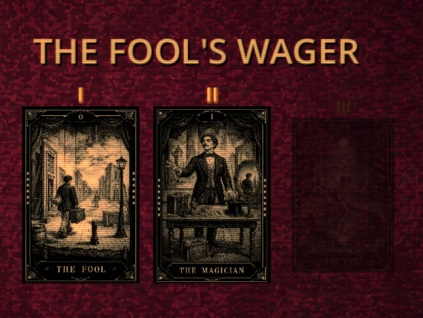
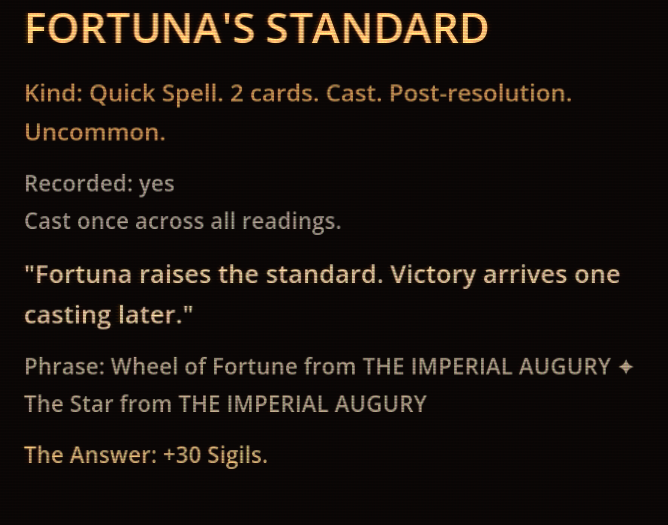
When selected cards complete a known Quick spell, the matching cards now show small carved-sigil symbols inside the card frame.

These are intentionally restrained. I did not want a loud tutorial glow or a giant effect around every possible card. The player should still have to pay attention.

The visual language is now:

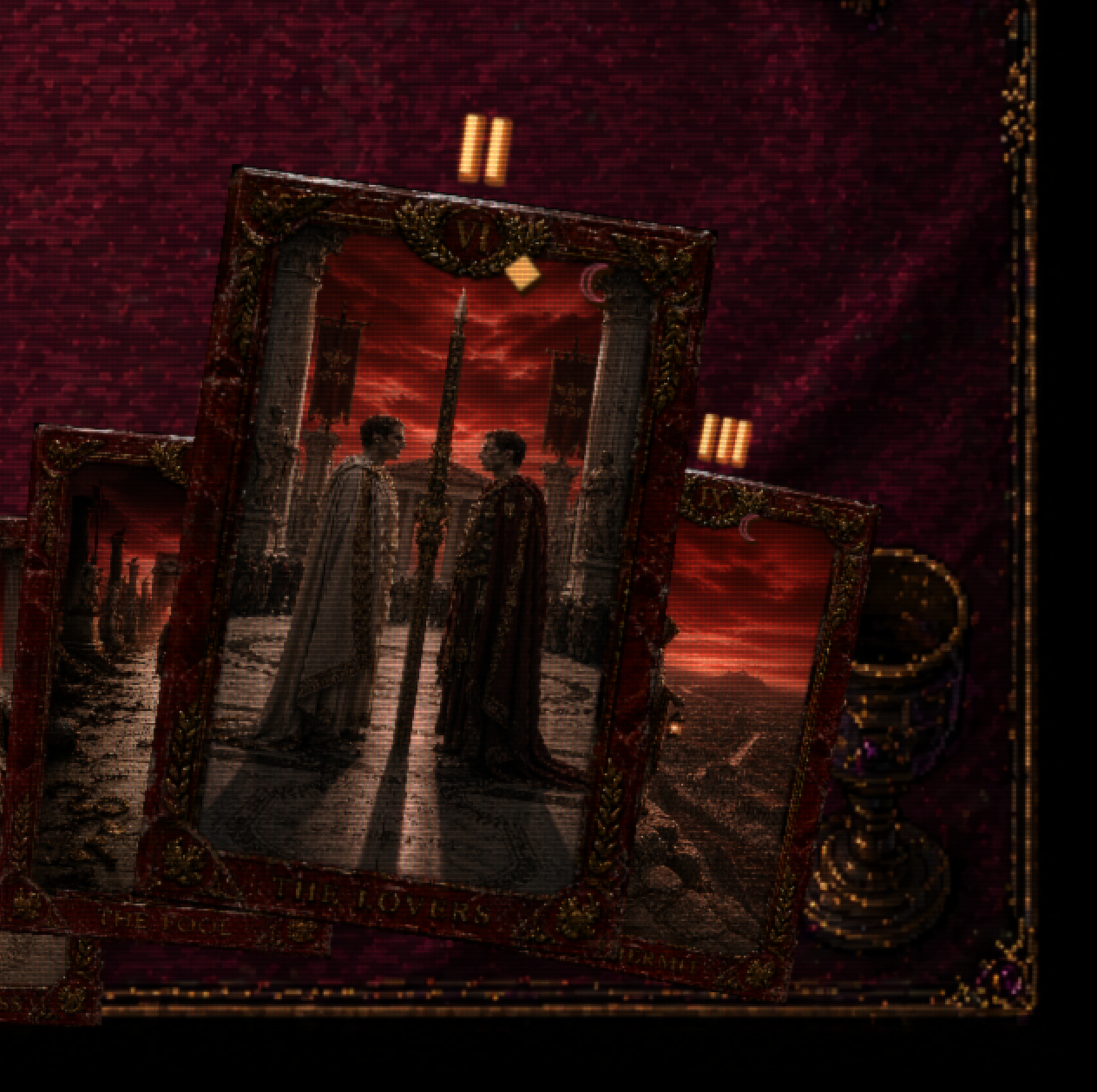
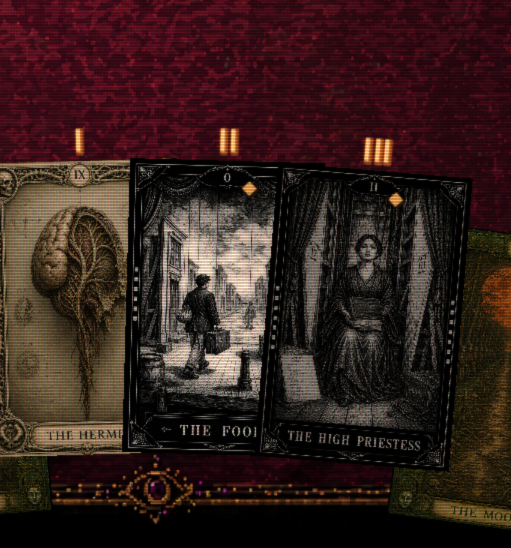
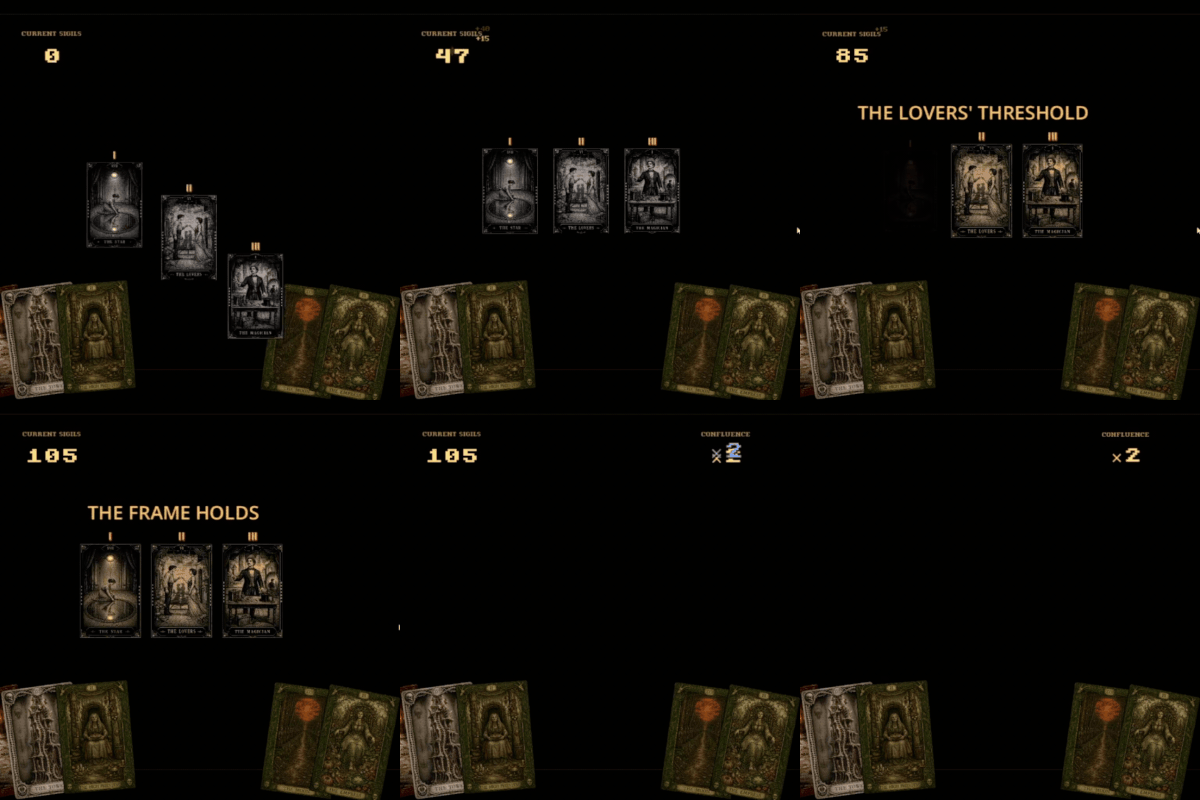
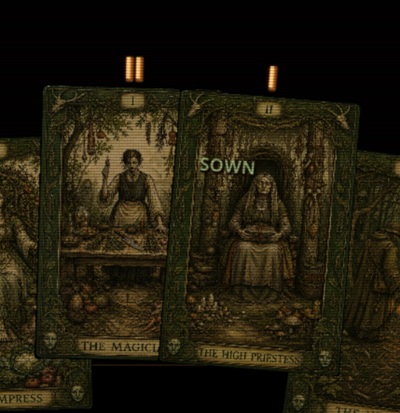
Roman numerals above cards = casting order Small carved sigils inside cards = confirmed spell membership Multiple sigils on one card = overlapping spell membership

This matters because some castings can trigger more than one spell at once. Earlier versions made overlapping spells look like one big blob. Now the player can see when one card is participating in multiple phrases.


[The II Card is part of two casts in this play. You can only be notified about spells you've casted before.] • YES I KNOW THE READABILITY IS TERRIBLE. GOTTA GO IN AND FIX. 

✦                                ✦                                ✦                                ✦                                ✦                                ✦                                ✦

Queued Payoffs

Delayed spell effects are also more readable now.

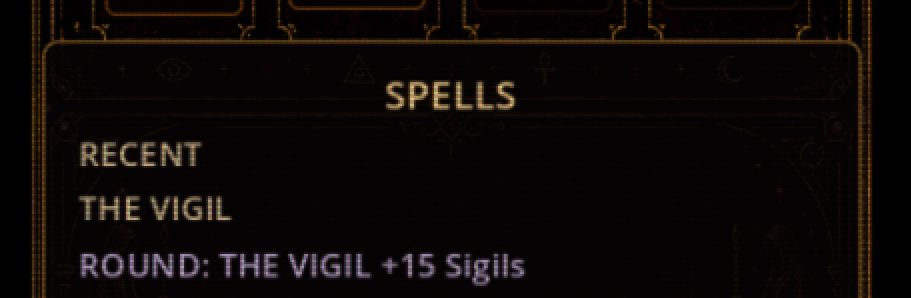
Some spells do not pay off immediately. They carry Sigils or Confluence forward into the next casting. Mechanically, this worked, but it could feel like the numbers changed silently.

Now queued payoffs visibly return when they apply. For example, a delayed Confluence bonus can travel into the Confluence readout as a blue multiplier.

That makes the cause-and-effect clearer:

A spell fired earlier. It lingered. Now it is paying out.


We've created a placeholder spell area, and the bits come out of it. The blue are next cast buffs. 

✦                                ✦                                ✦                                ✦                                ✦                                ✦                                ✦

Current Sigils and the Casting Handoff

The scoring reveal also got a better physical structure.

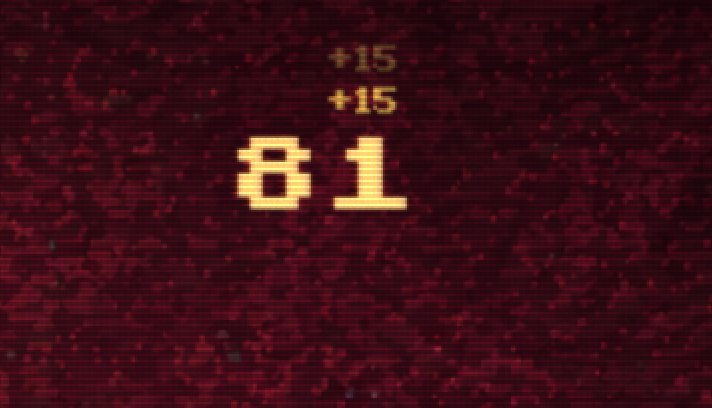
Current Sigils now appears during scoring and acts as the current casting’s accumulator. Score bits and effects feed into it while the casting resolves.

When the casting is finished, a compact +N badge travels from Current Sigils into the Round Total.

It is still a v1 version of the effect, not the final polished scoring presentation, but the grammar is much clearer now:

This casting produced value. That value moved into the round. The Toll responded.


We have them flying to building total that exists on the table, then that super awesome stylized building total will go towards your current total and EXPLODE. FUCKIN BOOM. The polish is desperately needed. hah.

✦                                ✦                                ✦                                ✦                                ✦                                ✦                                ✦

Final Art Integration Begins

The other big step was starting the final-art integration.

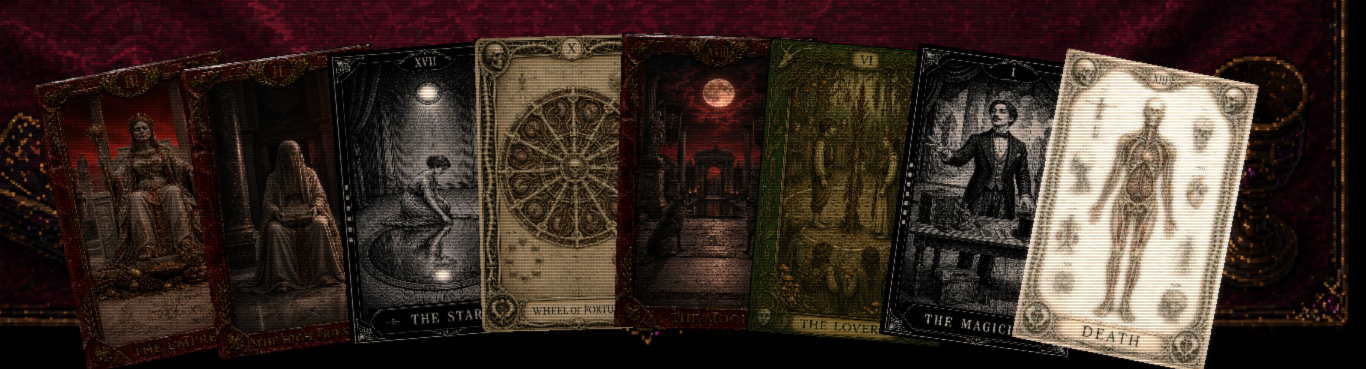
The first two sets now have their 'final' [yeah right huh lmao] gameplay card art wired in:

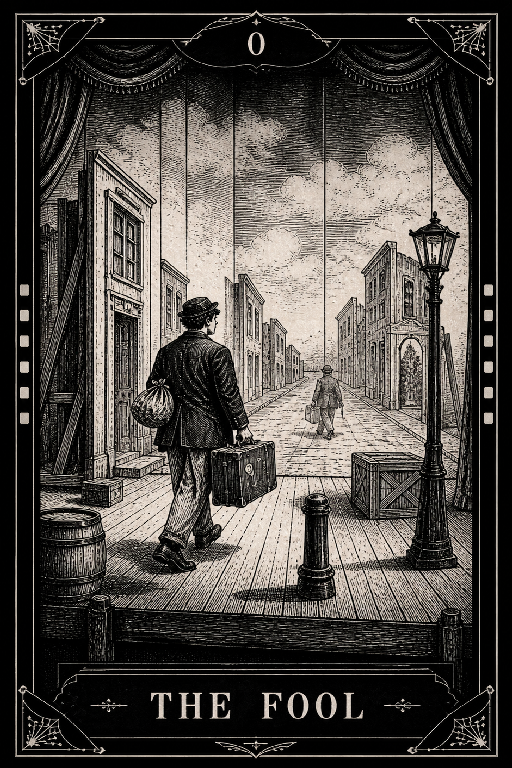
THE SILVER NITRATE DREAM


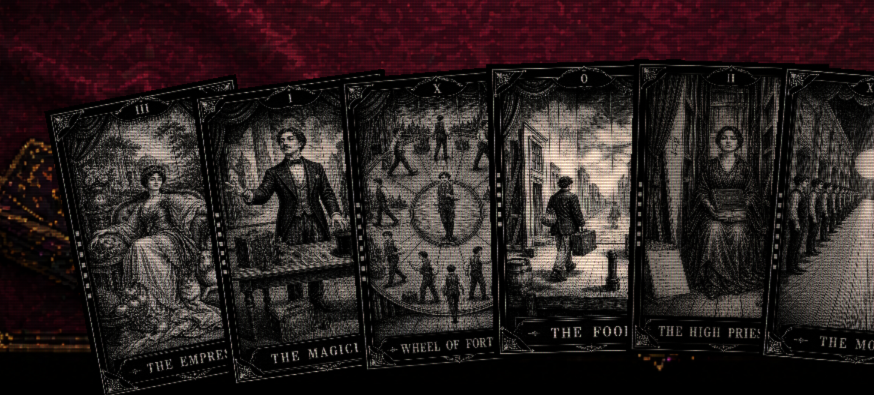
I'm partial to this set. I really dig it. I'll show you guys a few more. I got the art extremely consistent, thank god.


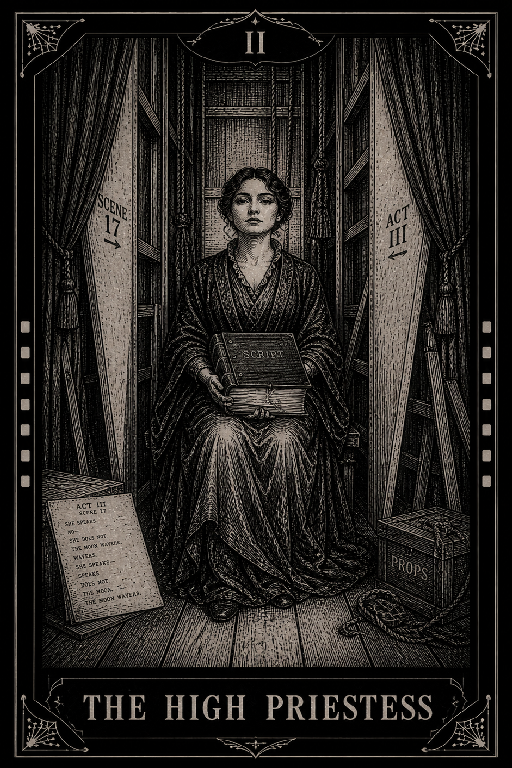
High Priestess. Is there a reason Moon is repeated that many times? 

'yeah you used ai and it fucked the text up!!!!' 

lol. or did it!? No but really there are tons of symbols and things that play off each other to add to multipliers and points. I wanted it to really rock off when you get a really lined up combination.


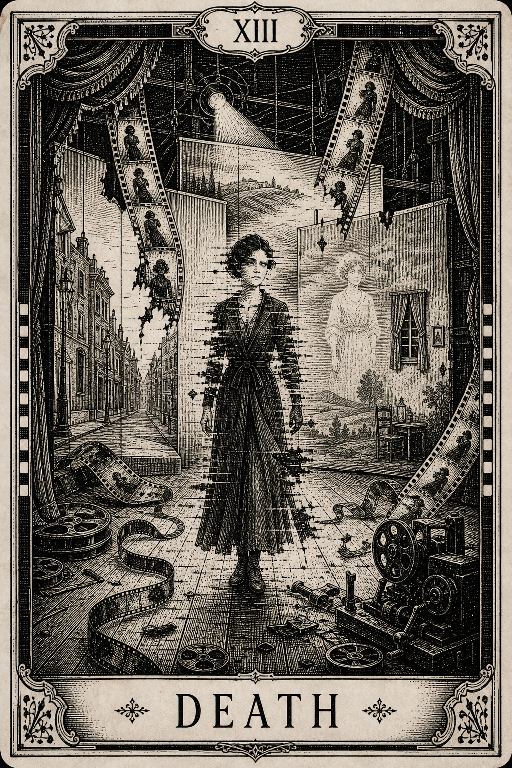
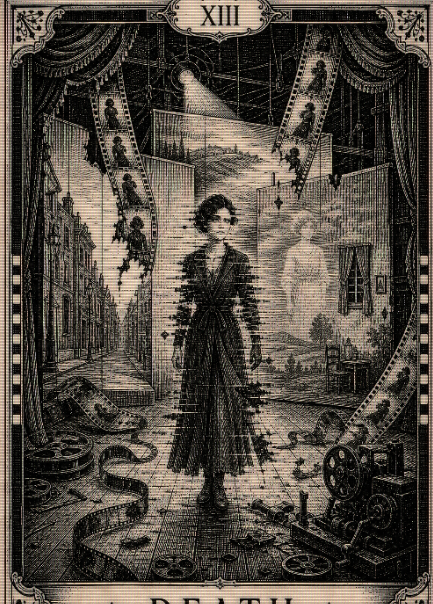
I was able to prompt an inverted death as well with consistent borders! text not so much, but hey. can't win em all. i love, it looks incredible in game under the bloom filter. It should be a rarer card and a big special / deep play enabler.

THE IMPERIAL AUGURY

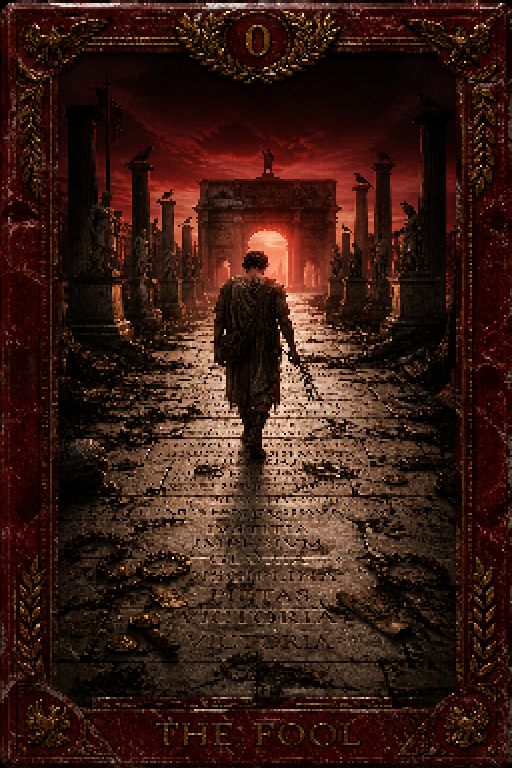
Text super unreadable we're going to make it a glowing mellow yellow in Aseprite sooner than later.


The game still keeps its internal resource ids stable for now, but the actual card art paths are now pointing to the new 512 × 768 final PNGs.

That means these sets are starting to feel less like placeholders and more like actual identities.

✦                                ✦                                ✦                                ✦                                ✦                                ✦                                ✦

First Silver Nitrate Dream Spell Batch

With the new Silver Nitrate Dream art in place, I also added the first real spell batch for that set.

The new spells include:

THE SILVER NITRATE DREAM THE FINAL CUT THE ACTOR’S SHADOW THE FRAME HOLDS THE REEL BURNS

These are built using existing systems only. No new mechanics yet. The goal was to give the set a stronger identity without destabilizing the scoring pipeline.

The Silver Nitrate Dream is starting to feel like:

Frame. Cut. Burn. Repeat.

The spells are not overpowered in early testing, but they should become more interesting as Confluence and multiplier planning deepen.

✦                                ✦                                ✦                                ✦                                ✦                                ✦                                ✦

Why This Pass Matters

This was not just UI polish.

This was about making Reverie’s core loop easier to read without removing the mystery.

The player should be able to understand the shape of a casting:

  • I selected these cards.
  • The game recognized a phrase.
  • The spell answered.
  • The payoff traveled.
  • The score entered the round.
  • The Toll reacted.

That chain is much clearer now.

✦                                ✦                                ✦                                ✦                                ✦                                ✦                                ✦

What Comes Next

The next direction is more set-identity content.

The Imperial Augury is likely next for its first spell batch. 

The goal is for each set to eventually have a distinct mechanical personality, not just different artwork.

For now, the focus is still small and controlled:

  1. More set-specific spells.
  2. Clearer scoring feedback.
  3. Better relic and omen attribution.
  4. More final card art.
  5. No giant system jumps until the current layer feels solid.
The shop is open. 
 The cards are waiting. 
 The signal is coming through.
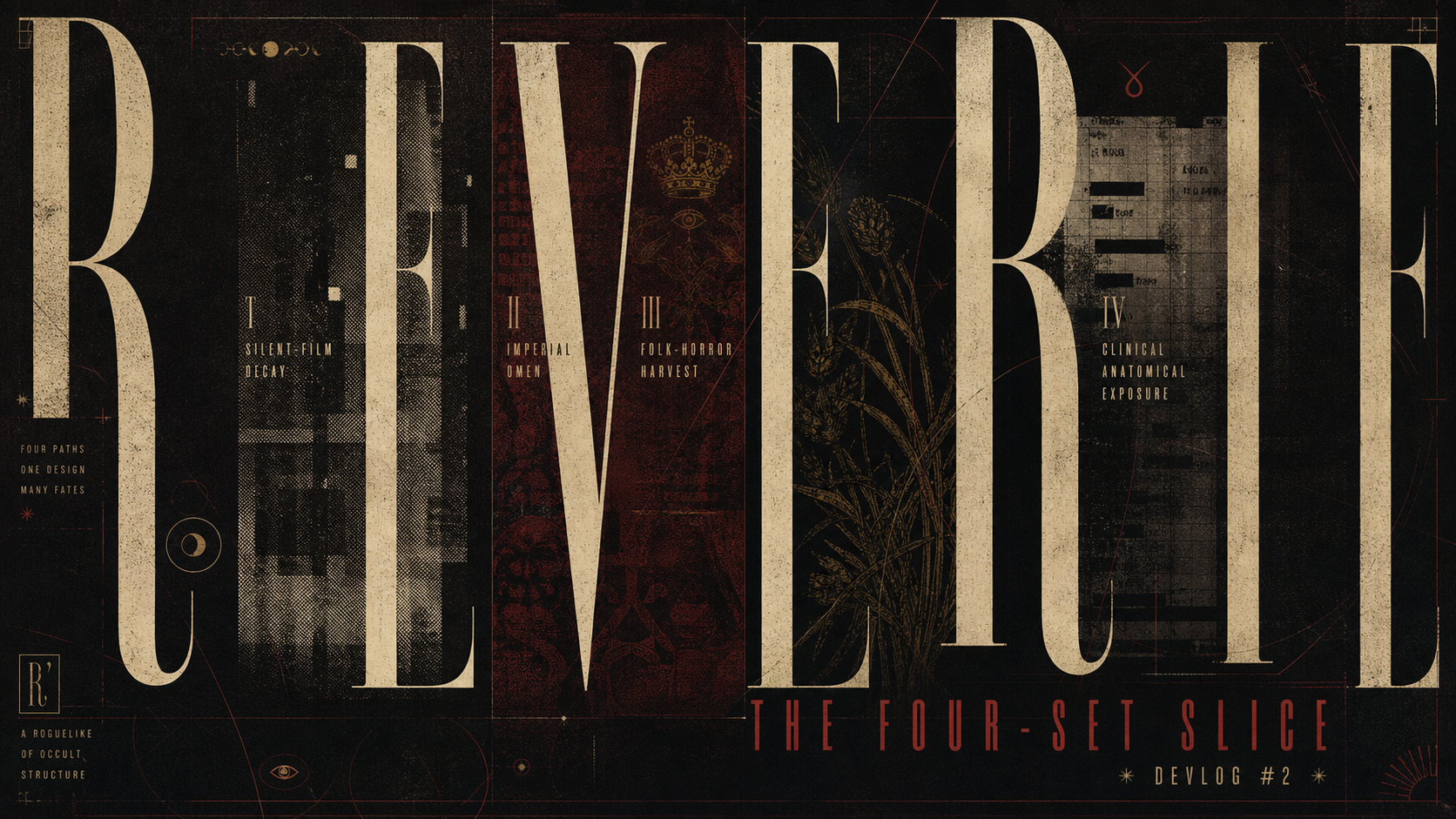
  • DEVLOG 2 — THE FOUR-SET SLICE [5/5/2026]

    Decisions were MADE.

    Reverie Changes shape again.

    The last time I wrote about the project (this morning) 

    I was getting ready to add spells for THE IMPERIAL AUGURY, the Roman-inspired tarot set. At that point, the game was still expanding outward: more sets, more possible spell phrases, more visual identities, more directions.

    Since then, a lot has happened [see the next post.] but most importantly, 

    I made a decision about scope.

    For now, Reverie is focusing on four active tarot sets.

    THE FOUR ACTIVE SETS

    The current playable slice now centers on four tarot sets.

    THE SILVER NITRATE DREAM

    Frame. Cut. Burn. Repeat.

    THE SILVER NITRATE DREAM is a silent-film nightmare of theatrical spaces, bad edits, staged rooms, collapsing sets, and worlds that only hold together while the camera keeps rolling.

    This set is about unreality as construction. Sets have seams. Rooms are flats. Light behaves like a camera trick. The cards feel like old film stock trying to preserve something that should have burned away.

    THE IMPERIAL AUGURY

    Decree. Omen. Authority. Collapse.

    THE IMPERIAL AUGURY is a Roman-inspired set about empire, prophecy, civic ritual, military divination, and the machinery of power interpreting disaster as destiny.

    This set is about authority reading signs in the sky and deciding that whatever happens next must have been inevitable. It is gold, marble, banners, omen-birds, bloodless ceremony, and the collapse already written into the architecture.

    THE HARVEST COVENANT

    Offering. Season. Witness. Sacrifice.

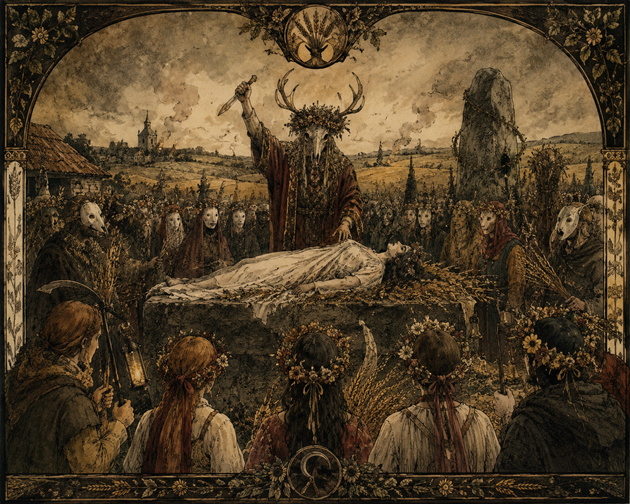
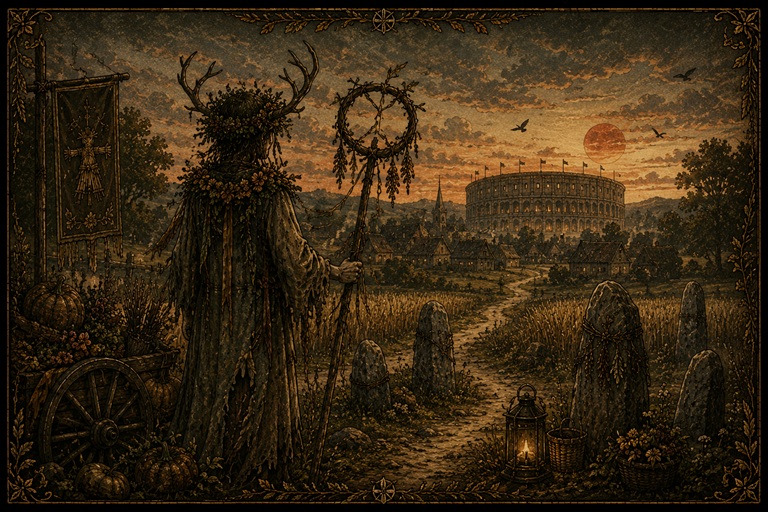
    THE HARVEST COVENANT is a folk-horror set about seasonal debt, communal ritual, old agreements, and the terrible feeling that the village already knows how this ends.

    This set is about the cost of return. Fields, masks, bells, dusk, ash, witnesses, and offerings. Nothing is random here. The harvest comes because it was promised.

    THE DISCLOSED FORM

    Observation. Exposure. Structure. Inevitability.

    THE DISCLOSED FORM is a clinical anatomical set built around antique medical plates, exposed structure, diagrammatic bodies, and horror through clarity rather than chaos.

    The idea is not gore. It is not blood or violence. It is the discomfort of being completely visible. A body treated as a diagram. A person turned into an academic plate. Something understood too clearly.

    Other sets still exist in the project. Some have art. Some have ideas. Some will probably return later.

    But they are not part of the current playable slice.

    The Starting Deck Customizer now focuses only on these four active sets. Older prototype sets are hidden for now instead of being shown as half-supported options. I also removed an old developer-only “Current Lineup” readout that was useful for testing but did not belong in the player-facing UI.

    This is one of those small changes that makes the game feel less like a prototype and more like a game.

    WHY FOUR?

    Originally, I wanted Reverie to have a lot of tarot sets.

    adding before finishing means:

    the game becomes wider without becoming clearer.


    Four sets is enough to show what Reverie is trying to do. 

    The player can start to recognize visual identities, spell identities, and set-specific patterns without drowning in options.

    It also gives me a better target for polish.

    Instead of asking, “What else can I add?” the question becomes:

    How do I make these four sets feel intentional, readable, and strange?

    That feels like the right question now.

    (1 edit)

    DEVLOG 3 [5/6/2026]

    THE BOOK STARTS TO ANSWER

    FROM ROMAN SPELLS TO 39 SPELLS

    The first update was around the point where I was preparing the Imperial Augury spell batch.

    That batch is now implemented.

    Since then, two more set-specific batches have also been added:

    THE HARVEST COVENANT

    and

    THE DISCLOSED FORM

    The game now has 39 total spells, including first-pass identity batches for all four active setsThis is part of the previous post, I just wasn't able to post the entire thing in one go.

    That number sounds bigger than it feels in play, which is important.

    The goal is not to overwhelm the player with a huge checklist of effects. The goal is to make the table feel like it has a language.

    A card is not just a value.

    It is a word.

    A casting is not just a hand.

    It is a sentence.

    Some sentences answer immediately.

    Some linger.

    Some return later.

    That delayed return has become one of my favorite parts of Reverie.

    There is something very right about a tarot roguelike where the table remembers what you did one casting ago.

    THE SPELLS ARE STILL DELIBERATELY SIMPLE

    A lot of the new set-specific spells are conservative mechanically.

    Most of them still use existing scoring effects:

    • adding Sigils
    • adding Confluence
    • or setting up a payoff for the next casting

    That restraint is deliberate.

    I do not want every new set to immediately require a brand-new mechanic. That is how a prototype turns into a pile of half-finished systems.

    Right now, the more important goal is to make each set start speaking its own language inside the systems that already exist.

    THE SILVER NITRATE DREAM should feel like frames, cuts, burns, and staged unreality.

    THE IMPERIAL AUGURY should feel like decree, omen, authority, and collapse.

    THE HARVEST COVENANT should feel like offering, season, witness, and sacrifice.

    THE DISCLOSED FORM should feel like observation, exposure, structure, and inevitability.

    The mechanics can deepen later.

    First, the language has to become readable.

    THE GRIMOIRE IS BECOMING A REAL SYSTEM

    The Grimoire also got a major pass.

    Earlier versions were closer to a basic spell list: useful, but not especially elegant. At 39 spells, that was no longer enough.

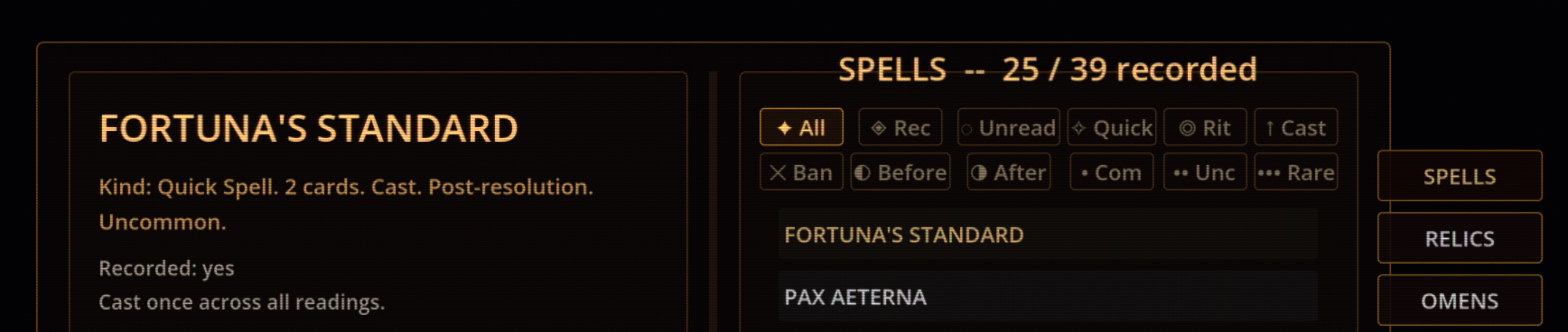
    So I added an in-book filtering system.

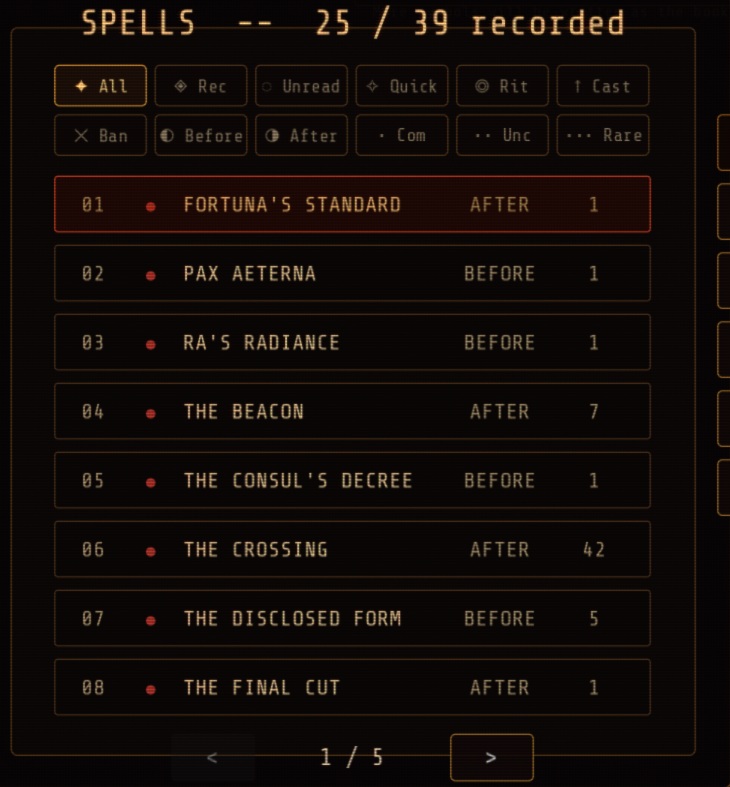
    The Grimoire now has filters for:

    • recorded spells
    • unread spells
    • Quick spells
    • Rituals
    • Cast-triggered spells
    • Banish-triggered spells
    • before-reveal effects
    • after-reveal effects
    • rarity

    This matters because the Grimoire is not just a menu.

    It is one of the main ways the player understands the game.

    Reverie is built around discovery. You are not supposed to know every phrase immediately. You learn the deck by playing it, noticing what happens, and slowly filling in the book.

    The current Grimoire is still not the final version.

    Eventually, I want the book to have a richer recipe language: more symbols, more readable glyphs, less plain text, and more of the feeling that the player is deciphering something.

    The current labels are functional, but not final.

    Long term, recipes should become more symbolic. A set might be represented by its own sigil. A card identity might have a small readable icon. Wildcards and flexible recipe slots should have their own visual language. Hovering those symbols should explain them without turning the whole book into a wall of text.

    That is the direction.

    But this pass was important because the spell list has become large enough that the book needs structure now.

    The Grimoire is no longer just a list of discoveries.

    It is becoming an instrument.

    THE DISCLOSED FORM

    The newest active set is THE DISCLOSED FORM. I posted about it in my previous 4slice Devlog.

    This set is built around anatomical study, old medical illustration, exposed structure, and calm clinical horror.

    The idea is not gore.

    It is not blood.

    It is not chaos.

    It is the discomfort of being completely visible.

    A body treated as a diagram.

    A person turned into an academic plate.

    Something understood too clearly.

    Its first spell batch includes:

    • THE DISCLOSED FORM
    • THE OPENED STUDY
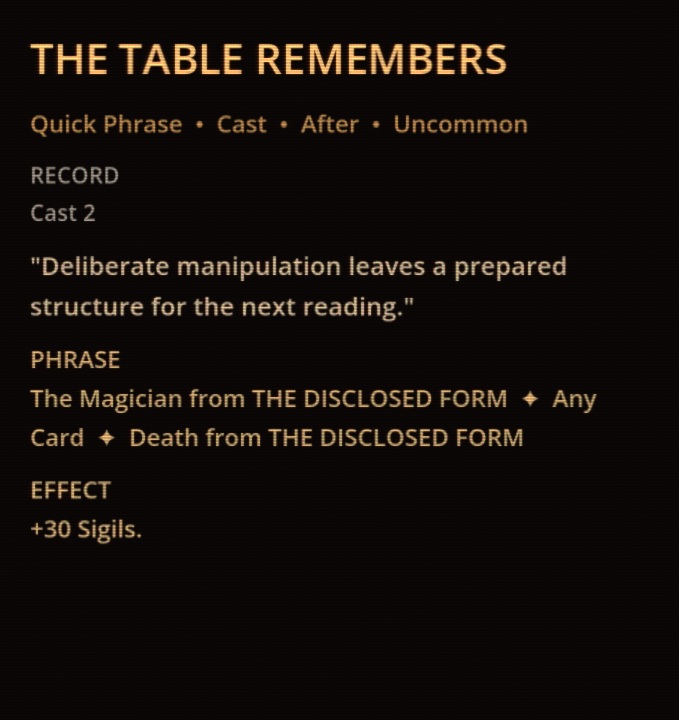
    • THE TABLE REMEMBERS
    • THE RIBS ALIGN
    • THE SECOND ANATOMY

    The batch leans into ordered exposure, study, mirrored structure, and delayed payoff.

    Mechanically, it gives the set a place in the current spell system without asking the rest of the game to change around it.

    That has become the current rule for new set content:

    Use the existing systems well before inventing new ones.

    CURRENT FEATURE SNAPSHOT

    Reverie is still unfinished, but the playable slice is much more coherent now.

    Current implemented features include:

    • Playable three-round run structure
    • Spread selection
    • Starting Deck Customizer
    • Four active tarot sets
    • 11-card focused Major Arcana scope
    • 39 implemented spells
    • Quick and Ritual spell system
    • Set-specific spell batches for all four active sets
    • Persistent Grimoire discovery and cast counts
    • Grimoire filtering
    • Pattern Tells for known Quick spell phrases
    • Relic shop
    • Offerings economy
    • Omen round pressure
    • Kinetic scoring reveal
    • Queued payoff travel
    • Current Sigils to Round Total handoff
    • Settings persistence
    • Deck, Ashes, Backpack, and Grimoire inspection tools

    There is a lot of structure here now.

    But structure is not the same as polish.

    That is the next problem.

    THE NEXT PHASE: POLISH, NOT EXPANSION

    The next phase is about polishing the four-set slice.

    • Making the Grimoire easier to browse.
    • Making Pattern Tells helpful without becoming visual noise.
    • Making scoring reveals clearer when multiple spells and delayed payoffs fire.
    • Making the four active sets feel distinct mechanically and visually.
    • Keeping the run playable while the presentation improves.

    There are still many planned systems:

    • deeper relics
    • hidden resonances
    • enhancements
    • seals
    • richer score effects
    • more tarot sets
    • stranger occult layer

    DEVLOG 3 - MAKING THE GAME EASIER TO READ

    This update is less glamorous than the last one. 

    • No big new tarot set.
    • No huge new mechanic.
    • No dramatic feature reveal.

    I have been working on the part of game development where you look at a screen and realize:

    “The systems are working, but the player cannot read them well enough yet.”
    That has been the current phase of Reverie.

    The game has enough going on now that rough presentation is starting to get in the way. 

    There are spells, delayed payoffs, relics, Omens, a Grimoire, a shop, a scoring reveal, multiple tarot sets, and a new testing spread.

    All of those systems technically work.

    But “technically works” is not the same thing as “feels good.”

    So this update is mostly about polish. [Not final polish, obviously lol devlog3]

    More like: the first serious pass at making the game easier to understand.

    THE ROUND SCREEN NEEDED HELP

    The biggest visual problem was the Round screen.

    For a while, I had placeholder sidebar art and table art in there. 

    It was useful early on, but it started making the screen feel worse instead of better.

    The game looked like it was wearing someone else’s clothes.

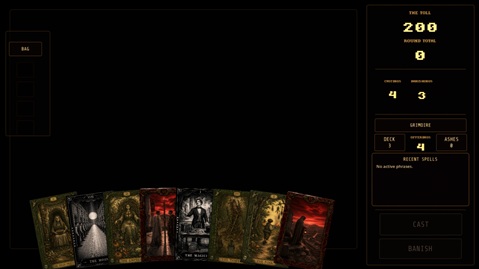
    So I pulled some of that placeholder art out and started building a more basic visual foundation.

    Right now the screen is being organized into clearer zones:

    • left side for relics and backpack
    • center for the table and scoring ceremony
    • right side for score/status information
    • bottom for the hand and immediate actions
    • It is still not final.
    • The table still needs real art.
    • The buttons still need work.
    • The right panel still needs hand-tuning.

    But the screen is starting to have an actual structure instead of feeling like a pile of useful things floating around.

    That is progress.

    THE SCORING REVEAL IS GETTING CLEARER

    A lot of time also went into the scoring reveal.

    This is one of the most important parts of Reverie, because the scoring is not just math. It is supposed to feel like the reading resolving.

    1. Sigils gather.
    2. Confluence multiplies them.
    3. The result moves toward The Toll.

    That sounds simple when written out, but it took a lot of small passes to make it readable.

    Some of the things that changed:

    • score bits now use different symbols depending on their source
    • spell effects now come from the cards/table instead of feeling like they came from an info panel
    • Confluence no longer sits on screen forever at ×1
    • Confluence now appears when it matters
    • the multiplier hits the current casting total
    • the multiplied result briefly appears before flying into Round Total
    • the final score handoff is cleaner and less boxy
    • result screens now clean up leftover scoring UI
    • None of that is flashy on its own.

    But together, it makes the game feel much less like debug math and more like an actual scoring ceremony.

    It is the supporting structure for when we REALLY add the fireworks.

    That is the direction I want.

    THE LIVING HAND

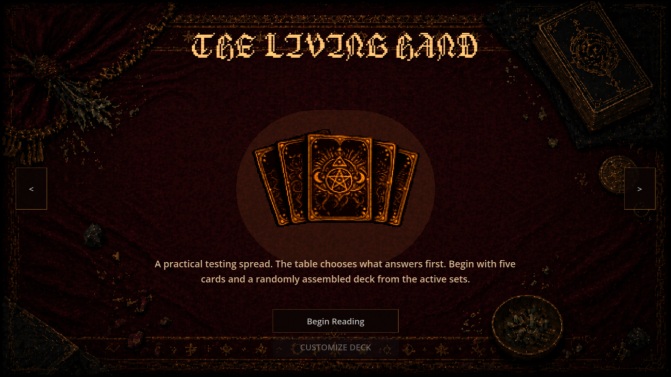
    I also added a new testing spread called THE LIVING HAND.

    T

    This is not the final deck customization system.

    The real version will eventually involve progression, unlocks, player level, and more structure.

    THE LIVING HAND is just a practical balance-testing spread.

    It gives you a 5-card hand, but still keeps the 3-card casting rule.

    That small change makes a big difference.

    You see more options.

    You see more possible spell phrases.

    You get more interesting decisions without changing the whole game.

    It has already been useful.

    also immediately revealed a bug: the randomized deck was changing between rounds instead of staying fixed for the whole run.
    That is exactly why I wanted this spread. It gives me a better way to see how the game actually behaves.

    THE GRIMOIRE IS LESS OF A WALL NOW

    The Grimoire is another place where readability started to matter more.

    At 39 spells, the book cannot just be a list anymore.

    It needs to be usable.

    Recent passes improved the font choices, cleaned up the spell rows, and made the spell details less bloated.

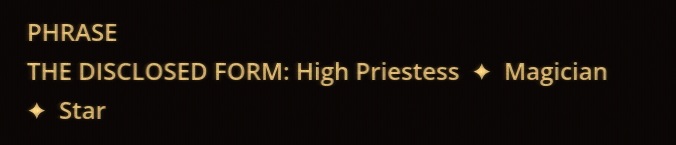
    One example: spell phrases from the same set are now compressed.

    Before, a phrase might repeat the full set name on every single card.

    Now it can read more like:

    THE DISCLOSED FORM:

    High Priestess ✦ Magician ✦ Star

    That is much easier to scan.

    OOPS. A WILD CARD YOU DONT GET THAT NICE GRIMOIRE ENTRY.
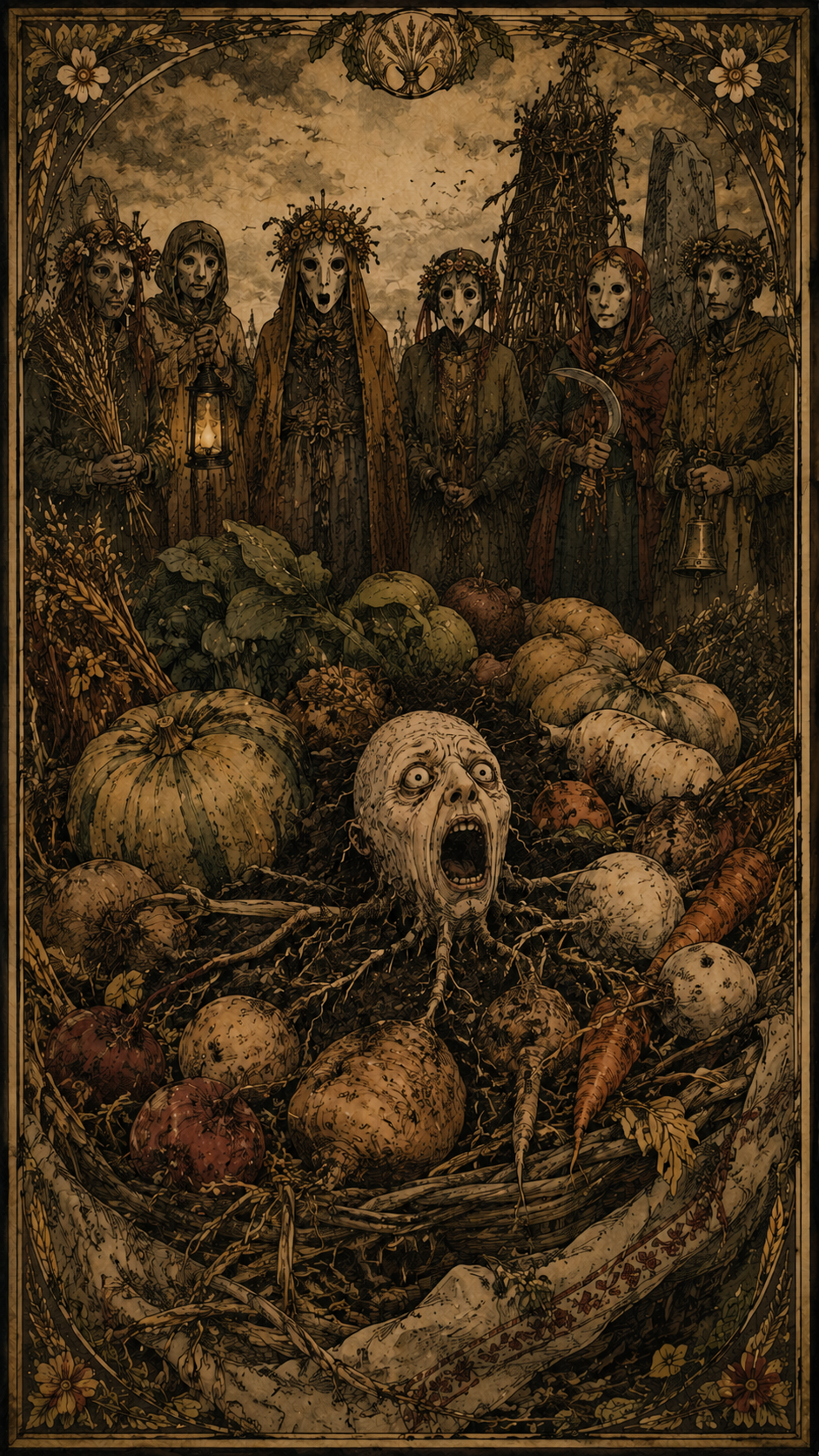
    There is still plenty to fix.

    The glyph/reference area is currently messy, and I want it to eventually become more icon-based, with mouseover explanations instead of a big list of text.

    But the Grimoire is moving in the right direction.

    Less debug list.

    More usable book.

    THE CROWS WERE TOO MUCH

    Audio got a small but necessary pass too.

    For a while, one sound was doing way too much work.

    1. Cast start.
    2. Spell trigger.
    3. Payoff reveal.
    4. Scoring beat - crow.wav

    It started to feel like the game was cawing at me constantly...

    I like crows.

    A lot.
    But even I have limits.

    So I split the audio vocabulary up a bit.

    • Cast start now has its own sound.
    • Spell triggers have their own sound.
    • Payoffs have their own sound.
    • Final score hits have their own sound.

    It is still placeholder audio, but it is already less exhausting.

    Eventually I want better final sounds, and probably different sound families for different kinds of spells. But for now, the important thing was simple:

    stop making everything sound the same.

    WHAT THIS UPDATE REALLY IS

    Devlog3 is not the kind of update where I can say “look at this one giant new thing.”

    • It is a lot of small corrections.
    • A box was too big.
    • A font was hard to read.
    • A sound played too often.
    • A number stayed on screen too long.
    • A score effect looked like it came from the wrong place.
    • A useful system was hidden behind bad presentation.
    • That is most of what I worked on.

    And honestly, this is probably the phase the project needed.

    Reverie has enough systems now that adding more is not automatically the best move.

    The better question is:

    Can the player understand what is already here?

    That is where the work is right now.

    CURRENT FOCUS

    The current focus [Today] is:

    1. making the Round screen readable
    2. tightening the scoring ceremony
    3. cleaning up the Grimoire
    4. reducing audio fatigue
    5. testing balance with THE LIVING HAND
    6. keeping the four active sets polished instead of adding more too soon

    There are still bigger systems planned.

    • More relics.
    • More set identity.
    • More Grimoire language.
    • More sound and visual effects.
    • Eventually, more tarot sets.

    But right now, the work is smaller and more practical.

    • Make it readable.
    • Make it feel better.
    • Make it less annoying.

    Then build on that.

    DEVLOG4 - The Table Starts Moving

    Yesterday's Devlog was about making REVERIE easier to read.

    That work was necessary. The game had systems, but the player needed to understand what was happening: where points came from, why spells triggered, what the route meant, and how to make decisions without staring at a debug machine.

    Since then, a lot has changed.

    This update is less about adding random new content and more about making the game’s core screens start behaving like the game they are supposed to be.

    The table is starting to move.

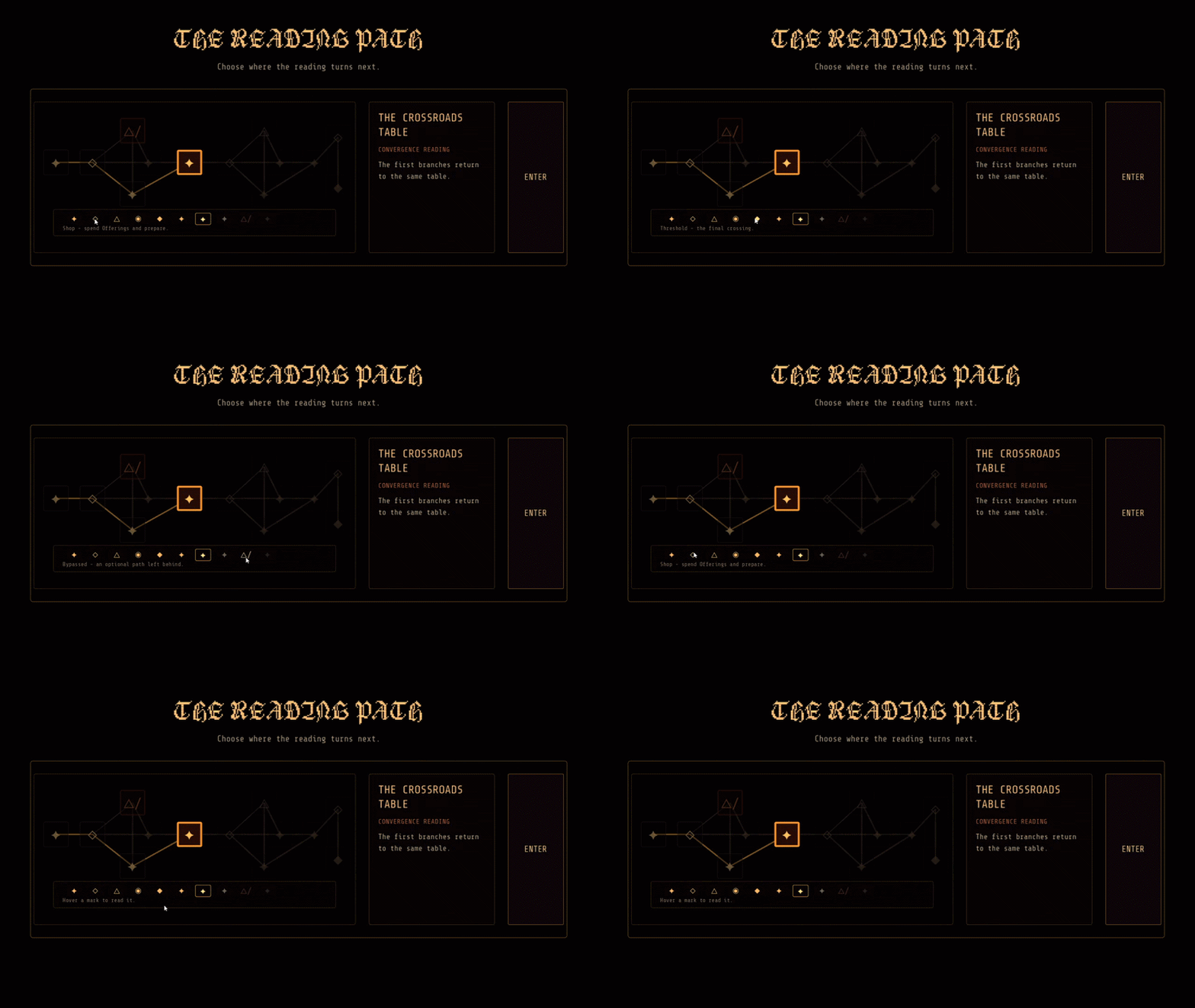
    The Reading Path became a real route

    The Reading Path was one of the biggest changes.

    Before, the route was functional, but it was too small and too literal. It was basically a short chain of nodes: round, shop, omen, final shop, final threshold. It worked as a prototype, but it did not feel like a run.

    Now the Reading Path is a larger hand-authored route map with:

    • branching paths
    • optional detours
    • convergence points
    • multiple shops
    • a final threshold
    • compact glyph nodes
    • a Grimoire-style key

    The map no longer uses big text boxes for every node. Instead, it uses symbols and lets the detail panel explain what the selected node means.

    That sounds small, but it changed the whole feeling of the screen. It feels less like selecting a menu option and more like following a strange reading across a board.

    We also changed a bug with how our run system // or THE SHROUD works.

    Previously, the game treated round 3 as the Shroud round. No matter what. That was fine for the tiny prototype route, but once the route expanded it became a problem. Normal late-route readings would accidentally become boss-pressure readings just because the internal round counter hit 3.

    That gives the route room to breathe.

    The scoring basket is becoming the main ceremony

    The scoring reveal has also changed a lot. It's still hilariously uniform. We'll probably add a cone downwards at an angle and randomize the bit spawning.

    The play area is now becoming the game’s scoring chamber.

    Instead of every score contribution simply flying straight into the UI, positive Sigil contributions now emit little bits into the central trough. The bits rain down, spread across the floor, collect together, and then drain into Sigils or Confluence.

    The important part is that this is not just visual noise. 

    The score still comes from the same authoritative math. 

    The basket is presentation, not fake scoring.

    But the presentation matters.

    A card giving +15 Sigils now feels more like it is physically contributing to the reading. It rains into the table. Multiple cards can rain bits at the same time. Spell and faction contributions can join the same scoring surface before the shared drain.

    Confluence bits are also visually distinct from Sigil bits. They are larger and heavier so multiplier gains read differently from point gains.

    This system is still early, but it is finally pointing in the right direction.

    Future basket work will probably include:

    • bit combining
    • merge effects
    • lingering omen, relic, construct, or ritual tokens
    • Sigils and Confluence crashing together
    • slot-machine-style final total settling

    But the foundation is now there.

    The table receives the score before the UI does.

    That is the feeling we wanted.

    The shop became an actual shop

    The shop also got a major pass.

    Previously, the shop had one relic offer and a couple of service panels. It worked, but it felt too much like a functional menu.

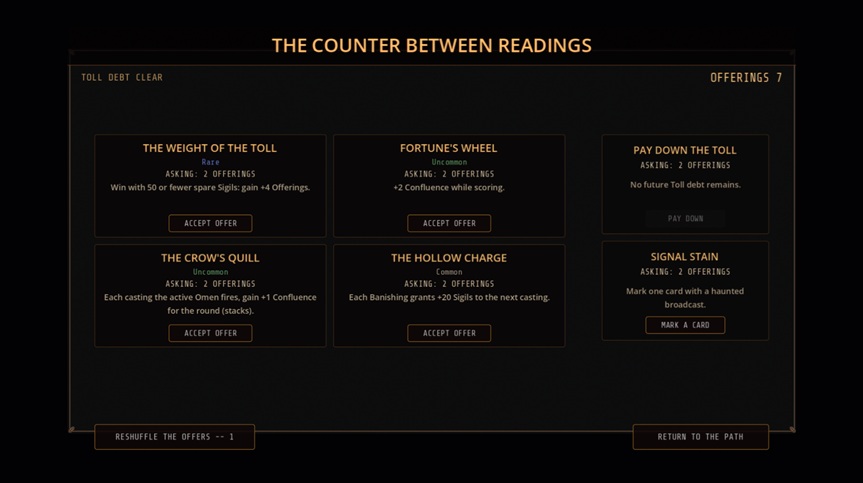
    Now the shop has a 4-offer relic grid.

    Each relic offer has:

    • name
    • rarity
    • cost
    • effect
    • its own purchase state

    Buying one relic marks only that slot as sold. The other offers remain available. Refreshing still costs 1 Offering, but now it rerolls the whole grid.

    The shop was also restyled closer to the Grimoire and Reading Path language: thinner amber linework, darker ledger panels, tighter spacing, and smaller buttons.

    The goal is for the shop to feel like an occult counter between readings, not a generic store screen.

    There are still future shop systems planned: card packs, card removal, faction services, and stranger offers. But this pass was about making the current shop feel like it belongs in the game.

    Death is now Legendary

    We also started adding card identity rarity.

    The current rarity tiers are:

    • Common
    • Uncommon
    • Rare
    • Epic
    • Legendary
    • Mythic
    • Corrupted

    Death is now globally Legendary and is no longer available in starting decks.

    This matters because Reverie should not treat every card identity as equally available from the start. Death should feel like an acquisition moment, not starter filler.

    For now, this is a small first step. Death is excluded from starter generation and the starting deck customizer, but the full rarity economy is still deferred.

    Eventually rarity will matter for:

    • card packs
    • shops
    • rewards
    • upgrades
    • special events
    • corrupted cards

    But this was the first piece of that foundation.

    The Silver Nitrate Dream got its first real identity

    The Silver Nitrate Dream has a strong visual identity: silent film, old theatrical framing, flicker, edits, repeated images, and haunted performance.

    Now it has mechanical identity too.

    WHAT does that mean? Passives? Builds? 

    Check them out in Devlog4.5

    What allllll this means for the game

    Reverie is still early, the numbers are not balanced yet.

    But the game is becoming more like itself.

    • The route is no longer just a menu. 
    •  The scoring reveal is no longer just arithmetic. 
    •  The shop is no longer just a debug store. 
    •  The Silver Nitrate Dream is no longer just a visual set.
    • The systems are beginning to form a language.

    That is the main progress since yesteday.

    Not everything is done. A lot is still rough. But the direction is much clearer now.

    The current focus is still the same:

    make the game readable  
    make the game strategic  
    make the game feel ritualistic  
    make every number have a source  
    make the table answer 

    Next up, we will probably keep testing the new route, shop, and scoring basket while continuing to give the four active factions more personality.

    Silver was the first one to wake up.

    The others are waiting.

    (1 edit)

    DEVLOG 5 - The Silver Nitrate Dream Learns to Remember

    The last Devlog was about getting the table moving. We now have routes, and a map, and some [very primitive] score effects. hah. This post is different. This is a little insight into what even makes Reverie a game in the first place. MECHANICS! Who the heck wants to play a calculator!?

    The Silver Nitrate Dream has always had one of the clearest visual identities in the game: silent film, old theatrical framing, flicker, title cards, projectors, shadows, and images that feel like they should have stopped moving a long time ago.

    VISUAL IDENTITY IS NOT ENOUGH! 

    A set in REVERIE should not just look different. It should make the player think differently.

    So this morning, Silver Dream started becoming a real faction.

    The Silver Nitrate Dream is not just - 

    “Oooo, old timey, black-and-white tarot.”

    It is about:

                                               retakes

                                                          repeated images

    edits

                                              ghosts of prior scenes

                  performance

    framing

                               the moment that survives after the scene ends

    The core idea is simple:

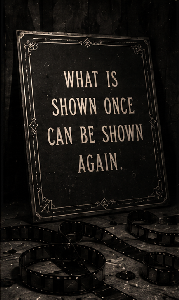
    What is shown once can be shown again. 

    That became the foundation for Silver’s first two faction mechanics
    SECOND EXPOSURE and AFTERIMAGE.

    Silver Dream | Set Passive #1 is SECOND EXPOSURE. 

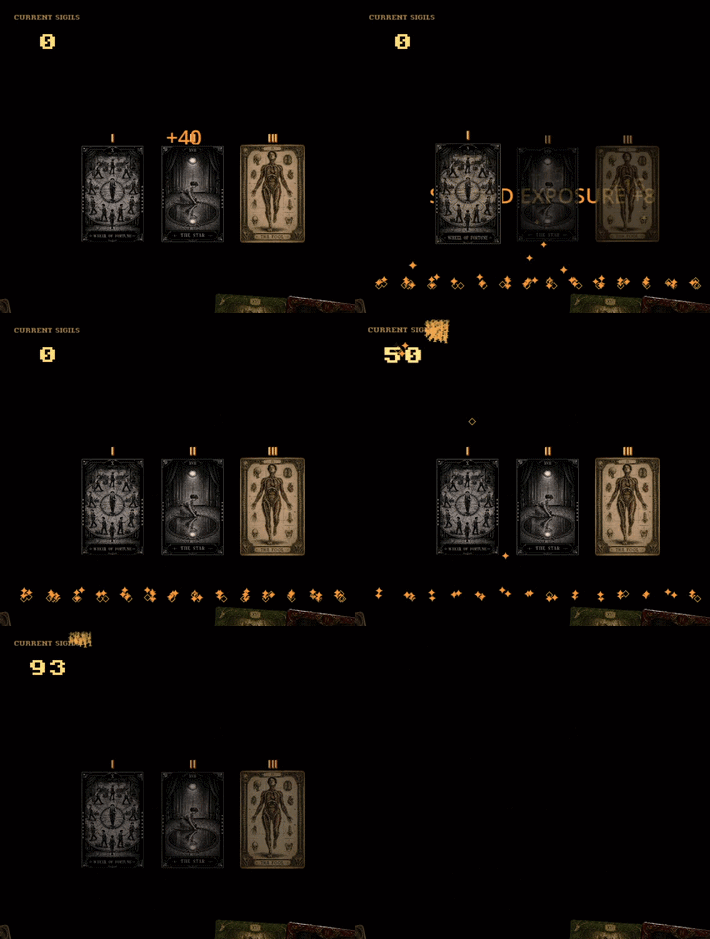
    [Not a great example picture, but the you can see the second proc score.]

    If a casting contains 2 or more Silver Nitrate Dream cards, the weakest Silver card is replayed at reduced value.

    Right now, because the current base cards are 15 Sigils, that usually appears as:

    SECOND EXPOSURE +8 

    It enters the scoring basket as its own named faction contribution.

    This is the simplest version of Silver’s identity: a played image appears again, weaker but still present.

    It is not a huge mechanic by itself, but it changes how the set feels. 

    • Playing two Silver cards together now means the scene repeats itself.
    • The card has been shown twice.

    It will play into a ton of synergy down the line.

    Silver Dream | Set Passive #2 is AFTERIMAGE. 

    If a casting contains 3 or more real Silver Nitrate Dream cards, the reveal pauses and asks the player:

    CHOOSE THE IMAGE THAT REMAINS 

    The eligible Silver cards become selectable. 

    The rest of the scene dims. 

    The chosen card gets a small spotlight moment.

    That chosen card becomes an Afterimage.

    On the next cast, the Afterimage returns as a phantom edge card.

    The player can choose whether it appears on the left or right side of the next casting:

    < AFTERIMAGE > 

    That matters because Quick spells care about card phrases.

    So the Afterimage is not just a bonus. It can help complete a spell.

    Example:

    Afterimage on the left:     AFTERIMAGE → Card 1 → Card 2 → Card 3   Afterimage on the right:    Card 1 → Card 2 → Card 3 → AFTERIMAGE 

    This lets Silver do something very specific: it edits the edge of the next scene.

    This part matters a lot.

    The Afterimage can help complete QUICK CAST spells, but it is not a normal card.

    It does not enter:

    • the hand
    • the deck
    • Ashes
    • replacement
    • Ritual history
    • Banish matching

    It does not count toward casting size. It does not count as another Silver card for Silver combo density. It does not become a loophole engine.

    It is a memory of a card.

    That boundary is important because it lets the mechanic feel strange without breaking the run.

    The AFTERIMAGE is allowed to haunt the phrase, not the whole system.

    Before this, a card set could have different art and different spells, 

    but the player was still mostly doing the same kind of math.

    Now Silver has a gameplay sentence:

    Play silver cards

    Repeat part of the scene.

    Choose the image that remains.

    Use that image to shape the next casting.

    That creates actual decisions.

    Do I play three Silver cards now to create an Afterimage?

    Which card should remain?

    Should it return on the left or right side?

    Can it complete a spell without spending a real card slot?

    That is the beginning of faction identity.

    I am not trying to overload Silver immediately.

    There are ideas for a Cut mechanic, where Silver could edit a card out of the scene or transform part of its value. 

    That still fits the set, but I'm holding it back for now.

    Too many manual choice moments in one faction could become annoying.

    Instead, Cut may eventually become part of a modifier or faction-shop system.

    Some saved ideas:

    CUT SEAL - This card is edited out after scoring and converts part of its Sigils into Confluence.

    SPLICED - When this card is replayed, its echo is stronger.

    BURNED FRAME - This card scores high once, then loses value.  

    DIRECTOR’S MARK - If this card is chosen for Afterimage, gain extra Sigils.  

    FINAL CUT - If this card is last in the casting, replay another Silver card at reduced value. 

    These are not implemented yet. 

    They are future directions. 

    And we have to add enhancements / seals / and stamps to the game before we can add any of those. 

    For now, the goal is to let SECOND EXPOSURE and AFTERIMAGE breathe.

    This is the direction I want every faction to move in.

    Not just:

    this set gives +30, that set gives +1 multiplier 
    [There will be these type of items, but with interesting twists.]

    But....

    this set changes how I think about the casting 

    Yes! That's what we want! or just...

    this set changes how I think

    The Silver Nitrate Dream now plays like memory and editing.

    The other sets should eventually find their own grammar too.

    • Imperial Augury should feel like decree, order, authority, and command.
    • Harvest Covenant should feel like offering, return, growth, and sacrifice.
    • The Disclosed Form should feel like structure, anatomy, exposure, and alignment.
    Silver was simply the first one to wake up.

    The current Silver Nitrate Dream package is:

    SECOND EXPOSURE // AFTERIMAGE // AFTERIMAGE ECHO

    It is still early. 

    It will need balance. 

    It will need better visuals. 

    It will need sound.

    But the shape is there now.
    The game is not just counting cards.
    It is starting to remember them.

    DEVLOG 6 — THE HARVEST COVENANT LEARNS TO OFFER

    The last DEVLOG was about The Silver Nitrate Dream learning to remember.

    This one is about The Harvest Covenant learning to take.

    Not because the numbers are final. They are not. Not because the system is perfectly balanced. It is absolutely not. But because the set finally started behaving like the thing it was always pretending to be. The Harvest Covenant is no longer just the folk-ritual set. It now has a gameplay identity.

    A Harvest card is not always played as a card.

    Sometimes it becomes ritual material.

    The question is no longer only:

    What does this card score?

    The question is:

    Is this card being read? Or is it being given?

    That is the whole faction now.

    Visual Identity is Not Enough. 

    A theme or set in a game shouldn't just look different.

    It has to make the player think differently.

    The Silver Nitrate Dream became about memory, replay, and lingering images.

    The Harvest Covenant needed its own answer.

    It already had the feeling:

    • offering
    • return
    • growth
    • witnessing
    • sacrifice
    • the village
    • the field
    • the uncomfortable logic of “this had to happen”

    But it needed mechanics that actually behaved like that.

    Not generic bonus points.

    Not “play three green cards, get a reward.”

    Something more specific.

    Something that felt like the table was accepting a card differently than it accepts the others.

    That missing idea finally clicked.

    A Harvest card can stop being a word in the casting. 

    It can become an offering.

    THE FIELD RECEIVES

    This triggers when you cast exactly 2 Harvest Covenant cards.

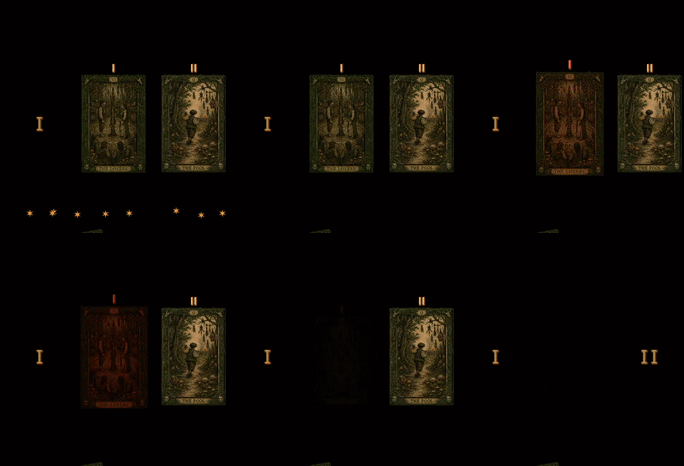
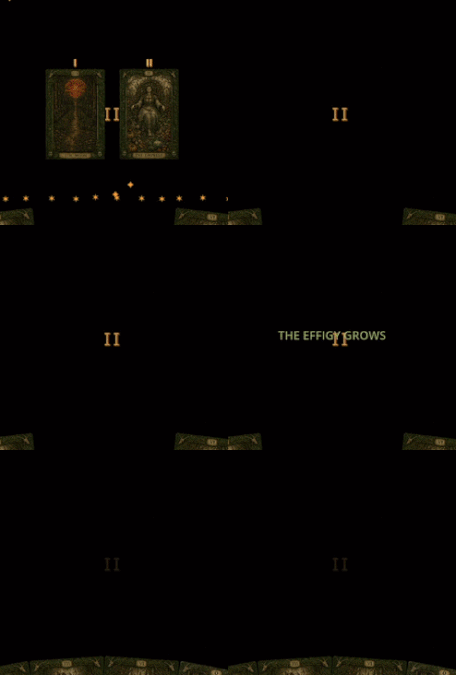
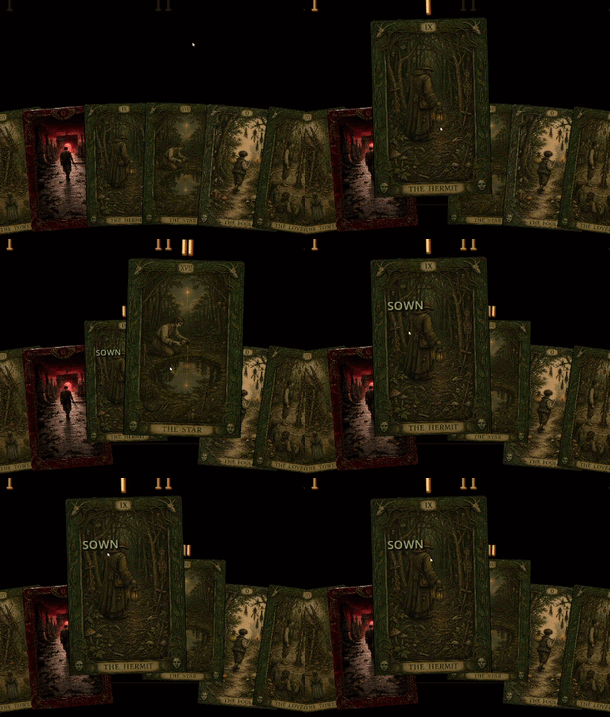
    The weakest Harvest card is Sown. Like this ->

    A Sown card still counts toward Harvest Covenant density, but it is no longer treated like a normal played card.

    A Sown card:

    • does not score its own Sigils this casting
    • does not complete spell phrases
    • still appears in the reveal
    • gains +10 Sigils after the reveal/handoff for the rest of the run

    So the current casting gets weaker.

    Their future gets stronger.

    The field does not read the card.

    It takes it.

    (this one also caused the effigy to grow. but you see the sown.)

    The important part is that the Sown card is not just “worth zero this cast.”

    It is removed from the normal meaning of the casting.

    If The Lovers is Sown, it does not complete a Lovers spell.

    It is no longer a word in the spell sentence.

    It is ritual material.

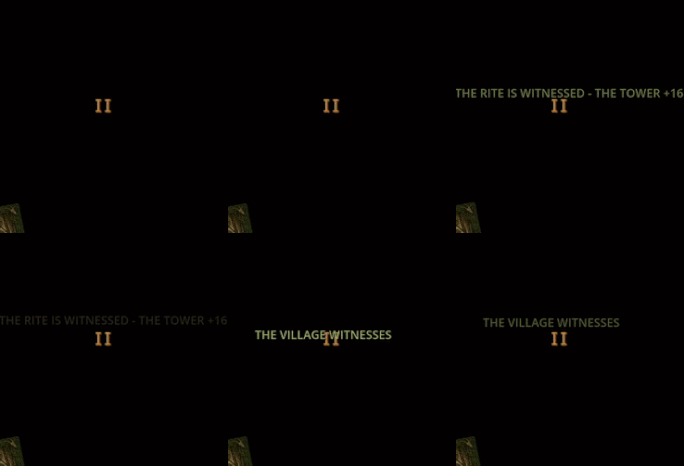
    THE RITE IS WITNESSED

    This triggers when you cast 3 or more Harvest Covenant cards.

    The weakest Harvest card is Offered.

    An Offered card:

    • does not score
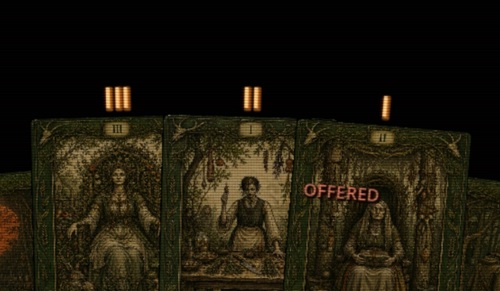
    • does not complete spell phrases
    • transfers its current Sigil strength to the strongest remaining Harvest card
    • is removed from the run after the reveal/handoff

    This is not a discard.

    This is an offering.

    The village does not waste the weak card.

    It feeds it to something that will remain.


    This is where the set finally started feeling like itself.

    The Harvest Covenant does not simply reward you for playing its cards.

    It asks you to decide which card the rite receives.

    A weak card can be planted.

    A weak card can be offered.

    A survivor can inherit everything.

    And because the offered card’s current Sigil strength matters, the whole system starts to compound.

    A card that has already grown can become better ritual material later.

    That is the part I love:

    The deck starts developing a history of what was given away.

    The Effigy

    The Harvest Covenant also now has a run-local ramp system [as does every other 'faction'.]:

    THE EFFIGY

    Harvest castings add Kindling.

    • 2+ Harvest cards  -> +1 Kindling 
    • 3+ Harvest cards -> +2 Kindling

    Every 3 Kindling:

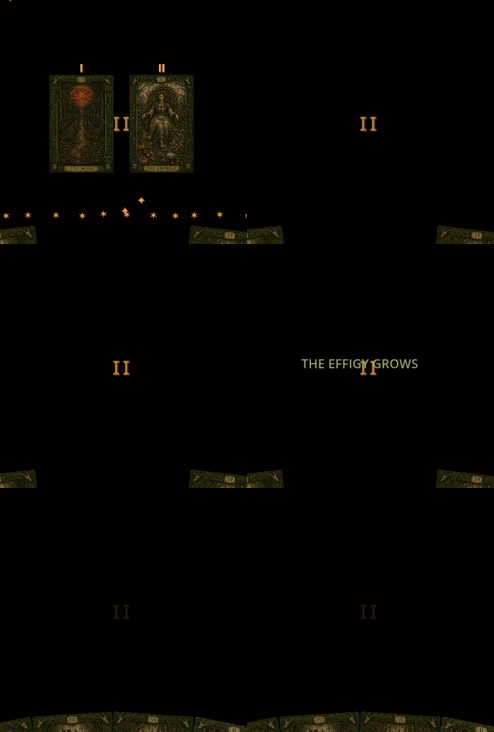
    THE EFFIGY GROWS

    When The Effigy grows, all Harvest Covenant cards gain +1 Sigil for the rest of the run. 

    [lol. i know.. i know.. polish when the systems are in place.]

    It applies to the cards at the time of growth, doesn't backpay!

    This matters because The Effigy does not live in isolation.

    It makes every other Harvest decision more dangerous.

    Sown cards grow harder.

    Offered cards transfer more.

    The whole faction starts compounding.

    So the loop becomes:

    Sow weak cards.   Let them grow. Offer weak cards. Feed their value into survivors. Build Kindling. Grow The Effigy. Make every future Harvest card more valuable.

    That is The Harvest Covenant now.

    Not a simple point bonus.

    A ritual economy.

    PLAYER CHOICE

    One thing I wanted to avoid: the game should not surprise the player by stealing a card.

    If the table is about to take something, the player needs to know.

    So Harvest now has pre-commit readability.

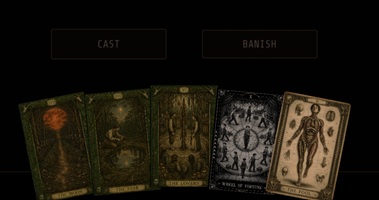
    Before you press CAST, the game marks the ritual material:

    SOWN OFFERED

    This is important.

    The rite should be harsh, but it should not be dishonest.

    If the player gives something to the field, they should understand what they are giving.

    The cruelty should come from the decision, not from UI ambiguity.

    DISPLAY ISSUES

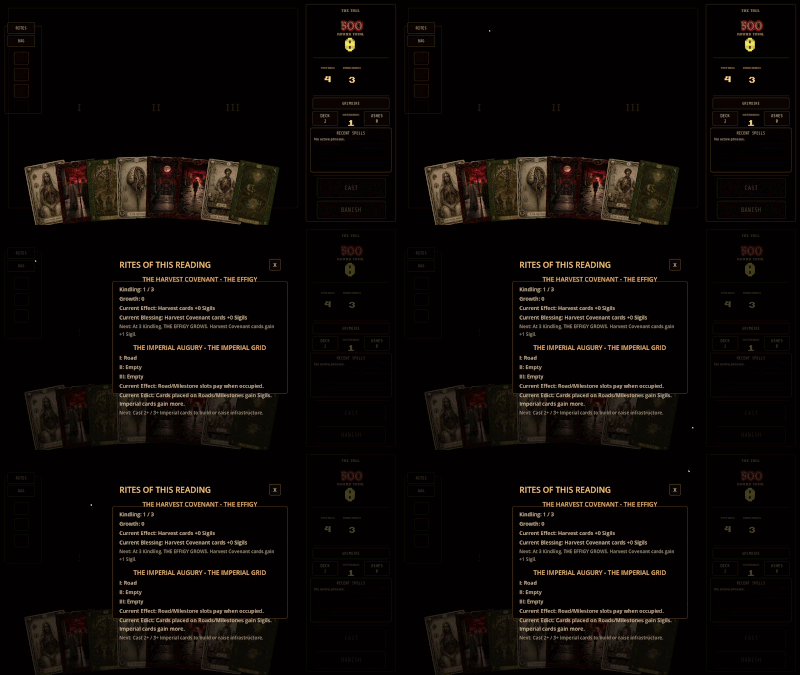
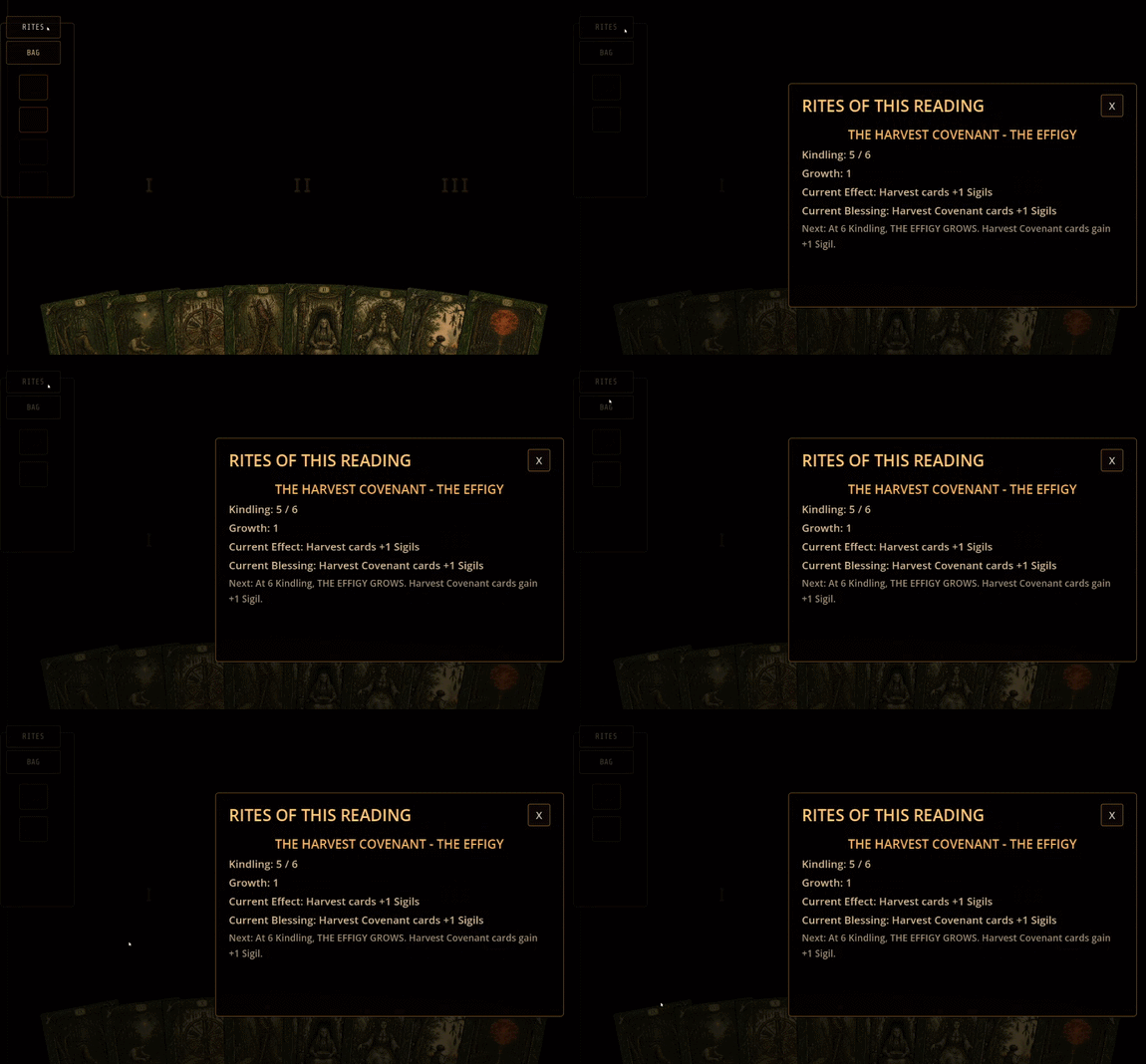
    Because these systems are run-local, REVERIE also needed a place to show what the current reading has become.

    That became the RITES overlay. 

    Extremely rough at the moment, but hey, we needed it to know what's happening. I am still deferring the polish pass until most of the necessary systems are in place. Every single one of these things will change. The effects and everything else. I just want to see how the actual game feels before I put tons of effort into that:

    WE NEED A GAME FIRST.

    anyway,

    RITES tracks things like:

    • Kindling
    • Effigy Growth
    • current Harvest blessing
    • active faction engines from other sets
    • This is not a permanent progression screen.
    • It is not a collection menu.
    • It is a quick reference for the current reading.
    • It was needed for testing.

    The game is starting to have more systems that persist through a run, and the player needs a clean way to ask:

    What has the table become?

    RITES is the first answer. 

    This system is powerful.

    It is also dangerous.

    Harvest can consume its own deck.

    That is correct for the faction. I do not want to sand that down. The whole point is that Harvest turns cards into offerings, and offerings should cost something. But it creates a new dependency. If a faction can remove cards from the run, the game needs ways to gain cards too.

    So this pass pushed REVERIE toward its first card acquisition system. (Which was always the plan anyway.)

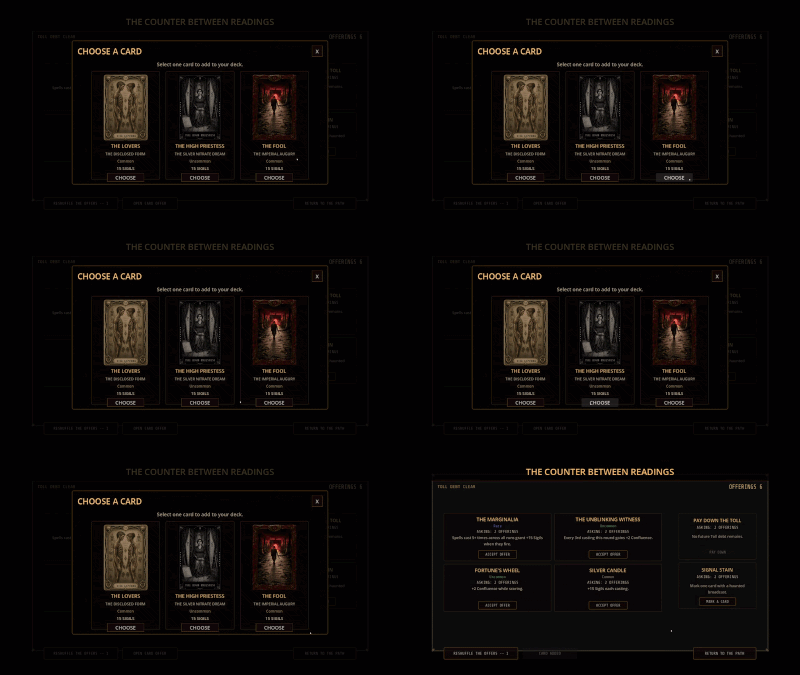
    There is now an early Card Reward v0:

    Choose 1 of 3 card offers.  Add the chosen card to your run deck. Same ol' Roguelike system. 

    Ideally we don't want it after EVERY 'reading'. Should be enough to give direction to your build off of the first map though.

    This is still early.

    Eventually, different Reading Path nodes should have different rewards, and a 3-card choice should be one possible node reward.

    For now, the important part is that Harvest created a real design need.

    It made the game ask for card acquisition.

    That is usually a good sign.
    A mechanic is doing something real when other systems have to exist around it.

    Before this, The Harvest Covenant could have stayed “the folk horror set.”

    It had the look.
    It had the mood.

    But now it has grammar.

    Silver remembers.

    Harvest sacrifices.

    Imperial builds the field.

    Disclosed opens the structure.

    That is the current shape of REVERIE’s faction design.

    Each set should not only look different.

    Each set should ask a different kind of question.

    Harvest asks:

    What are you willing to give away?

    And then it remembers the answer.

    We will visit Rome later today, or tomorrow morning.

    This is all still early.

    The numbers are not final.

    The visuals need more work.

    The sounds are not there yet.

    The card reward economy is only in its first usable form.

    The Harvest Covenant will need more support as runs get longer and deck-building gets deeper.

    But the shape is there now.

    That is the part that matters.

    The game is not just counting cards.

    It is starting to ask what the cards are willing to become.