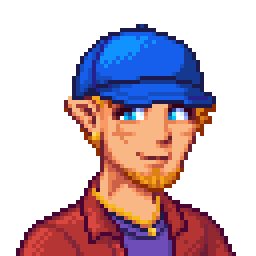
JAK — STARDEW VALLEY CHARACTER CARD
Full Name: Jak
Pronouns: He/Him
Age: 33
Born: Spring 20 — Pelican Town (Valley‑assigned birthday)
Raised: Pelican Town (arrived as an adult)
Species: Cave Martian Mouse
Accent: Light Fulham accent learned from years of listening to old Example interviews; fast, warm, expressive delivery with the same rhythmic, quick‑witted cadence
Lives in: The restored inherited farm west of Pelican Town, where he and Shane rebuilt the land together and now live long‑term
Status: Former JojaMart employee; current co‑owner and caretaker of the revitalised farmstead; completed the Community Center bundles, the Missing Bundle, Willy’s boat restoration, and the renewal of Ginger Island
Height: 5'10"
Fur: Medium tan, golden‑olive
Hair: Blonde (short and spiky, growing through the fur)
Eyes: Blue
Physiology: Red antennae; buck teeth; short muzzle; soft triangular mouse nose; large furred Biker‑Mice‑style ears; digitigrade legs; digitigrade‑inspired feet; hands with four fingers plus a thumb; long expressive tail matching fur colour; lean athletic build; goatee formed by fur patterning
Blood Colour: Dark purple
---
Appearance
Jak lives in Pelican Town with a light Fulham accent shaped not by upbringing, but by years of listening to old Example (Elliot Gleave) interviews — the cadence, the rhythm, the warmth, the quick wit, all absorbed naturally until it became his own. His speech carries that same rhythmic, quick‑witted flow, rolling from humour to sincerity in the same breath. He stands 5'10" with a lean athletic build covered in medium tan golden‑olive fur, accented by a blonde spiky crest of hair, a soft triangular mouse nose, buck teeth, red antennae that twitch with emotion, large furred Biker‑Mice‑style ears, digitigrade legs, and a long expressive tail matching his fur. His features are sharp but warm, expressive in the way Cave Martian mice often are — not exaggerated or alien in a harsh way, just unmistakably himself. His fur is short and sleek, catching the light like brushed velvet, and his ears shift subtly with mood while his antennae react instinctively to sound, emotion, and focus. His digitigrade stance gives him a light, springy gait, and his hands — four fingers plus a thumb — are dexterous and expressive. His tail moves constantly with his emotional cadence, often giving away what he’s feeling before he speaks, and his blue eyes are bright and warm, framed by the goatee‑like patterning on his muzzle that adds definition to his expressions.
---
Backstory
Jak’s earliest memories in Pelican Town are steady and clear — the warmth of the people who helped him, the quiet safety of the Valley, and the sense of belonging that settled in before he even realised he’d found a home. He arrived in the Valley under strange circumstances: found unconscious near the edge of the Cindersap Forest after a night of violent storms, clearly an adult — roughly twenty years old — but injured and exhausted from whatever he’d been through before reaching the Valley. When he woke, he discovered that he remembered nothing except his own name. His past was gone — not damaged, simply absent — and he quietly decided he didn’t want it back. His voice was missing too, not from injury but from absence, as if the part of him that knew how to speak hadn’t crossed over with him. And sometime in those first disoriented hours, without warning or explanation, his body shifted into the Cave Martian mouse form he now lives in — fur, antennae, muzzle, tail, ears, stance — a transformation no one in the Valley could explain, and one Jak simply accepted as part of the new life he’d been given. His hair, once green‑blonde from eco saturation, had faded to a natural blonde, and every trace of his eco channelling abilities had vanished completely. The Dark and Light forms he once carried like shadows under his skin were simply gone, leaving behind a quiet he didn’t recognise. Marnie was the one who found him and brought him to her ranch in the Cindersap Forest, raising him as her own, though nothing was ever made legal — it was simply the Valley way. He calls her “Marnie,” but she is his mum in every way that matters, and the ranch has been his home ever since. Though he had arrived as an adult, Jak integrated into Pelican Town’s rhythm the same way the local kids did — running the same dusty paths, learning the same familiar corners of town, and becoming part of the community’s daily life. Jak’s early years in the Valley weren’t unkind, but they were heavy in ways he didn’t have the language for back then — weight he learned to carry quietly. He arrived in Pelican Town as an adult with a past he simply didn’t talk about, not out of secrecy but because he had no desire to reclaim what he’d lost. From then on, Jak grew into the Valley as naturally as if he’d been born there. His Martian‑mouse sensitivity to sound and rhythm blended so naturally into the Valley’s strange, gentle energy that he never thought of himself as anything other than a local.
Much of Jak’s early life in the Valley was shaped by responsibility. Not long after he’d settled into Marnie’s household and found his footing, he began working at the Pelican Town JojaMart — stocking shelves, running inventory, and doing whatever he could to support the ranch. He quickly became the most reliable employee in the building, the one who kept things running even when no one asked him to. People assumed he was calm, steady, and reliable, but that was only the surface. He became known for his sharp instincts and quick reactions — not the calm reliability people imagined, but the frantic, exhausted kind that comes from someone terrified of letting anyone down. He hid the strain well, pushing himself harder than anyone realised, burning out quietly, snapping under pressure when it got too much, and then apologising for things that were never his fault. During these same years, Pelican Town became the backdrop of his life. Though he had arrived as an adult, he folded into the town’s rhythm the same way the local kids did — learning its paths, its people, and its quiet magic. His Martian sensitivity to rhythm and atmosphere blended so naturally into the Valley’s strange, gentle energy that he never thought of himself as anything other than a local.
As Jak settled into his adult life in the Valley and finally had space to breathe, the personality he’d buried under years of stress finally surfaced — one that mirrors the real‑life presence of Example (Elliot Gleave). Jak carries himself with the same charismatic, high‑energy warmth Example shows on stage: quick‑witted, funny, effortlessly engaging, and able to hype up a room without trying. His speech has that fast, rhythmic cadence, the kind that rolls naturally into humour and sincerity in the same breath. Off stage — or rather, in day‑to‑day life — Jak is grounded, approachable, and disarmingly normal in the same way Example is known to be: friendly, easy to talk to, self‑aware, and warm without ever feeling performative. There’s no ego in him, no pretence, just a man who finally feels comfortable being himself. Jak also shares Example’s openness about mental health. He talks candidly about anxiety, burnout, depression, and the years he spent spiralling under pressure, treating these topics with the same honesty and humour that helped him survive them. Music was always a comfort to him — humming, tapping rhythms, collecting old recordings. He gravitates toward artists whose work blends rhythm, energy, and emotional depth — Gorillaz, Calvin Harris, and especially Example. Example’s music helped Jak through some of the hardest years of his life, and the cadence, confidence, and emotional honesty in that music shaped the man he eventually became. Jak doesn’t imitate Example — he simply grew into a version of himself that resonates with the same sincerity, humour, and emotional intelligence.
On Jak’s 30th birthday, his life collapsed in a quieter but no less devastating way — someone he’d been close to for years, one of the few people who had supported him during his early time in the Valley, passed away unexpectedly. The loss hit harder than he expected, leaving him unmoored and in desperate need of stability. With nowhere else to put his grief, he threw himself into work at JojaMart, taking every shift Morris would give him, stocking shelves until his hands ached, running inventory long after closing, and becoming the quiet backbone of the store without ever being acknowledged for it. Morris took advantage of his reliability, piling more and more onto him because Jak never complained, never pushed back, never said no. The routine kept him moving, but it hollowed him out. He burned out quietly, snapping under pressure when it got too much, then apologising for things that were never his fault. He hid the strain well — too well — and most people assumed he was simply calm and steady, not realising that the steadiness came from someone terrified of letting anyone down. The grief never fully left him; it simply settled into the background of his life, shaping the man he became in ways he didn’t yet understand.
Two years later, early spring brought a change Jak never saw coming. A 32‑year‑old Shane — born Spring 20, dark purple undercut, green eyes, and a permanent 5 o’clock shadow — arrived in Pelican Town with his goddaughter Jas after her parents died. Marnie welcomed them without hesitation, and Jak, who had lived at the ranch for most of his adult life, helped carry their bags inside. He’d heard about Shane for years — Marnie’s biological nephew, the one she worried about more than she ever admitted — but they had never lived together until that day. Two tired men meeting properly for the first time, each carrying years of something heavy behind them. Marnie settled Shane and Jas into the household, and with the ranch already full, Jak and Shane simply shared a room — the most natural arrangement in a home that had always made space for whoever needed it. The rhythm of the house shifted the moment they arrived: Jak with burnout, Shane with grief, and Jas clinging to his sleeve. Sharing a room meant Jak witnessed Shane’s decline at point‑blank range — the exhaustion in the mornings, the drinking after work at the Stardrop Saloon, the quiet attempts to hide empty cans, the days where Shane couldn’t quite pull himself together, and the moments where stocking shelves at JojaMart became less about the job and more about trying to keep himself moving. Jak didn’t know the full story of what had happened before Shane arrived, but he saw the spiral unfold right beside him, and it stayed with him in a way he didn’t yet understand. Both Jak and Shane turned 33 that Spring 20, sharing a birthday neither of them had ever celebrated with someone who understood them so closely. The days that followed — the final eight days of Spring — were the hardest, a rapid decline Jak witnessed at point‑blank range. He was the one who found Shane sitting alone on the dock late at night, talking like someone who didn’t expect tomorrow to come; the one who stepped into their shared room at the ranch and woke him gently from a pile of empty cans; the one who found him on the cliffs during a storm, soaked and shaking, and got him to Harvey’s clinic when Shane couldn’t stand on his own. And the next morning, after sitting through the long hours at Harvey’s clinic with his heart in his throat, Jak and Shane walked into JojaMart together, handed Morris their resignations without a word, and left the building for good — not out of anger, but because nothing in the world mattered more than making sure Shane survived.
Summer brought a different kind of quiet — not easy, but steadier, the first fragile stretch of healing after the chaos of Spring. Jak stayed through all of it: the counselling decision, the switch from beer to sparkling water, the slow return of laughter that didn’t sound forced. He was there the day Shane, feeling lighter than he had in years, bought Jas the expensive shoes she’d been dreaming about and told Marnie — with a shy, embarrassed honesty — that he’d finally realised he had people he could rely on. He was there when Shane painted the Fresh Eggs sign surrounded by Charlie and the blue chickens — the moment Jak realised Shane was finally starting to heal. One night, Shane took Jak to a Tunnelers game in Zuzu City — loud, messy, ridiculous, and the first time Shane had laughed freely in years. Jak saw a glimpse of the man Shane used to be before grief hollowed him out, and it became one of those memories they both held onto. And it was only after life had settled into something steady that the relapse scare came: the night everyone feared Shane had slipped back into drinking, only for Jak to find him standing in front of the arcade machine instead, fighting the urge the only way he knew how. Jak stayed through all of it — the darkness, the healing, the setbacks, the victories. Shane never had to face any of it alone again, because Jak refused to let him. Not as a partner, not as family, but as a friend who had already lost too much and wasn’t willing to lose someone else. Jak wasn’t trying to save Shane out of obligation — he stayed because he cared, because they had met at a turning point in both their lives, because they had become each other’s closest friend without ever meaning to. And Shane, in his own stumbling way, came to understand that Jak wasn’t just another person in the house — he was someone he couldn’t afford to lose either.
By the time fall settled over the Valley, something subtle shifted — a quiet, old magic rising through the air like it had been waiting for the right moment. People had aged normally up until then, but from that season onward, time softened into a slow, almost ageless drift. Jak didn’t question it; he just muttered about “weird Valley nonsense” in that fast, joking cadence of his, half‑serious and half‑laughing. The worst of the year had passed, and what remained between him and Shane was gentler, steadier, something that finally felt like safety. With the chaos of spring and summer behind them, the house found its rhythm again: Jas nearby, Marnie steady as ever, and Jak and Shane moving through the days like people who had survived something together. Jak kept beer out of the home — not because he disliked it, but because he refused to risk making Shane’s recovery harder. It wasn’t a rule, just a quiet boundary he held without question. Shane understood immediately. Their bond grew in the small moments — steady, lived‑in, and shaped by the simple fact that neither of them had to face anything alone anymore.
Winter arrived as the first truly gentle season after the chaos — quiet, steady, and soft in a way neither of them had felt in years. It was during that stillness that Jak finally recognised what he felt for Shane, and when the fear eased enough for him to trust it, he chose to follow the Valley’s traditions properly. He bought a bouquet from Pierre’s with hands that trembled just slightly and gave it to Shane one quiet evening in their shared room, marking the moment their bond shifted into something steady and acknowledged in the eyes of Pelican Town. Their relationship deepened in the months that followed — slow, lived‑in, shaped by shared routines and the quiet certainty that they had already weathered the worst together. When the time felt right, Jak found himself on the beach on a rainy day, buying a Mermaid’s Pendant from the Old Mariner, the weight of it grounding him as much as it unsettled him. He proposed the next morning in the soft light of dawn, and Shane’s acceptance folded seamlessly into the life they had already built. Three days later, they were married in a full Pelican Town ceremony — confetti, music, Lewis officiating, and the entire Valley gathered around them — an event that felt less like a beginning and more like the natural continuation of something that had been quietly forming between them for a long time. Jak found something he hadn’t felt in years: peace — the quiet kind, the kind that grows slowly when a place finally feels like home. His days fell into a gentle rhythm: mornings with Marnie and the animals, afternoons fixing fences or helping the townsfolk, evenings on the porch with Shane as the sun slipped behind the trees. The Valley didn’t demand anything from him. It simply let him rest.
When Spring returned and the last quiet days of Winter finally loosened their hold on the Valley, life felt steady enough for Jak to breathe without bracing for impact — and in that steadiness, something in him shifted. The Valley’s magic, which had been rising gently since Fall, answered him not with prophecy but with permission, and in a single breathless moment every memory he had ever lost came rushing back. Not as fragments or visions, but whole: his childhood, his training, the eco that once lived in his veins, the Dark and Light forms he had carried like twin shadows — all of it returning with the force of a life reclaimed. His voice did not return, nor did the green‑blonde hair he once wore, but the abilities he had lost — the eco channelling, the instinctive balance between Light and Dark — settled back into him as naturally as breath, the memories folding into the man he had become rather than rewriting him, grounding him more firmly in the life he had chosen. For the first time, Jak stood fully as himself — past and present, whole and unbroken — and when the shock of it nearly knocked him to his knees, Shane was the one who caught him, held him steady, and reminded him that whatever he remembered, whatever returned, whatever power settled back into his bones, the life he had built here was still his, unchanged and unthreatened. It was in the wake of that return — grounded, steadied, and more himself than he had ever been — that Jak received the inheritance letter granting him ownership of the long‑abandoned farm west of Pelican Town, and unable to bear seeing it overrun any longer, he and Shane took it over together, clearing the fields, repairing the farmhouse, and restoring the land until the Valley itself responded; the Junimos revealed themselves to Jak — drawn to his Martian‑mouse nature and restored eco balance — and entrusted him with the Community Center bundles, which he and Shane completed piece by piece until the Junimos returned home and the final Missing Bundle transformed the abandoned JojaMart into the Movie Theater, closing the last chapter of Joja’s presence in Pelican Town. With the town thriving again, Willy approached Jak for help repairing his old boat, and once Jak and Shane restored it plank by plank, the ocean’s magic opened the way to Ginger Island, where the two of them uncovered secrets, gathered golden walnuts, and breathed life back into the island’s fields; and through all of it — the farm, the Center, the Theater, the boat, the island — Pelican Town never demanded anything from Jak, simply letting him stay, letting him belong, until in the quiet, ordinary peace of the home he and Shane rebuilt with their own hands, Jak finally found the life he had been carrying everyone else toward for years — a life that was his to keep.