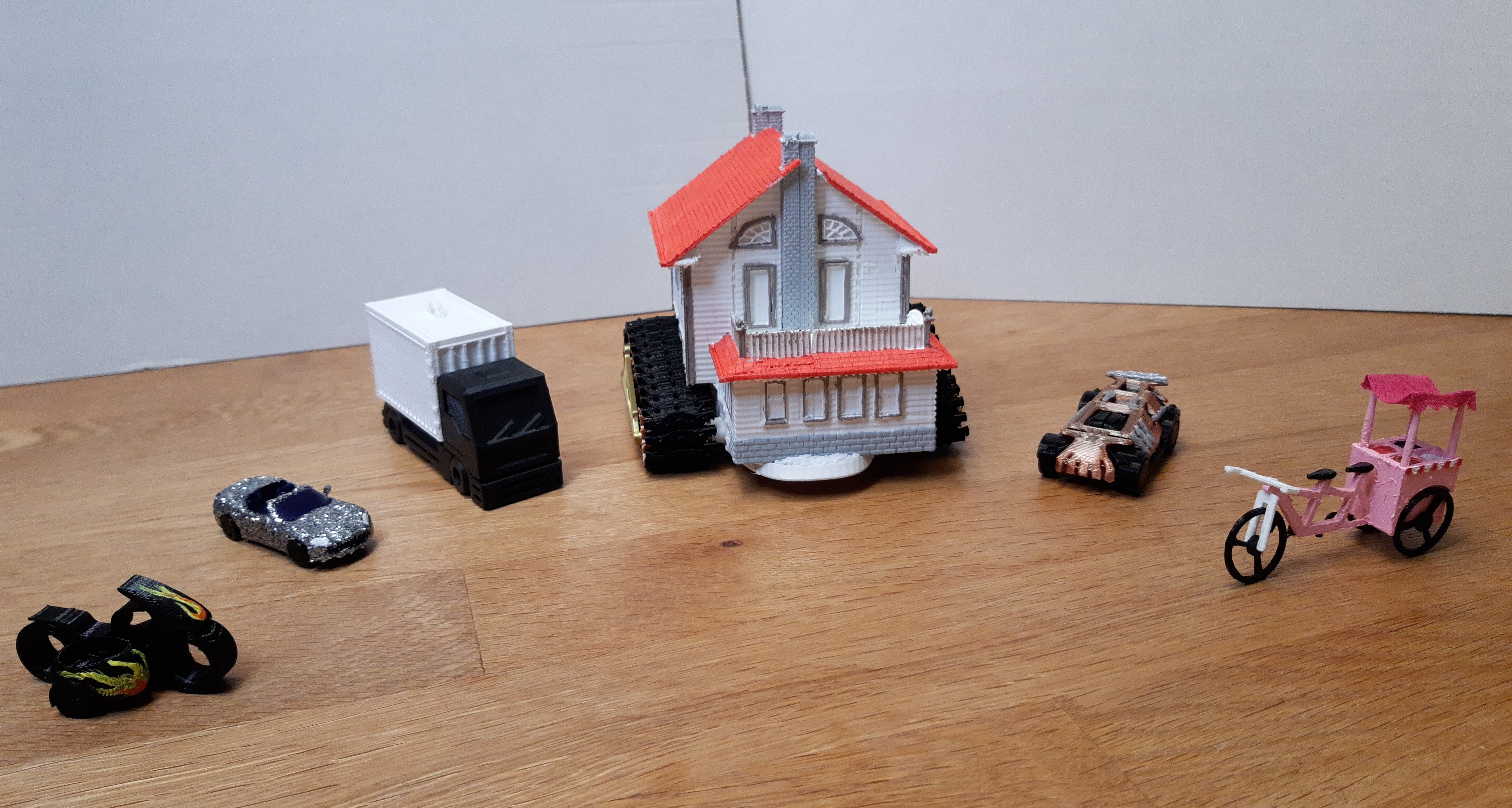
Hello! It's been a hot second since I posted. My group just concluded our first adventure in the Disparateum!
This was originally meant to be a one-shot, but we wound up needing four sessions to tell our story. We have zero regrets, this was an absolute blast!
I have so much I want to share here, so buckle up, this is gonna be a rather long comment ;)
Now, our Knight is a private detective who's trying to figure out who murdered his brother seven years ago. This kind of precluded that our overall story would revolve around solving this murder mystery. But all across our first session, the players had engaged a lot more with the Thief and Seer's traits - we learned about a street race (tying into the Thief's "Reckless Driving" trait) and we got into a duel (with the Seer's "Expert Duelist" trait). We also had a lot of fun coming up with new NPCs together, and giving them all sorts of connections to both the PCs and to other NPCs. Love triangles, mafia connections, rivalries, we had it all. And while this was all great fun, as a GM I struggled to somehow tie this in to the original murder mystery.
At least, during Session 1, we found out about the murder weapon. So at the start of Session 2, the players had a lead to follow. It wasn't a very clear lead, though, and we kept right on in our disparate way of coming up with characters, giving them interesting connections to other characters, and overall hinting at a large underlying mystery that we never quite defined (and that felt like it was defying any attempt at definition, at this point).
It was at this point, mid-session, where I had the idea of pausing the narrative, asking the players to put down their roles for a moment, and think off-screen together. We set the narrative aside and went to the meta-level. Instead of talking about what our PCs do next and what happens to them, we started discussing the narrative as a whole: Where is the murder weapon now? What was the motive for that murder anyway? Where do we want this story to go?
This was before Act 2 released. Much later, when I first read Act 2, I was very excited to read about the Surreal and the Rite of Way - it feels very much like the piece that we needed in our Session 2, and that I then kind of made up on the spot! Honestly, I felt pretty good about that - it gave me confirmation that I did something right in our Session 2. Even if we didn't have a layer to go to, we performed our Rite of Way anyways. And it worked like a charm.
Together, we'd determined a number of things. We found out that the Knight's brother was never the murderer's intended victim - that was actually a different NPC we'd met. We found out where the murder weapon ended up. We drew a whole sticky-notes-and-red-string conspiracy board to figure out which NPCs are connected to which events and how.
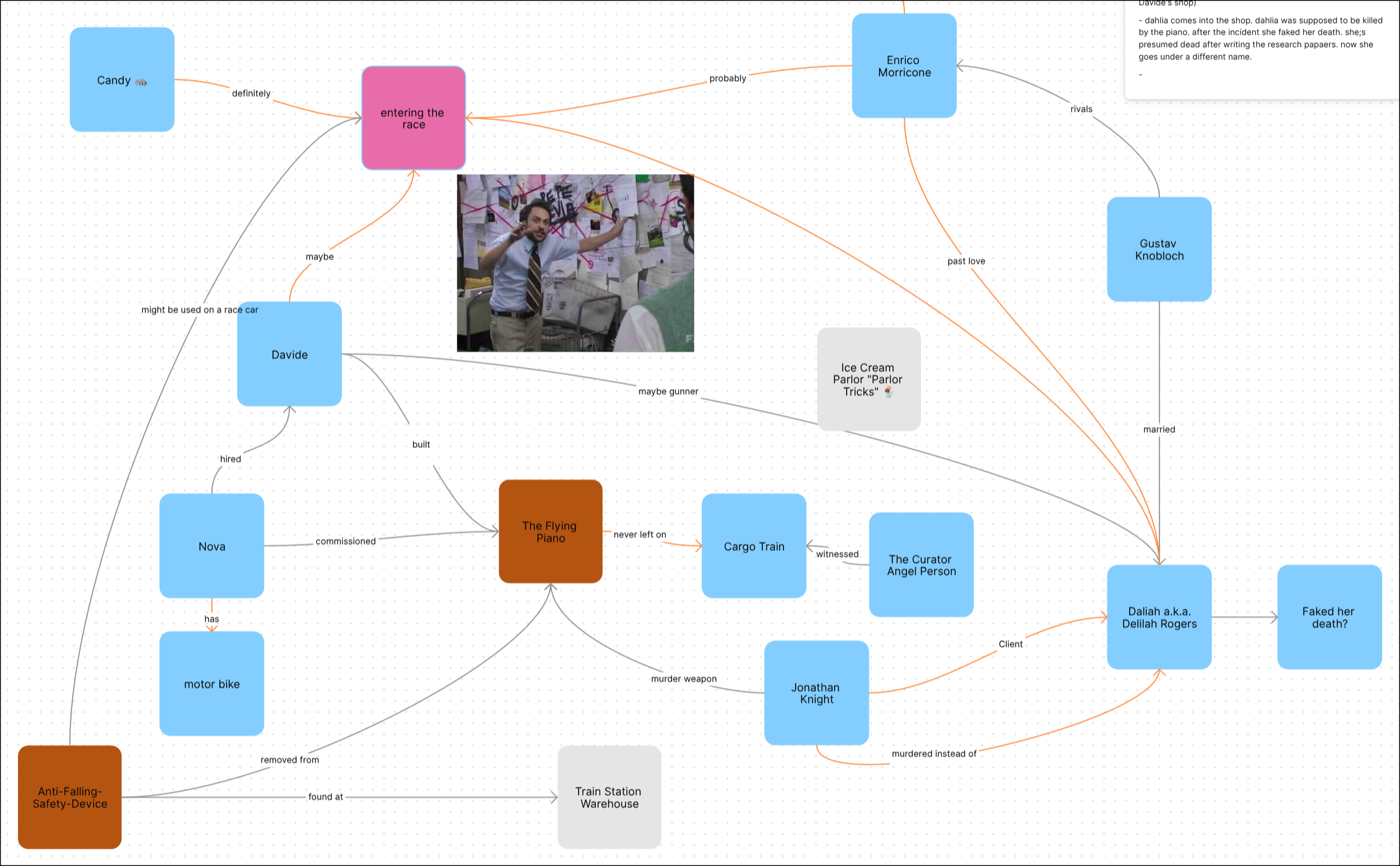
And, most importantly, we determined this: We all wanted the finale of our story be about the PCs participating in the Undercity Street Race. I'd invented that race as part of an NPC's traits, specifically to mesh with our thief's "Reckless Driving", and the players all immediately locked on to this idea and kept bringing it up. By this point, we already had three NPCs who were intent on participating in this race, and naturally our thief was also very keen on it. We decided that this race shall be the finale, and somehow, we will solve the murder mystery during the race.
We concluded our Session 2 pretty shortly after this (and after a short sequence of visiting the MoAM, and learning more about an NPC's true identity by stumbling upon their portrait in the Gallery). We were feeling really good about our narrative, but I as the GM was left with a somewhat difficult task: How exactly does this street race tie into the murder mystery? Why would the knight need to participate there in order to solve the case? Would the murderer be there? Why?
I agonized over this for several weeks in between our sessions 2 and 3. The answer came to me in a flash, mere hours before session 3 was gonna start (I must've had some of that "Profound Epiphany" flavored ice cream from Parlor Tricks): The prize for the winner of the race would be the murder weapon! (Which is a flying piano, if you recall). This solved all my problems: The Knight would now need to win this race, since the murder weapon is bound to be a crucial clue. And at the same time, the murderer would want to win as well: to get their hands on the murder weapon and destroy this piece of evidence!
With that decided, I opened Session 3 by narrating the "prize reveal" ceremony of this street race. The players immediately recognized the flying piano for what it was and decided to participate in the race. And from that point on, the plot was really starting to move forward. The first half of the session was spent obtaining a vehicle. Since our thief had set a personal goal of driving the most ludicrously large vehicle they can get their kleptomaniac hands on, I had at some point invented a house on tank tracks - Mortal Engines style - that was parked somewhere in the Named City. This, naturally, was the vehicles my players wanted for the race. We had a fun old time first locating the vehicle in the City, and then convincing its inhabitants (two elderly ladies) to let us borrow it for a moment. ("We're just here to fix the central heating, nothing to worry about!").
That done, we went to the start of the race. At some point, we'd decided together that it'd be really funny if every single NPC we'd met would show up here, and therefore I had a lot of fun coming up with the racing teams and their vehicles. (This race was supposed to be for teams of 2 - one driver, one gunner. Obviously.)
Therefore, the racing contestants were:
- the raccoon mechanic and the mafia assassin, in the mechanic's own self-made car
- the femme fatale and her sidekick, on a motorcycle which the PCs had given her in a previous session (in trade for information about the murder weapon)
- the "Actually Intended Murder Victim" and her rich mafioso husband, in a ludicrously expensive rhinestone-bedecked sports car
- the two random guards of a warehouse where we at some point looked for clues about the murder weapon - in a truck that very obviously belongs to the warehousing company
- Maggie Morthendain and the Curator, on a pink ice cream vending tandem tricycle
- and of course our PCs, riding their borrowed house on tank treads.
I came up with a little bit more structured rules for the race itself - (and I mean a little bit. It still wasn't very structured - it was largely inspired by gshowitt's Crash Pandas but without dice.) I also wrote a new layer, mostly to give the players more relevant ways to spend their tokens to influence the race.
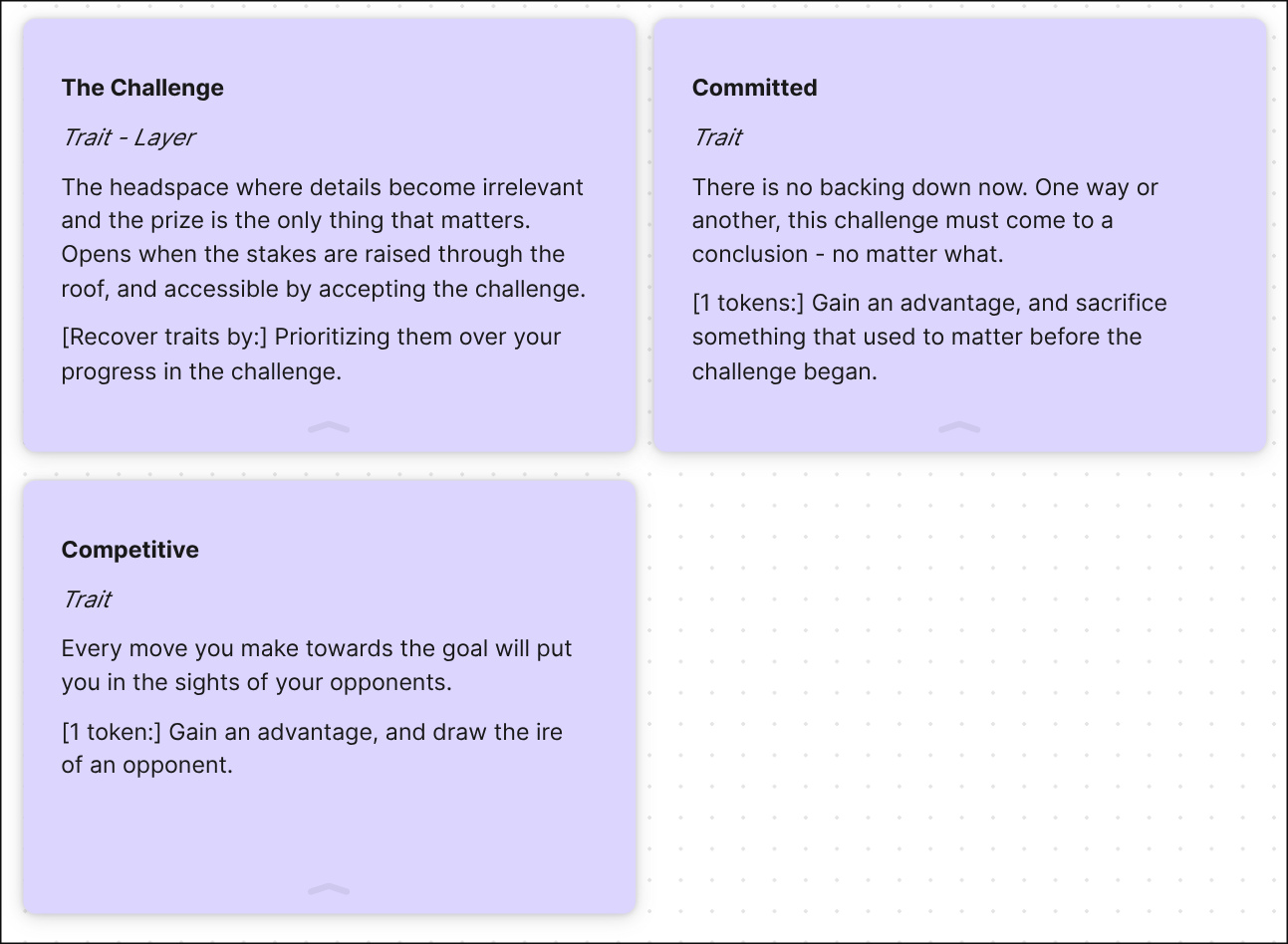
I think the layer worked well. Though, it left the City's "Sprawling" trait exposed, and that ended up being the most-used layer trait for the players to influence the race. ("I spend a token to find something new around the corner ... there's a construction site, and a cement mixer is parked diagonally across the road, blocking the path!") - I think this is a feature, not a bug ^^
The original intention had been to conclude our story in Session 3, but we didn't quite manage. We ran out of time, and ended on a cliffhanger at the point where the Knight figured out who the murderer was. (In a proper sherlock-holmes-style deduction where you figure out everything that happened through a super contrived chain of reasoning based on a collection of random facts. This happened right after the Knight got a scoopful of "Profound Epiphany" ice cream slapped right in their face by Maggie, who was of course the ice-cream-slinging gunner of her team.)
So, I once again had time to prepare, and Session 4 would be the real finale. By this time, Act 2 had released, and the things I found in there gave me the perfect idea for how to wrap this up.
We could've just finished the race and then used the prize - the flying piano, the murder weapon - to figure out what Really Happened when the Knight's brother died. But to me that didn't feel satisfying. So instead I decided that we'd figure that out first, and then finish the race. And we'd do that by going into an extended flashback scene, courtesy of the Memory layer!
The idea was that as the Knight is having this ice-cream-induced deductive epiphany, we the Players would play out an extended flashback so that we can figure out what Really Happened. And Act 2 gave me the perfect tool for this: Masks.
I wrote three masks; one labeled The Victim, one was The Target, and one was The Culprit. Of course, the players at this point knew who each of these were: the Victim was the Knight's brother. The Target was that one NPC we'd decided together was the intended murder victim. And the Culprit was the murderer, whose identity we'd revealed at the very end of Session 3. (It was the Femme Fatale, of course.)
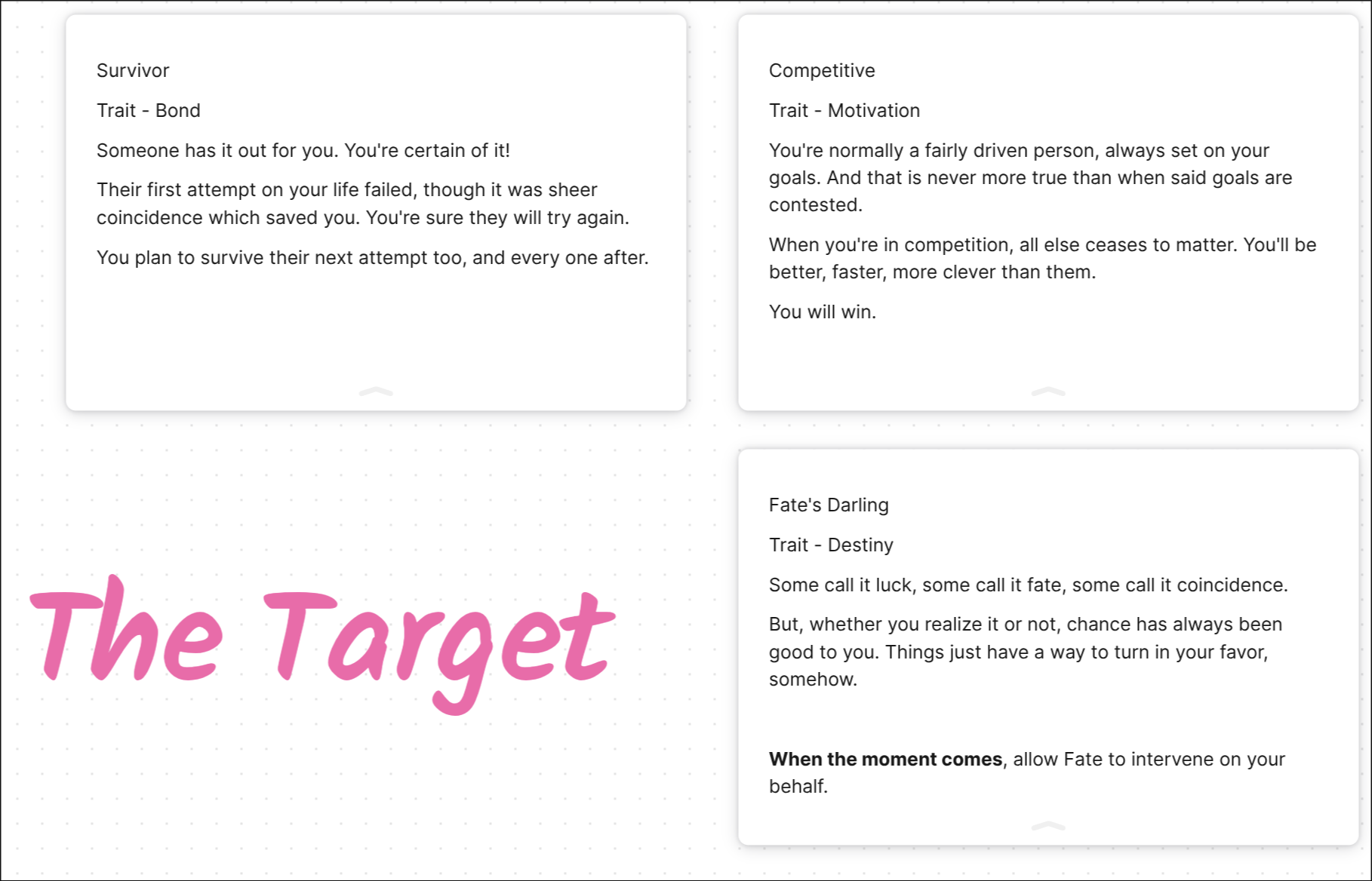
I wanted for us to learn during the flashback what really happened, why the Knight's brother died instead of the murderer's actual target, and what exactly the murderer's motive was. Instead of relying completely on improv here, I came up with these answers ahead of time, and wrote pieces of the answers into the three masks. My intention was that all the information would be there, but no single player would have all of it, and they'd have to play out the scene - with the masks as guidance - to find out the truth.
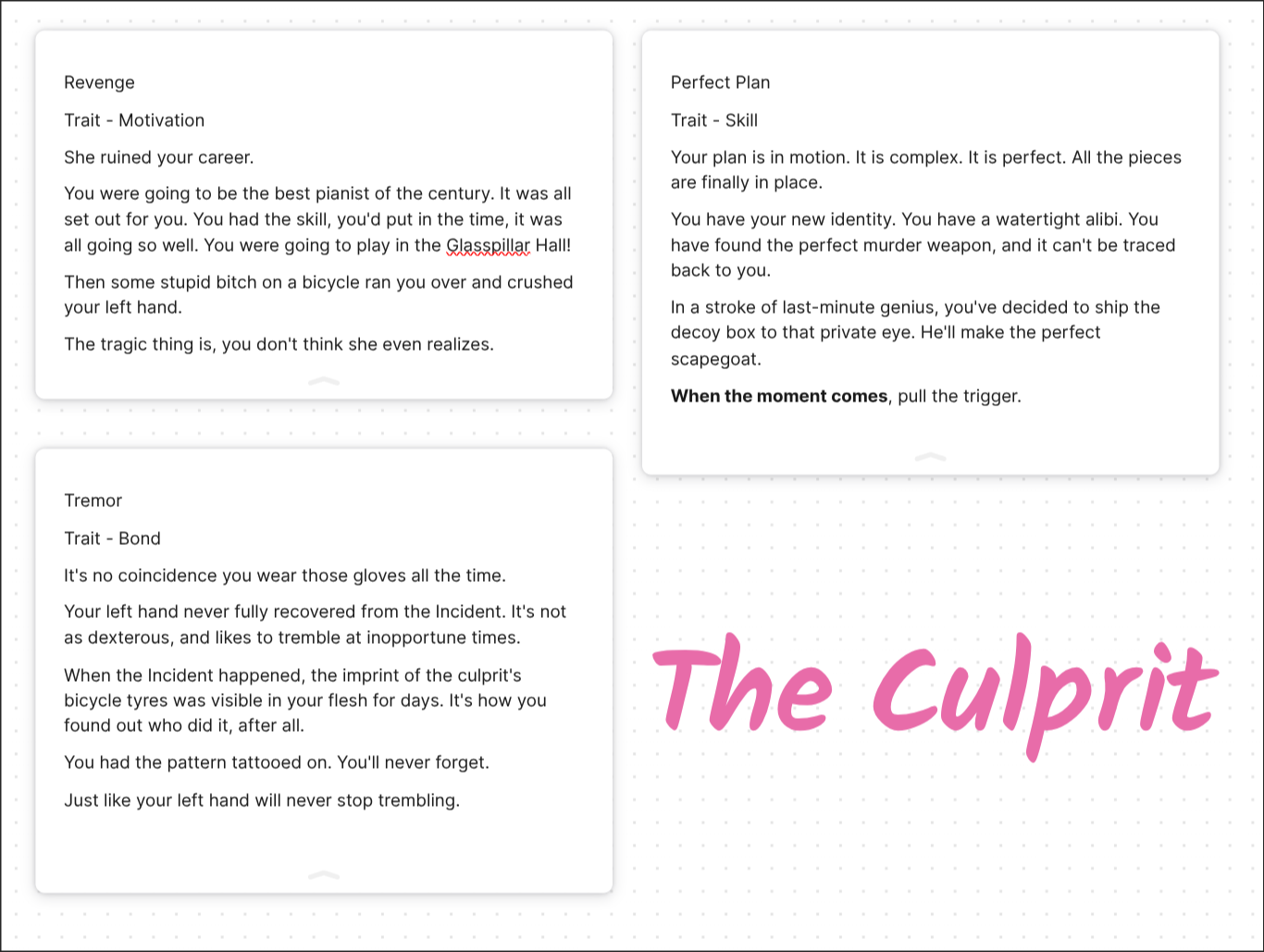
Each mask had three traits. The Culprit's traits explained the murderer's motive, explaining how the Target had wronged them in the past. The Target's traits explained what brought them to seek the help of a private investigator (that would be the Knight's brother, who was a private detective just like the Knight - we'd established that the Target was the Victim's client at the time of the murder). And the Victim's traits contained the clue for why the Victim died in the Target's place.
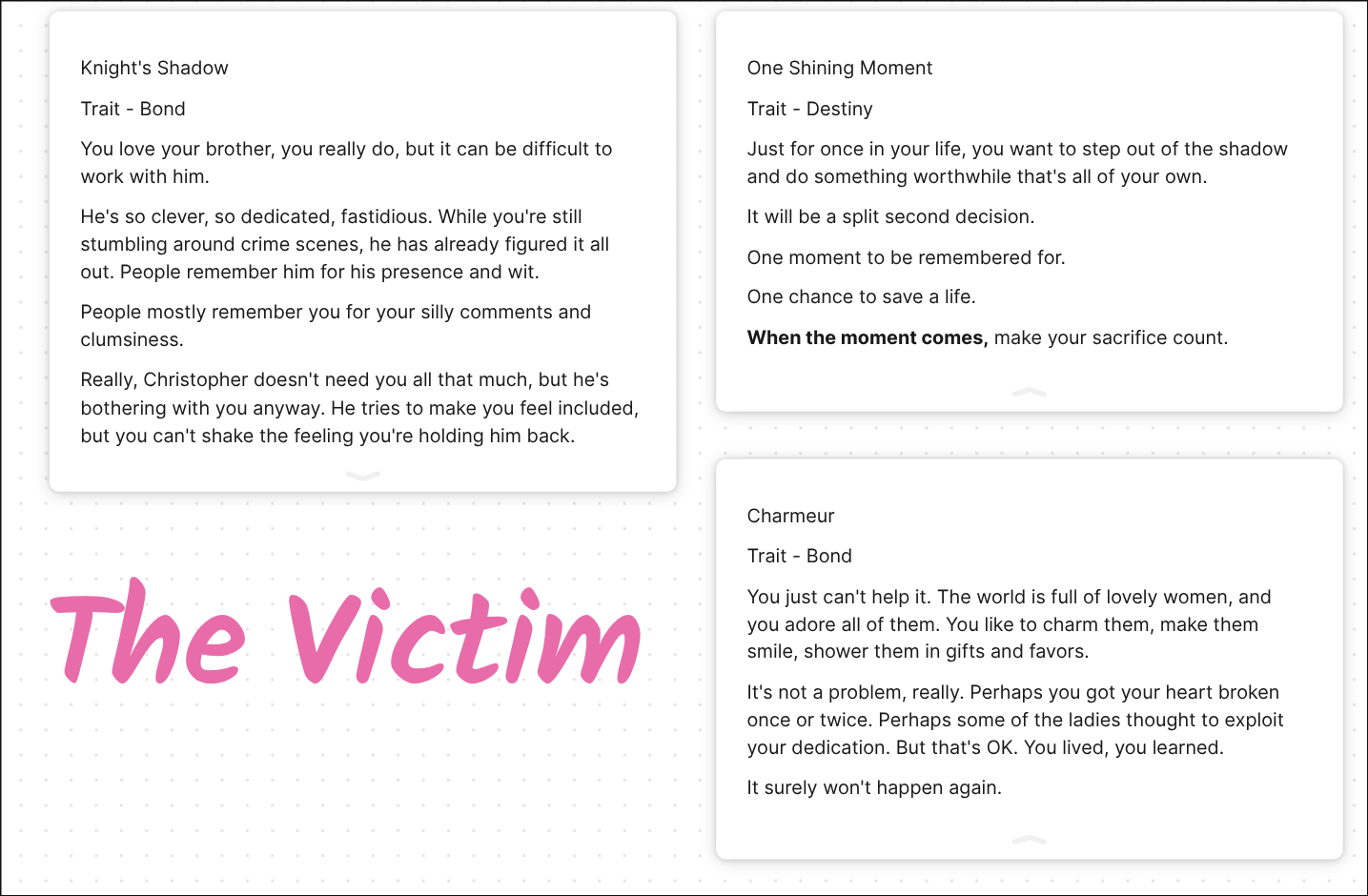
Most crucially, each mask contained a trait with the phrase "When the moment comes ...". This was a direct instruction for what they would do at the moment of the murder, and if they all follow this instruction, then the whole "why did the Victim die instead of the Target" mystery would reveal itself.
I let the players freely choose which mask they wanted. The Thief wound up playing the Culprit, the Seer was the Target, and the Knight played the Victim. This scene played out wonderfully, I was really happy with how that went! In the beginning, I had to curb the player's enthusiasm a little - both the Target and the Culprit at some point tried to bend the narrative in some contrived way to solve the "why did the Victim die instead of the Target" mystery. I told them to not worry about it and trust the process - the Victim had the most relevant instructions there, but the other two players did not know this.
In the end, I think we managed to pull off a scene that was improvised but still captured this feeling you get on the final pages of a murder mystery novel, when the culprit is about to be found out and the mystery is about to unravel - for each player, there was something surprising in this scene. It was just something different for everyone, because I gave them all only part of the information. I'm honestly super proud of this scene, and I felt like a genius mastermind while planning and executing it. And despite all the planning, there was still a lot of room for the players to improv - they came up with the setting and the surrounding events. The Culprit was largely left to their own devices in describing their murder masterplan. The only "scripted" bit was the very moment when the piano fell, and it didn't feel super scripted because none of the players had the full script. (Or at least, I think that's how it felt. You'd have to ask my players ;) )
We took a break after the flashback, and then went right back into our race - this whole scene happened in a split second of epiphany, after all. The PCs didn't end up winning the race. They came in second after the raccoon mechanic (whose life dream it'd been to win this thing), and the players then asked nicely whether they could perhaps borrow the prize for a bit to use it as evidence to convict a murderer. The mechanic was happy to help them.
What an adventure. I'm fully blown away by this framework - it provided a depth that I honestly didn't expect, and I feel that over these 4 sessions it has taught me a lot about GMing in general. 10/10, I would definitely play again!
It was also really cool to observe how the players, over time, got more and more comfortable with the framework. In the beginning, it was "can I do this?", "What can I do?", "Is this against the rules?" - but with every session, together, we learned something more. In Session 1 we got to grips with spending tokens to impact the narrative (and not just our character's actions), and using the narrative as a way to resolve conflict. ("What is the most interesting outcome?") - In Session 2, we started using our traits a lot more, and accepted that it's also OK and totally fun to discuss the narrative from an outside perspective. In Session 3, we were really grooving with how things work, and I'd often hear the players suggest narrative twists with "Wait, wouldn't it be interesting if ...?". And finally in Session 4, we tried Masks, and it was really fun to see the established PCs blend together with the roles they were playing in the flashbacks. And also in this session, we finally started using Layer traits a lot more, which we'd neglected a bit previously.
I think we would still have more to learn - I feel that we under-utilized our NPC's traits, for instance, even when we had a lot of fun coming up with them together. But for now, our journey through the Disparateum has concluded. We'll surely come back one day.
Thanks, once again, for providing this absolute gem of a game!
(You have my permission to share this post on social media if you want :) )
Bonus content: For the most part, we played online, but our final session was in person. To celebrate the occasion, I made props for the fun vehicles of all the racing participants. I think Maggie and the Curator's ice cream trike is my favourite :D