On Sale: GamesAssetsToolsTabletopComics
Indie game storeFree gamesFun gamesHorror games
Game developmentAssetsComics
SalesBundles
Jobs
TagsGame Engines

Emberfall - A Bard's Tale-like retro Dungeon Crawler

A topic by Dungeon Crawl Software created 15 days ago Views: 99 Replies: 2
Viewing posts 1 to 3
(1 edit) (+1)

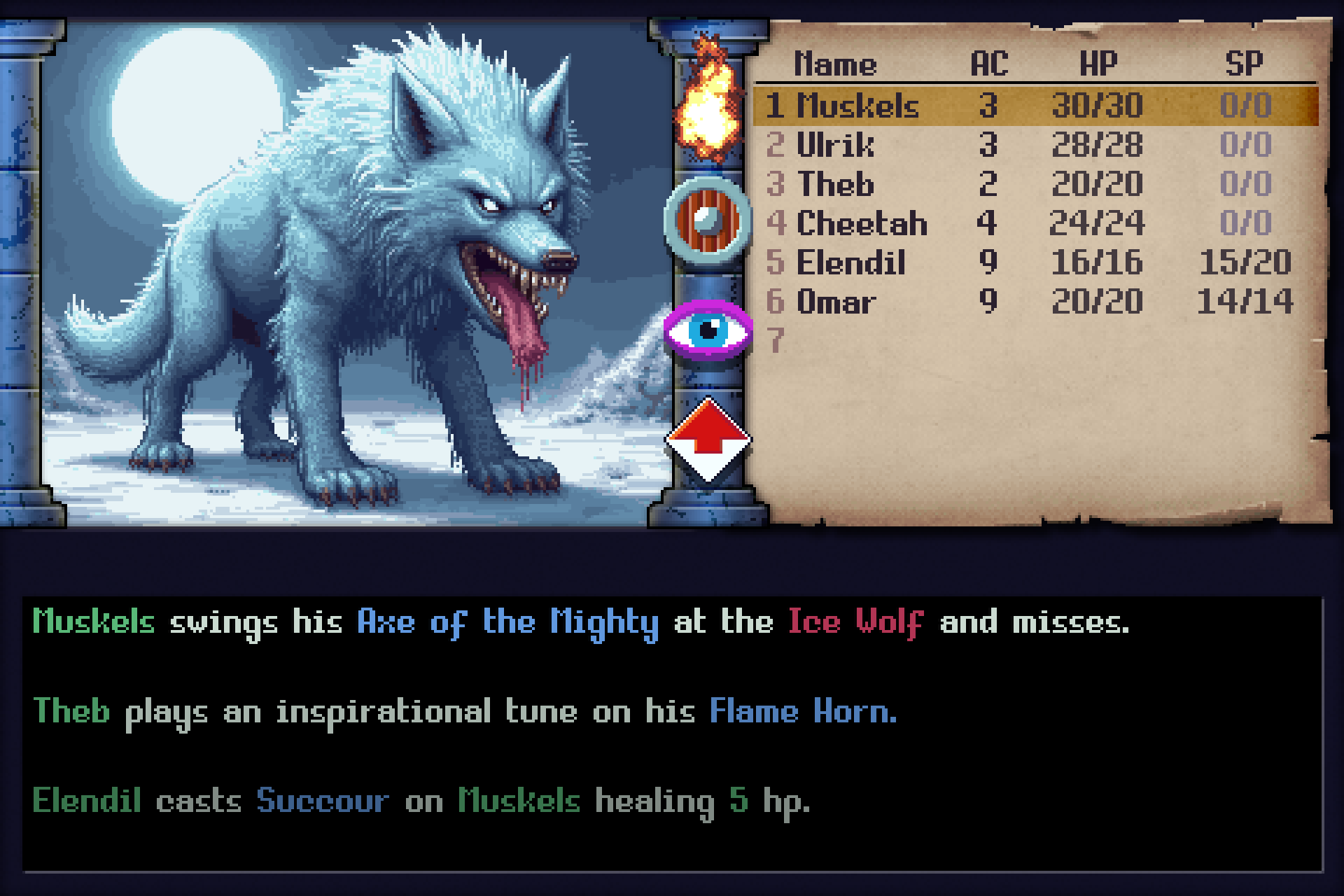
I started working on Emberfall about a month ago.  I have wanted to create a retro dungeon crawler for a while.  My first PC game was Bard's Tale and it was freaking amazing at the time!  Love every second of it.  We knew exactly sequence to teleport to land on the reoccurring groups of 99 Berserkers and WAST them to pieces so that our party could grind out the levels.  Then came Dragon Wars, Dungeon Master, Lands of Lore, the Eye of the Beholder series and many others.  So I wanted to pay homage to that era of my life.

Artwork

So, let's start with the elephant in the room.  I use RetroDiffusion AI for pieces that I can't do myself.  I find it a useful tool but not a replacement for a real artist.  I have to heavily edit much of what the AI produces but, not being an artist myself, some of it is beyond my skills to fix.  Some of the smaller pieces and the UI were drawn by me either completely or by altering resources from real artists.  I try to use artists' work when I can but for now my finances dictate what I can afford and what I can't.

Current Progress (Dec 5, 2025)

This is the coldest day of 2025 so far for me here in eastern Canada.  It's currently -12 C with a feels-like temperature of -23 C (about -9F).  It will definitely get colder but I thought it was pretty apt that I start my first Dev Log for Emberfall today.  Emberfall is built on a 2D engine called Mini Micro.  So far, I have created a framework to aid in:

  • Signal Bus communication to decouple the framework areas
  • Scenes, Scene States and Scene Management
  • Input handling through defining Actions, Groups and Contexts
  • Audio System that supports music in two parts (intro and a loop) as well as sound FX on separate channels
  • Resource loading
  • Bitmap font support using the BM Font tool

From the framework, I've been able to create

  • A resource loading scene with a progress bar 
  • A Main Menu with a simple snowing particle system
  • A freezing Scene transition effect
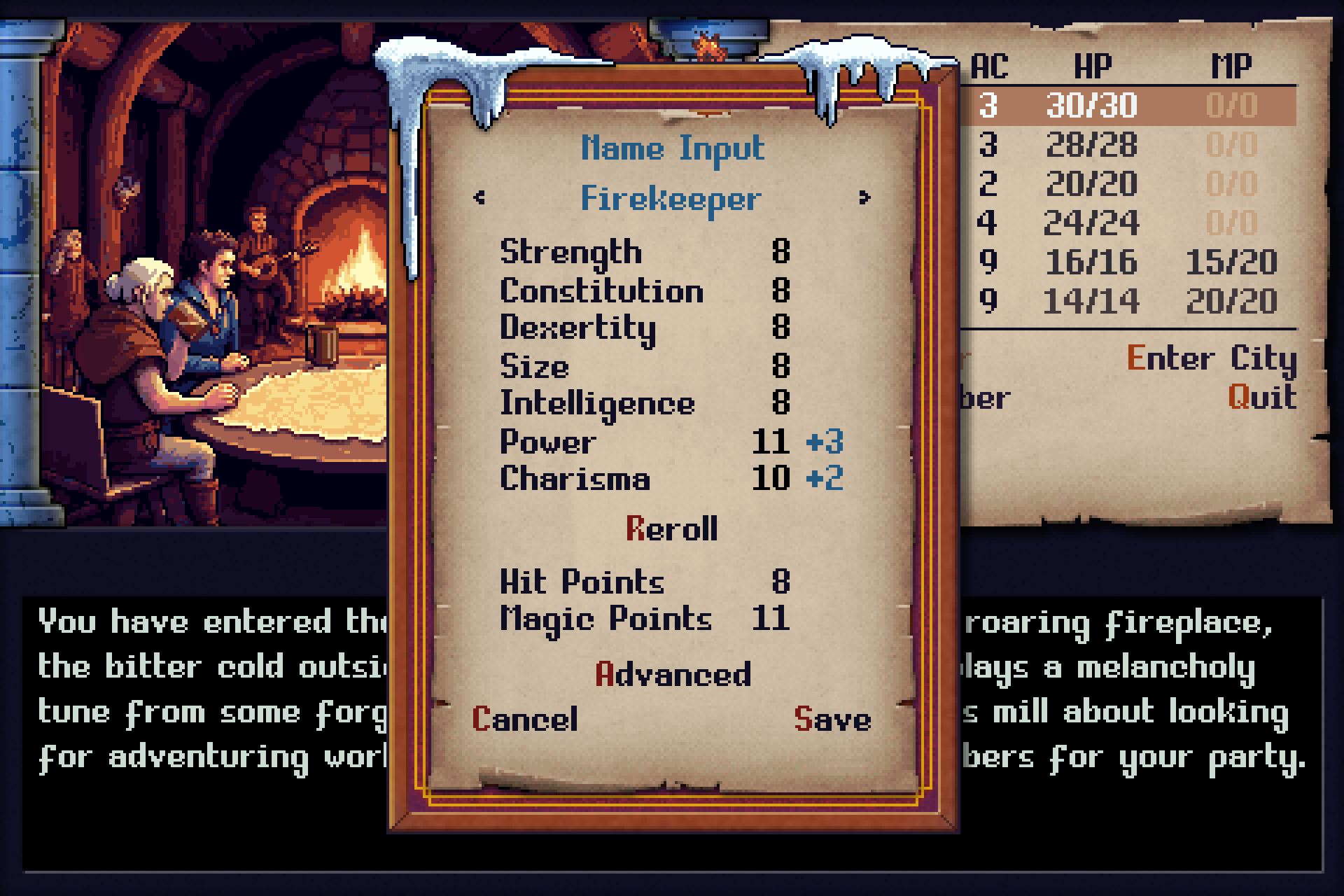
  • An animated Adventurer's Guild where the player will be able to manage their party, save/load and enter the city.

I'm working hard to get a demo ready but it is still early days.  Currently, I'm still working on the party management in the Guild interface to create, add and remove characters.  If there is anything from the above feature list that you would like me to specifically talk about or if you have questions about the game itself, let me know.  I'd be happy to share.

If this project seems like something you would be interested in playing, please follow my Itch account.  Thanks.


Hey there, love the vibe and outlook of your game, would love to discuss more about it, can you send me a message on Discord at _chrisshadow

Learn the rules like a pro...

For an RPG, the game mechanics are probably one of the most important aspects of the game design.  Originally, I wanted to make my own rule system but then I changed my mind because 

  • An existing system would already be play tested and stable
  • Depending on the license, I could reuse the text, from the rule book, in game
  • And I had enough on my plate just building the game itself

And since there are some very good rule sets already released that have commercial use licenses, why reinvent the wheel?  I decided to spend a few days scouring RPG forums and stores for potential rule systems.  I was looking for a classless, skill-based system because I wanted to something similar to Dragon Wars.  That's when I stumbled across OpenQuest SRD which is published under the Creative Commons license.  It's a great fit.

So you can break them like an artist

Except for the fact that some of the rules in OpenQuest are designed to have a human Game Master.  This makes it impossible to implement those rules if they are subjective such as how well the player role-played a situation.  So I modified the following rules:

Fortune Points

Characters in OpenQuest have a pool of points that they can use to re-roll failed skill checks and to avoid death.  The character will be granted a certain amount when the character is created and, depending on how the player performed during a game session, might gain more.  This was the first rule that I had to replace in OpenQuest because it would be difficult to implement the spending of these points without interrupting gameplay frequently and impossible to define the quality of the player's roleplaying during a session the way a human GM would.

I introduced a new hidden stat called Luck.  Each time a character levels up, their Luck is restored to 100%.  If they fail or fumble a resistance roll, their Luck is automatically checked as if it were a skill.  If the Luck test is successful, their resistance failure is turned into a success and their Luck drops by 10%.  Should the character take a hit that would ordinarily kill them and their Luck test succeeds, then their Luck is dropped by 50% , if they have 50 or more points still left, and their HP is reduced to 1 but they are still alive.

Luck is restored to 50% when sleeping at an Inn and can be restored through certain powerful spells.  Otherwise, the character's Luck remains low until they level up again.

Growth Points

In OpenQuest, a character improves themselves through Growth Points.  These are earned through three means:

  • Completing Quests
  • Completing and Engaging in Motives of the Character
  • Through Skill Use

It wouldn't be difficult to tell when a quest was completed or when a skill test would reward a growth point.  But it would be impossible to tell what the motive of a character was without some input from the player that just seems awkward.  And to force the player to define the motives for 6 characters like that would slow the already lengthy character creation process.  So I decided to just reward slightly more points for completing quests to compensate.

Personal, Sorcery and Divine Magic

OpenQuest has three different forms of Magic: Personal, Sorcery and Divine.  There are different but slightly overlapping rules for each.  For Emberfall, I felt this was too complicated.  So I trimmed out Sorcery and Divine.  Everything is run by the Personal Magic rules and are just renamed to Elemental Magic.  Emberfall has five different schools of magic:  Fire, Wind, Earth, Ice and Shadow.

Archetypes

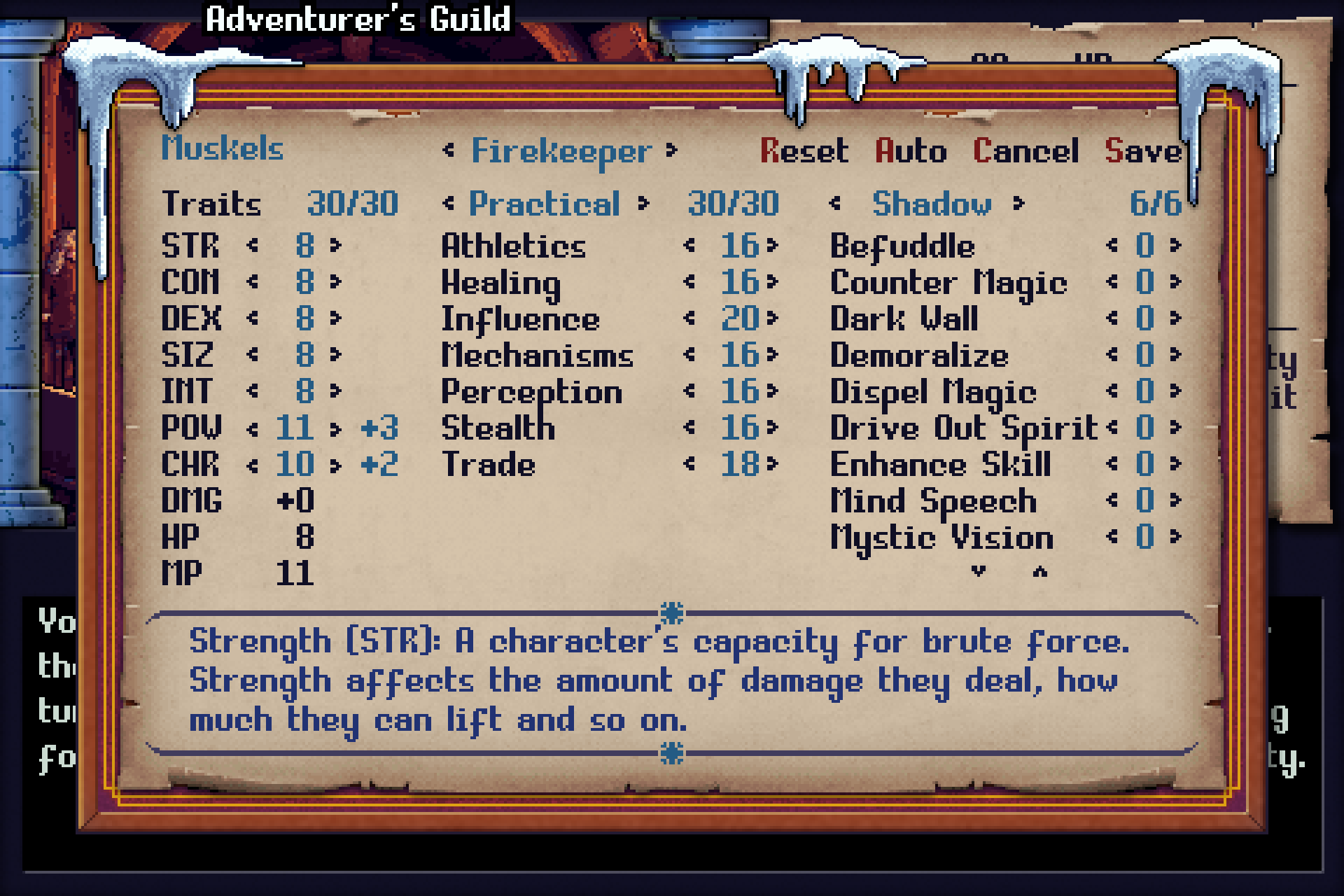
Something I added to give the game more flavour and starting character a little extra bonus, are Archetypes.  There are 10 Archetypes:

  • Blacksmith - A master of metalworking and forge craft.  
  • Firekeeper - A sacred guardian of flame and warmth.
  • Furrier - A trapper and skinner who knows the wilderness.
  • Healer - A compassionate practitioner of healing arts.
  • Hunter - A skilled tracker and survivalist trained in the wilderness.
  • Laborer - A builder and craftsperson skilled in construction.
  • Merchant - A trader skilled in commerce and negotiation.
  • Miner - A hardy worker who knows the depths of the earth.
  • Sage - A scholar and keeper of ancient knowledge.
  • Warden - A guardian trained to protect and patrol.

Each Archetype has their own attribute and skill bonuses.  Most have modest starting equipment and some even have known spells.

Character Generation

The OpenQuest SRD describes two ways to create a character:  Points and Random.  I'm still working on it but the plan is to have both systems supported.  When creating a character the game starts with the simple approach of random rolling of the character.  If the player clicks the "Advanced" button, it will allow them to build their character using the Point system which gives them a greater control over their build.

Of course, if the player just wants to get out immediately into the world, they can just load the pre-generated party that comes with the game and just go.

So far, OpenQuest seems like a really good fit for Emberfall.  Its Creative Commons license allows its SRD to be used in a commercial project like Emberfall as long as I include the appropriate attribution which will be found in the Credits of the game.