

I reviewed itch's terms of service very carefully before deciding on itch.io for my games because violating a terms of service would make me personally feel horrible. I found that the content I make is not in violation so I proceeded.
Since the bans I rereviewed to see if there were any changes to the terms of service and still I am found that I am not in violation.
My two games are yandere/horror games however many other yandere games were not banned so maybe it was a mistake, however it happened during the NSFW sweep.
One of my games was published in 2022. So it was not found to be in "violation" for 3 years before that sweep. As were some other examples I will post below:
Another example:
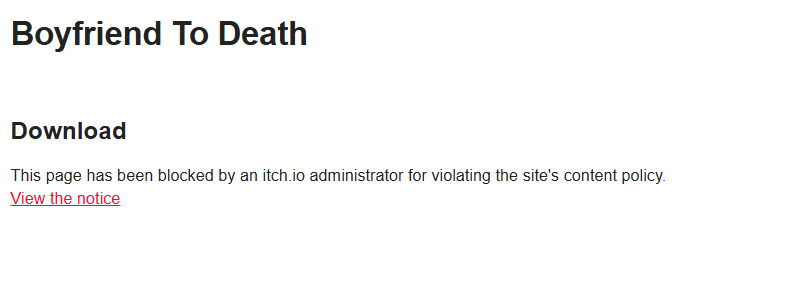
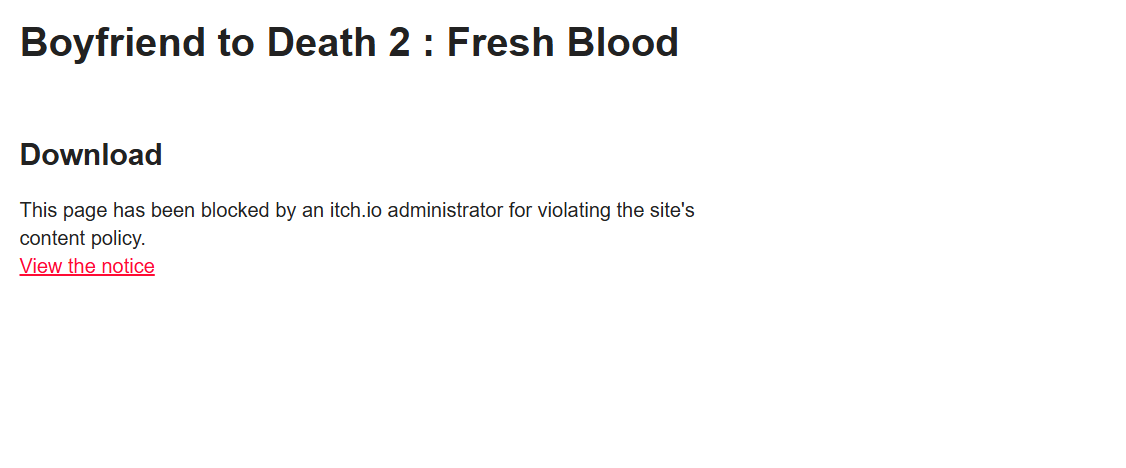
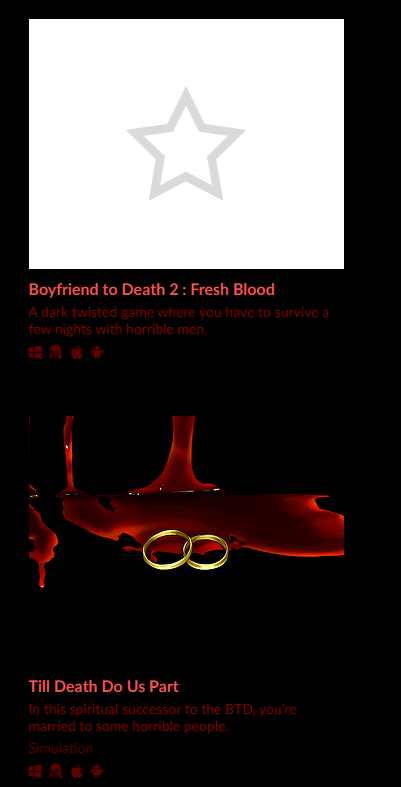
This content creator was hit with it as well. Till Death do us part is of the same content of her Boyfriend to death series but it cherry picked which ones it banned instead of banning all it's content.
Neither of these titles nor mine are glorifying violence nor have real life depictions of people which is what's stated in the terms of service.
They feature trying to escape a serial killer/yandere but in no way frame the "bad guy or his/her actions" as justifiable or desirable.
Glorification of violence is the act of portraying violent acts in a way that presents them as admirable, justified, or desirable, often by highlighting their heroic, exciting, or aesthetic aspects while downplaying their negative consequencesThis can be seen in media like movies, video games, and video games, where violence is often framed as a heroic or necessary solution to conflict.
All of these games are dark psychological horror game presented entirely from a first-person perspective, where the player experiences the story as the victim rather than the aggressor. Their framing centers around empathy and immersion in the protagonist’s trauma and survival, rather than glorifying or endorsing harmful actions.
The games all explore themes of trauma, control, and survival through a horror lens. While they all contain dark and mature content—including fictional non-consensual scenarios—they ultimately are BDSM role-play fantasy that stresses the importance of consent in real-life contexts. Before the narrative begins in each and every single one of these banned games, the players explicitly have to consent to the scenarios and are clearly informed about the content they’ll engage with.
My games specifically always presents these themes as horrifying and critiques the mindset behind them. My intention is to create a safe, fictional outlet for exploring complex kinks or fantasies in a controlled environment —one that may help players avoid riskier or more dangerous real-world alternatives. It also offers players a way to confront difficult emotions and desires through fiction, rather than through real-life risk. Which is the heart of its purpose: to provide a creative, controlled, and safe emotional outlet. It also delivers the kind of intense, cathartic thrill that draws people to horror films—pushing boundaries within a space where no one is truly harmed.